
Disrupting the Healthcare System
This morning I attended a conference titled “Disruption and Innovation in Healthcare 2.0“ at Washington University in St. Louis. I was humbled at how well informed and nuanced the speakers were. They included Alex Gorsky (CEO of Johnson and Johnson), I certainly learned a lot. My main concern is that the ability to understand the complexity of the health care system is well beyond the ability of most people. The simplistic positions of our politicians are a great disservice to our country. For example, it is absolutely clear that our health care system is NOT a functional market, meaning that the Ayn Rand/Free-Market conservatives are deceiving us when they claim that all we need to do is “get government off our backs” to fix healthcare. I admire that progressive politicians are calling for universal access (something that almost all developed countries have, but not the U.S.). That said, how do we square that universal access with the need to incentivize future innovations, in addition to ongoing care? Any big changes to the current system could have disasterous ramifications.
The stakes could not be higher. To the extent we are tempted to implement broad new changes, we need to keep in mind (as one of today’s speakers said), “This is not a dress rehearsal. It’s the real deal.”

[On the right] Johnson and Johnson CEO, Alex Gorsky
The speakers somberly delivered the following shocking information: There is currently no payment model for many current (and anticipated) extremely expensive curative therapies. Thus, people who can be CURED of horrific diseases will languish under the status quo because we can’t figure out how to give them more than palliative treatment, even when palliative treatment is sometimes more expensive in the long run. I dare you to read previous sentence a few times and then shrug and try to convince yourself that we, as a country cannot do better.
Here’s another fact was mentioned several times today: 75% of our health care budget is the result of bad choices made in early life by individual Americans. Preaching at people to get their act together shouldn’t offend reasonable people. For instance, urging that children should eat healthier food should be applauded, even though some conservatives ridicule Michelle Obama’s urgings in that direction. But what about more? To what extent should we, must we, put some skin in the game for people who are actively self-destructing their bodies? I think we need to seriously look at some low-hanging fruit and make some people uncomfortable for their own well being and for the greater good of the United States. The overall health of the United States is most definitely a public good. The ill-health of any of us affects all of us.
These issues are ultra-complex, highly nuanced, in addition to being critical important. Anyone pretending otherwise should be promptly yanked off the political stage.
Here’s more information about this event. It was being video-recorded and hope that it will be made available to anyone interested in these issues. “2nd Annual Olin Business School Healthcare Symposium: 'Disruption and Innovation in Healthcare 2.0'
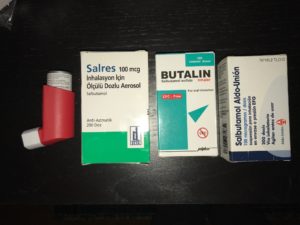 I am now in Madrid. Yesterday, I visited a pharmacy here, no prescription, and they sold me the "equivalent," the inhaler on the right. Price was 2.5 Euros (about $2.85). I spoke with the pharmacist in Spanish. I told her that in the United States, my inhaler costs about $80 with the insurance rate, $300 without. Her immediate reaction was shock at the price. The she became angry, and asked "What do children do when their families cannot afford the medicine?" I told her that I don't know, and that it is a terrible situation and that there is no excuse for it.