
The growing global warming gap . . . psychoanalyzed
MSNBC offers the following on the global warming gap, based on a recent Gallop poll:
On the question of whether they believed the effects of global warming were already happening, the percentage of self-identified Republicans or conservatives answering "yes" plummeted from almost 50 percent in 2007-2008 to 30 percent or less in 2010, while liberals and Democrats remained at 70 percent or more, according to the study in this spring's Sociological Quarterly.Notice that the question wasn't about causation. It did not ask the cause of the warming (human caused versus natural fluctuation), but merely whether the Earth was warming. Perhaps Gallop should have coupled its question with these just to get at the root of this insanity (and see here): A) Do you trust thermometers? B) When your mother used a thermometer, did you trust her? and C) When scientists announce the following data, are these highly credentialed professionals actually acting as conniving scam artists who are out to try to somehow make a bunch of money?
 Caveat: I know that I've betrayed my beliefs that the earth is, indeed warming. This is not to suggest that I ever advocated any sort of cap and trade approach to the problem, which I consider to be a fraud in general and riddled with corruption wherever it has been allegedly implemented (based, for example, on this Harper's Magazine article titled "Conning the Climate," (October 2007).
Rather, I believe that we need to have the intelligence and courage to directly regulate our production of CO2. I'm not confident that we'll be able to do that. Why? Because America has an extremely long track record of failing to do what intelligence and self-restraint would require. We are a nation steeped in ignorance, as demonstrated by the large numbers of people who refused to believe basic thermometer data.
Caveat: I know that I've betrayed my beliefs that the earth is, indeed warming. This is not to suggest that I ever advocated any sort of cap and trade approach to the problem, which I consider to be a fraud in general and riddled with corruption wherever it has been allegedly implemented (based, for example, on this Harper's Magazine article titled "Conning the Climate," (October 2007).
Rather, I believe that we need to have the intelligence and courage to directly regulate our production of CO2. I'm not confident that we'll be able to do that. Why? Because America has an extremely long track record of failing to do what intelligence and self-restraint would require. We are a nation steeped in ignorance, as demonstrated by the large numbers of people who refused to believe basic thermometer data.
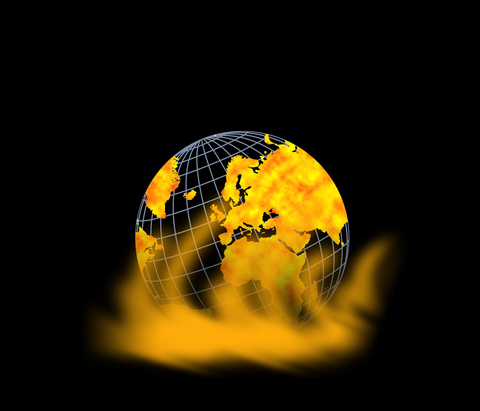 People don't engage in climate denialism because they are "stupid." Most evidence deniers are quite capable of considering evidence and making rational decisions, but there is a lot more going on in humans than rational thought. There is also our emotional/social side. To describe human animals, psychologist Jonathan Haidt uses the metaphor of a lawyer riding an elephant. Public assertions that contradict clear evidence are public displays of group loyalty, and sometimes people are more compelled to display loyalty than to crunch data to a logical conclusion that conflicts with tenets embraced by the group. For the most part, this decision to choose loyalty over evidence is not a fully conscious one, but it can often result in a compelling display of loyalty to the extent that it is an expensive display. Amotz Zahavi has written extensively on this topic of expensive and therefore reliable displays. I discuss this urge to display as a badge of group belonging in my five-part series called "Mending Fences." See also, this post on the work of Richard Sosis.
I would describe the process like this: It's as though the felt compulsion to show loyalty to the ingroup erects an electrified fence in the mind of the group member protecting the group's creed of beliefs from serious critical inquiry. If humans were really heating up the planet, it could call for humans (to the extent that they acted as good-hearted moral beings) to make dramatic coordinated changes in the way we run our society. But if this could be done at all, it could only be done by government fiat. But modern conservatives hold it as a religious belief that government is feckless and wasteful. Although it seems pointedly absurd for those of us who trust the readings of thermometers, it is much easier to deny rising temperatures than to admit this evidence but then explain why one is not doing anything meaningful about the problem. Especially given the fact that conservatives tend to live inland (coastal areas tend to have more liberal inhabitants--Jonathan Haidt explains this geographical dispersion).
People don't engage in climate denialism because they are "stupid." Most evidence deniers are quite capable of considering evidence and making rational decisions, but there is a lot more going on in humans than rational thought. There is also our emotional/social side. To describe human animals, psychologist Jonathan Haidt uses the metaphor of a lawyer riding an elephant. Public assertions that contradict clear evidence are public displays of group loyalty, and sometimes people are more compelled to display loyalty than to crunch data to a logical conclusion that conflicts with tenets embraced by the group. For the most part, this decision to choose loyalty over evidence is not a fully conscious one, but it can often result in a compelling display of loyalty to the extent that it is an expensive display. Amotz Zahavi has written extensively on this topic of expensive and therefore reliable displays. I discuss this urge to display as a badge of group belonging in my five-part series called "Mending Fences." See also, this post on the work of Richard Sosis.
I would describe the process like this: It's as though the felt compulsion to show loyalty to the ingroup erects an electrified fence in the mind of the group member protecting the group's creed of beliefs from serious critical inquiry. If humans were really heating up the planet, it could call for humans (to the extent that they acted as good-hearted moral beings) to make dramatic coordinated changes in the way we run our society. But if this could be done at all, it could only be done by government fiat. But modern conservatives hold it as a religious belief that government is feckless and wasteful. Although it seems pointedly absurd for those of us who trust the readings of thermometers, it is much easier to deny rising temperatures than to admit this evidence but then explain why one is not doing anything meaningful about the problem. Especially given the fact that conservatives tend to live inland (coastal areas tend to have more liberal inhabitants--Jonathan Haidt explains this geographical dispersion).