
A Question for Those Who Claim that America’s Schools are Properly Teaching Students About Racism

We're repeatedly hearing that Critical Race Theory (or whatever you want to call this, which is being taught in all these places) merely means teaching America's racial history in classrooms (as though this sad and deplorable American history is not being taught in most schools).  Here is a summary of what is happening:

Increasingly, American institutions — colleges and universities, businesses, government, the media and even our children’s schools — are enforcing a cynical and intolerant orthodoxy. This orthodoxy requires us to identify ourselves and each other based on immutable characteristics like skin color, gender and sexual orientation. It pits us against one another, and diminishes what it means to be human.

I would ask a question to those who advocate for CRT: Do you agree with the following basic principles that have been articulated by Foundation Against Racism and Intolerance (FAIR):

What We Stand For

We defend civil liberties and rights guaranteed to each individual, including freedom of speech and expression, equal protection under the law, and the right to personal privacy.

We advocate for individuals who are threatened or persecuted for speech, or who are held to a different set of rules for language or conduct based on their skin color, ancestry, or other immutable characteristics.

We support respectful disagreement. We believe bad ideas are best confronted with good ideas – and never with dehumanization, deplatforming or blacklisting.

We believe that objective truth exists, that it is discoverable, and that scientific research must be untainted by any political agenda.

We are pro-human, and promote compassionate anti-racism rooted in dignity and our common humanity.

The FAIR Pledge

Fairness. “I seek to treat everyone equally without regard to skin color or other immutable characteristics. I believe in applying the same rules to everyone, and reject disparagement of individuals based on the circumstances of their birth.”

Understanding. “I am open-minded. I seek to understand opinions or behavior that I do not necessarily agree with. I am tolerant and consider points of view that are in conflict with my prior convictions.”

Humanity. “I recognize that every person has a unique identity, that our shared humanity is precious, and that it is up to all of us to defend and protect the civic culture that unites us.”

FAIR Principles of Peaceful Change, Based on Dr. Martin Luther King Jr.'s Principles of Nonviolence

Exercise Moral Courage. Telling the truth is a way of life for courageous people. Peaceful change cannot happen without a commitment to the truth.

Build Bridges. We seek to win friendship and gain understanding. The result of our movement is redemption and reconciliation.

Defeat Injustice, Not People. We recognize that those who are intolerant and seek to oppress others are also human, and are not evil people. We seek to defeat evil, not people.

Don’t Take the Bait. Suffering can educate and transform. We will not retaliate when attacked, physically or otherwise. We will meet hate and anger with compassion and kindness.

Choose Love, Not Hate. We seek to resist violence of the spirit as well as the body. We believe in the power of love.

Trust in Justice. We trust that the universe is on the side of justice. The nonviolent resister has deep faith that justice will eventually win.

It is my strong suspicion that tens of thousands of teachers in thousands of school districts no longer agree with the above principles.  I am seeing increasing amounts of evidence for this every day.

I proudly stand behind the above principles set forth by FAIR. I am honored to stand for the above principles along with FAIR's Distinguished Board of Advisors.
Continue ReadingA Question for Those Who Claim that America’s Schools are Properly Teaching Students About Racism

“But Where is Critical Race Theory Actually Being Taught?”

When I deny that the current versions of CRT are related to the Civil Rights Movement, I assert this because:

A) CRT and antiracism are obsessed with dividing people into "colors" and treating them differently on the basis of "color."

B) The Platform of CRT and antiracism have no meaningful mechanism for improving the lives of the poor minority populations they pretend to serve.

C) CRT and antiracism excel at denying data relating to their mission (including police statistics and economic facts, such as the fact that 60% of Americans who identify as "black" are middle class or above).

D) CRT and antiracism advocates do not extol the teachings of Martin Luther King.  In fact, King's teachings are barely mentioned in training materials.

There are other difference too, but this is a sampling based upon some of the articles I've written recently.

Increasing numbers of people are starting to understand that CRT and "antiracism" have no meaning connection to do with the traditional Civil Rights Movement, but now they are increasingly denying that CRT and "antiracism" are being taught in schools. I see this as motivated reasoning based on the fact that most of these people (the ones I know) are only exposed to left-leaning legacy media. These people admit of only a few outliers and deny that CRT or antiracism is a significant problem in the U.S. I disagree, based on these resources:

The recent case of Dana stangel-Plowe, former teacher at a school in Englewood.

The recent case of Paul Rossi.

The observations of Andrew Gutmann, a former parent at Brearly School.

Christopher Rufo's reports based upon leaked training materials at numerous schools.

Chloe Valdary teaches a good-hearted program to diminish bigotry she compares to the CRT programs of which she is knowledgable.

Numerous reports by Parents Defending Education.

Numerous reports of attempted cancellation based on CRT here.

Reports at businesses by Counterweight.

Many more reports here, by Princetonians for Free Speech.

I have also been personally contacted by approximately a dozen people who work in academia who are afraid to speech honestly on issues because CRT permeates the campus

More reports here (Stanford) and here (Rutgers).

John McWhorter's receipt of numerous complaints (see the comments) here.

Another recent resource is Christopher Rufo's "Critical Race Theory Briefing Book." 

There are numerous other reports, more of them surfacing every week. I will try to update this list periodically.

Continue Reading“But Where is Critical Race Theory Actually Being Taught?”

What Should be Done about the Way Many Schools are Preaching Critical Race Theory to their Students?

Bari Weiss has written a column that includes a comprehensive discussion with Christopher Rufo and attorney/writer David French. It is a highly civil and insightful discussion. She begins her column with this:

If you are reading this, I suspect you are disturbed by an ideology that segregates people by race; that insists on a racial hierarchy in which entire racial groups are monolithically good or bad; that does away with race-blind tests in the name of progress; and that insists that any inequality of outcome is evidence of systemic discrimination.

Those are bad ideas at odds with our most foundational American values. On Friday, Andrew Sullivan published an essay arguing that CRT removes the “bedrock of liberalism.” I agree.

The question is: What should be done about it? . . . The idea of banning ideas should make any American shudder.

In my discussion below, everything I write is a paraphrase other than the bits of text that are in quote marks.

At min 35 in the discussion French asserts that the many new statutes banning there teaching of critical race theory "flat out violate the constitution." I agree with Weiss and French. There is a big difference between teaching about a subject and preaching that subject in a way that makes students feel that they are compelled to agree. French disputes that the CRT movement has deep radical control over America's institutions, even though it is influential. He believes that we have the means, including our legal system, of addressing this ideology. He worries that overblowing the force of CRT is mustering a anti-First Amendment pushback on the political right (e.g., regulating big tech and anti-CRT legislation).

Rufo "strongly disagrees, urging that CRT is overwhelming American institutions from coast to coast, and that these are extraordinary and dangerous times. He argues that the State does not have free speech rights. They, through public schools, have a state run monopoly and a captive audience (that consists of children, even young children) upon which they are forcing compelled speech that takes the form of "racial poison." Children should not be compelled to express belief in racial essentialism, racial discrimination, the need for collective guilt or the need to acknowledge that one is responsible for the crimes of one's ancestors. He argues that the State, though Departments of Education, already have the power (and obligation) to implement the school curricula.

French responds (at min 45) that much of the proposed legislation is not necessary in that there are already robust Constitutional protections against compelled speech. Further, many of the bills are not limited to K-12 education. Unconstitutional grant-making is already illegal by the theory of "unconstitutional conditions." We need to take these bills "bill by bill." There might need to be a lot of litigation about this, in that many of these bills are wildly vague. French completely agrees that compelled CRT speech is improper (with or without the new bills). Some of these bills improperly take aim at some of the foundational principles of traditional liberalism.

Rufo argues that these new ("race neutral") laws are necessary to protects one's right to conscience. He argues that communities ought to be able to enforce their own values in their own institutions, which they fund. He argues that many of the laws allow the teaching of CRT as a theory, in a contextual way, but you can't force your students to believe them. You cannot teach CRT as a dogma. He argues that the State has much more "shaping power" in K-12, grades that students are required to attend. He argues that the public should also do whatever it can to shape the values instilled by public colleges, including criteria for grant-making, which many of these new laws seek to protect.

French compares to teaching religion. The Constitution allows teaching about Christianity, but not teaching it "as truth."

Weiss asks French what he would suggest to combat CRT if these new state laws are unconstitutional. He suggested local courageous control of schools. Get involved in your child's school. Many non-elite public schools are not steeped in CRT. There are many opportunities to speak up. In K-12, the state is already given lots of leeway to determine curriculum. Laws affecting that cannot be unconstitutionally vague.

French: The question is not whether these ideas are good. The question is what are the limits of constitutional protection? Many of these bills attack compelled speech, but the First Amendment already protects students from compelled speech. Right now, no school has the right to force a student to wrote a letter of apology to students for one's "white privilege."

Rufo urges that these bills are necessary because students are being forced to do such things. Rufo states that he has a database of more than 1,000 institutions where students are currently being forced to engage in such behavior.

French responds: "Then file a lawsuit." He admits that only the Idaho statute comes close to being constitutional. The other statutes ban the expression of particular viewpoints. (Min 1:02:00). This is lawful only in narrow circumstances (re state employees). The universities do not have First Amendment rights, but the professors do, and based on French's experience as an attorney, most of these new laws will be struck down as speech codes, if challenged in court.

French "wants to hear" from those who promote CRT. He disagrees with many of these ideas, but he wants to hear them, understand them and, I many cases, reject them. But he does not want to ban these ideas from the marketplace of ideas.

Weiss to French: Aren't the CRT promoters trying to erase the ability of people like French to reject CRT?

French: There is no doubt that many of these people want to shut him up. There are speech codes and they generally fail in the courts. Foundation for Individual Rights in Education (FIRE) indicates that at one time 80% of colleges had speech codes.  As a result of litigation, only about 25% of them currently have speech codes.

At min 111, both French and Rufo, who have Multi-racial families, describe how they talk with their own children about their "identities and about what it means to be American." It was a heartfelt ending to a vigorous and engaging conversation.

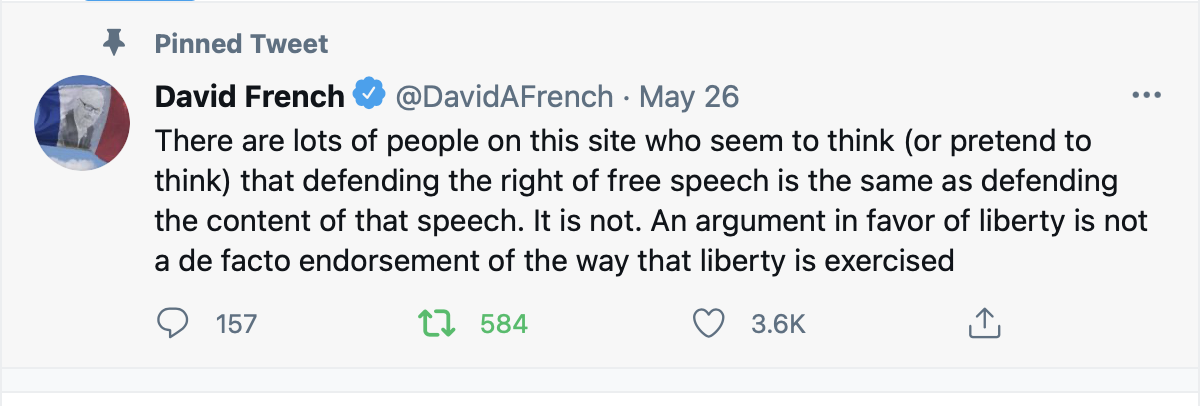
Follow up Tweet by David French:

Continue ReadingWhat Should be Done about the Way Many Schools are Preaching Critical Race Theory to their Students?

About Lindsay Shepherd

Today I learned about the 2017 case of Lindsay Shepherd, a graduate student/teaching assistant at Wilfrid Laurier University (WLU) in Waterloo, Ontario. Her crime was to allow an even-handed classroom discussion about a Canadian law compelling the use of particular pronouns according to Jordan Peterson.

Her case also reminded me of the importance of (at least sometimes) secretly recording conversations.

Here is what happened, thanks to her foresight in recording a massively dysfunctional conversation Shepherd was forced to have with her supervisor, Nathan Rambukkana.

Shepherd is now an author. You can follow her at https://twitter.com/NewWorldHominin

Here is an excerpt from a review of Shepherd's new book, Diversity and Exclusion: Confronting the Campus Free Speech Crisis::

This continuing campaign against Shepherd based on a pursuit of ideological purity should be regarded as a dark stain on the entire academic community. Throughout the book it is clear that Shepherd’s love of teaching is what defines her commitment to “open inquiry and the pursuit of truth.” As such, that unnamed college missed an opportunity to hire a first-rate educator – not to mention a heck of a storyteller. Sadly, demonstrable ability and commitment are now less important on campus than political alignment. That said, given her obvious attributes of drive, character, intelligence and sense of opportunity, it seems highly unlikely we’ve seen or heard the last of Lindsay Shepherd. As her experiences at Laurier make plain, she has an awful lot to say. And she’s not afraid to say it.

Continue ReadingAbout Lindsay Shepherd

How Pervasive is the Teaching of Critical Race Theory?

Last month, Andrew Gutmann started speaking out against critical race theory, as it was being taught at his daughter's private expensive Manhattan school, Brearley School. In his letter to the Brearly community, he accused Brearly of teaching children illiberal and indoctrinating antiracism initiatives and divisive obsession with race. Gutmann has founded Speak Up For Education. .

Today, Gutmann authored an opinion piece at The Hill. Here is an excerpt:

There appears to be widespread belief that opposition to critical race theory is a view held solely by the political right. This perception is wrong. It is certainly true that the conservative media has almost exclusively embraced viewpoints unfavorable to critical race theory while the liberal-oriented media has been overwhelmingly approving. But our polarized media does not seem to accurately reflect the view of most Americans.

Since my letter became public, I have received several thousand supportive emails and messages from people across this country, including many from self-described Democrats and liberals. The tone of most of the messages sent to me is not at all political in nature; instead, the tenor is one of desperation and powerlessness.

I have received emails from parents expressing devastation that their kids, as young as five years old, are coming home from school after being taught to feel guilty solely because of the color of their skin. I have received messages from grandparents feeling hopeless that their grandchildren are being brainwashed and turned against their own families. And I have received notes from teachers brought to tears because they are being required, day after day, to teach fundamentally divisive, racist doctrines and being forced to demonize their own students.

Perhaps the most powerful – and most frightening – of the notes I have received are the several dozen from those who identify themselves as having immigrated to America from the former Soviet Union or from countries in formerly communist Eastern Europe. These emails are never political in nature and are nearly identical in message: These first-generation Americans all write that they have “seen this movie before.” They are familiar with the propaganda, the tactics of indoctrination and the pervasive fear of speaking up that plague today’s United States. Simply put, they cannot believe this is happening here.

Continue ReadingHow Pervasive is the Teaching of Critical Race Theory?