More Criticism of the Political “Left” and “Right” from Eric Weinstein

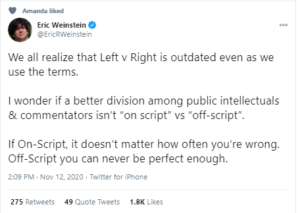
Eric Weinstein's apt Tweet:

Or, instead of off-script and on-script, should we refer to people as "Thinks for Themselves" and "Doesn't Think for Themselves"? Labels of Left/Right are (often intentionally) deceptive, obscuring massive internal dissent within the "two" tribes for purposes of feigning homogeneity. Tribes use these labels to fluff up their feathers to try to appear coherent, like politically powerful voting blocks.

The labels "Left" and "Right" look precise, but simplistically clean appearance of these labels disguises a lack of precision.  Primarily, these labels refer to heterogenous tribes that try to portray themselves as homogenous.  This is not merely academic. The use of the Left/Right labels (legitimized and amplified by lazy media and social media) is tearing our society apart.

Continue ReadingMore Criticism of the Political “Left” and “Right” from Eric Weinstein

Back to Separate But Equal, and Other Recent Manifestations of Woke Culture

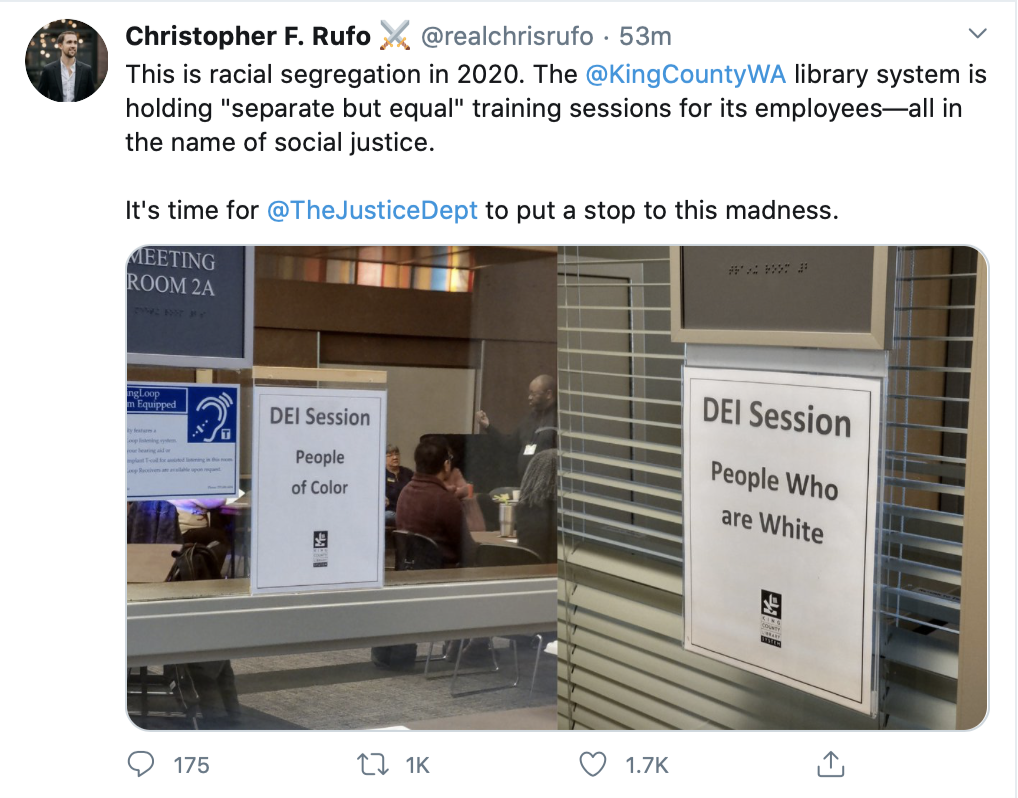
I hate to keep writing about Woke issues, but this ideology increasingly concerns me as the 2020 election approaches.  It is  an issue that mainstream Democrats ignore or downplay, yet the Republicans have recognized it for the cultural cancer that it is.  Woke ideology has successfully entrenched itself deeply into many of our meaning-making institutions and this has positioned it well to spread far, which is unfortunate. Here's a recent example:

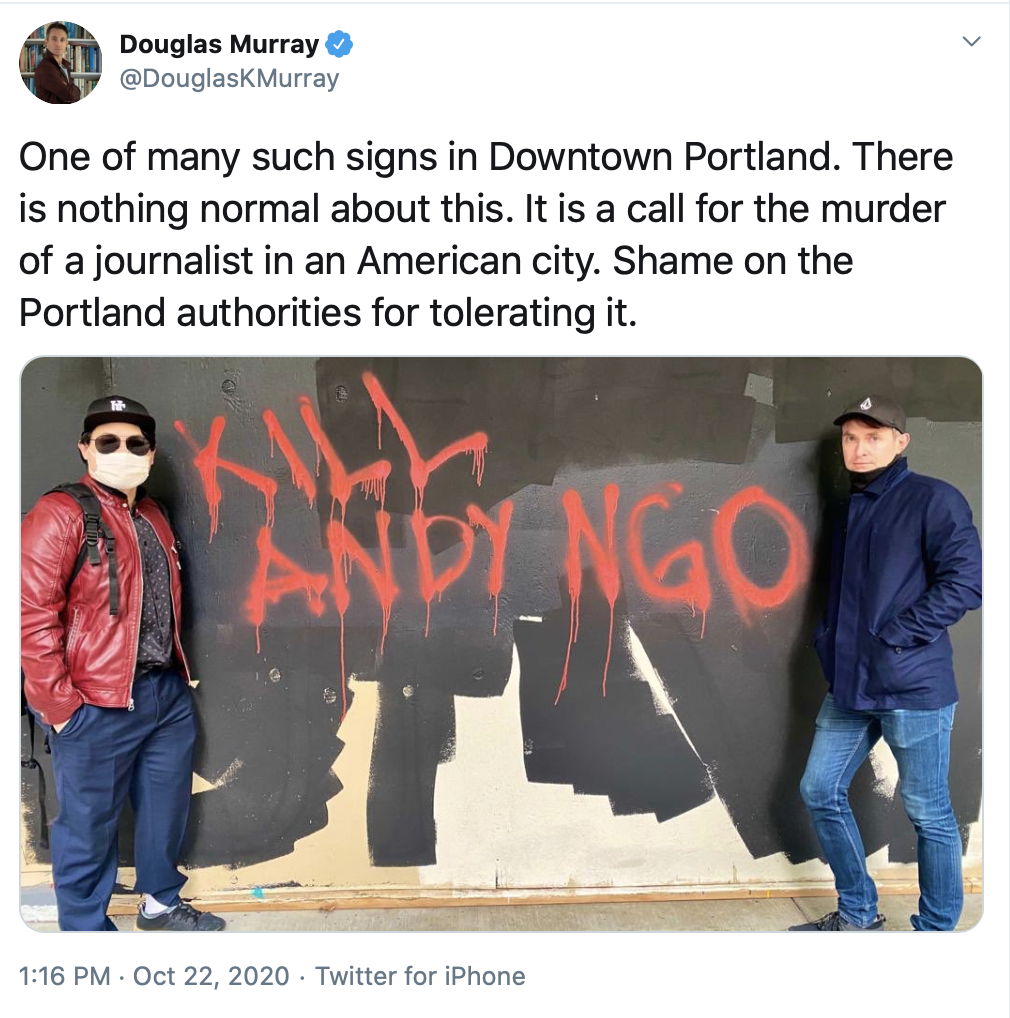
Making things worse, far too many Woke advocates are willing to tap into authoritarian tactics.

Andy Ngo's "crime" is that he is reporting on what he is seeing on the streets in Portland, including ongoing attempts to damage or destroy federal property.  The NYT thought this sort of thing was a worthy topic, even when it occurred in a much milder form, when right wing zealots merely occupied federal property for a month in 2016 (see here, for example), but "America's newspaper of record" has barely any interest in Portland or Seattle.  Because of this vacuum, these stories and concerns critical of Woke culture are being covered mostly by conservative media and without sufficient discussion or nuance. As I noted above, it is my concern that these issues are keeping the upcoming election close. This unwillingness by people on the political left to criticize "their own" is unfortunate.  Those relatively few socially brave traditional liberals who are willing to speak out, many of whom consider themselves well-entrenched on the political left, are often being accused of being conservatives/Republicans by others on the political left, merely because they are willing to speak out. This has left many traditional liberals (like me) feeling like we no longer have a political home.

One must usually seek out alternative news sources to find thoughtful discussion about the Woke movement. For those who are trying to get up to speed, consider visiting New Discourses (founded by James Lindsay) and Quillette.

Woke ideology is disproportionately affecting younger adults, people who are increasingly coming into positions of power.  This phenomenon was rather predictable based on The Coddling of the American Mind, by Greg Lukianoff and Jonathan Haidt. For another thoughtful discussion about the correlation of age and receptiveness to Woke ideology, see this Wiki letter exchange between Sarah Haider and Ayaan Hirsi Ali (the following excerpt was written by Sarah Haider):

Wokeism is, perhaps, an anti-ideology—a will to power that can be most concretely identified not by what it values or the future it envisions, but by what it seeks to destroy and the power it demands. This makes it especially disastrous. For, when an existing organizing structure is destroyed with no replacement, a more brutal force can exploit the resulting power vacuum. . . . Once liberal institutions have been delegitimized by the woke, what will replace them?

But while its philosophy is empty, the psychology of wokeism is deeply satisfying to our baser instincts. For the vicious, there is a thrill in playing the righteous inquisitor, in mobbing heretics and demanding deference—brutal tactics that keep the rest of us in line, lest we be targeted next. Meanwhile, the strict social hierarchies of the woke are reassuringly simple to navigate: one always knows one’s place.

By contrast, liberalism flies in the face of human nature. “I disapprove of what you say, but I will defend to the death your right to say it” is a phrase so often repeated that we have forgotten how deeply counterintuitive it is. We want to punch the Nazi (or gag him), not defend his right to march. Liberalism might ultimately be good, but it doesn’t feel good. And this is why it may find itself vulnerable to public abandonment, especially in times where it is most necessary. . . .

You rightly point out that liberalism has formidable champions in Sam Harris, Richard Dawkins, Christopher Hitchens and J. K. Rowling. Yet Hitchens is gone and all the others are over fifty. Likewise, this summer, when I co-signed an open letter in defense of free debate, I was disconcerted to see how few of the other signatories were even close to my age.

Bari Weiss recently noted that:

The civil war inside The New York Times between the (mostly young) wokes and the (mostly 40+) liberals is the same one raging inside other publications and companies across the country. The dynamic is always the same. The Old Guard lives by a set of principles we can broadly call civil libertarianism. They assumed they shared that worldview with the young people they hired who called themselves liberals and progressives. But it was an incorrect assumption.

This has been my experience too. Woke adherence can be predicted by generation - where true liberals exist, they exist primarily among the old guard. If the woke have won over the young, they have captured the future.

This ideology manifests in many other ways too.  For instance, insincere and dishonest debate about the unprecedented surge in (mostly) young girls who are being convinced that they were born in the wrong body, leading to permanent body-altering surgery, hormones and other treatments.  You won't find honest discussion about these issues in mainstream media--certainly not in the NYT. Instead of wide-open discussion based on a foundation of biology and medicine, you will only hear discussions where the "factual" foundation is ideology.  This is insane. There is a war going being waged to protect young girls (progress being made in Great Britain), yet many media outlets are afraid to cover the story. To learn young girls are being physically damaged by this ideology, you'll need to go to places like Joe Rogan's podcast. His recent episode featuring Abigail Shrier and her excellent book, Irreversible Damage: The Transgender Craze Seducing Our Daughters, resulted in an attempt by employees of Spotify to muzzle Rogan on this issue and other Woke issues. Refreshingly, Rogan counter-attacked by posting this video on Twitter, suggesting that he has carefully anchored his right to speak freely in his Spotify contract:

There are some bright spots--some well-placed people calling out Woke ideology for the illiberal, dysfunctional and mostly dishonest cult that it is. For instance, check out this recent discussion between Sam Harris and John McWhorter. That said, for each of these well-placed people willing to speak out, there are many other people who believe in a vigorous and open discussion, a willingness to consider dissenting speech and a dispassionate determination of the facts as the basis for conversation. Unfortunately, most of these people are lesser known than Joe Rogan (and J.K. Rowling) and more vulnerable to cancellation (see the comments here).

I could go on, but I won't do that here.  I'll try to move on to other topics for awhile . . .

Continue ReadingBack to Separate But Equal, and Other Recent Manifestations of Woke Culture

NYT Rethinks the Factual Basis 1619 Project

Bret Stephens has given the 1619 Project a much-needed sober factual analysis revealing that the Project is laced with ideology. To its credit, the NYT has printed Stephens' critique. Serious historians are thus getting a well-deserved moment in the sun. Here's an excerpt from Stephens' article:

An early sign that the project was in trouble came in an interview last November with James McPherson, the Pulitzer Prize-winning author of “Battle Cry of Freedom” and a past president of the American Historical Association. He was withering: “Almost from the outset,” McPherson told the World Socialist Web Site, “I was disturbed by what seemed like a very unbalanced, one-sided account, which lacked context and perspective.”

In particular, McPherson objected to Hannah-Jones’s suggestion that the struggle against slavery and racism and for civil rights and democracy was, if not exclusively then mostly, a Black one. As she wrote in her essay: “The truth is that as much democracy as this nation has today, it has been borne on the backs of Black resistance.”

McPherson demurs: “From the Quakers in the 18th century, on through the abolitionists in the antebellum, to the Radical Republicans in the Civil War and Reconstruction, to the N.A.A.C.P., which was an interracial organization founded in 1909, down through the civil rights movements of the 1950s and 1960s, there have been a lot of whites who have fought against slavery and racial discrimination, and against racism,” he said. “And that’s what’s missing from this perspective.”

In a lengthier dissection, published in January in The Atlantic, the Princeton historian Sean Wilentz accused Hannah-Jones of making arguments “built on partial truths and misstatements of the facts.” The goal of educating Americans on slavery and its consequences, he added, was so important that it “cannot be forwarded through falsehoods, distortions and significant omissions.”

Continue ReadingNYT Rethinks the Factual Basis 1619 Project

We Love it That Two (Count’em) Two Cartoon Dimensions Pretend to Describe Complex Political, Racial and Economic Systems

When you last purchased a car or a phone, it was probably an important purchase for you, so you considered many aspects of the product, including cost, function, aesthetics, performance and many other things. When we deal with complex things, we are rightfully motivated to carefully consider many such dimensions. Most of us dig deep into these many factors before making such purchases. The same thing occurs when considering a long-term romantic partner. Most of us will consider dozens of factors before settling into such a relationship. In fact, if we failed to do such a careful analysis, our friends and family would consider us to be reckless. Complex issues demand complex and nuanced analyses.

We don’t use this same degree of care when it comes to evaluating the types of politics. Instead, we jam all the possibilities onto a one-dimension line containing endpoints of “left” and “right.” We do this despite the fact that people are complex and they fall into many dimensions of political attitudes. If you were to gather 100 random self-declared “Conservatives” into one room (or 100 “Liberals” or 100 “Libertarians”), you will have a rich diversity of thought, and you’d starkly see this, if only you take the time to get to know these people. For some reason, however, we are willing posit a simplistic binary single-line political analysis, despite the rich multi-dimensional complexity of political thought in the U.S. This lazy shortcut invites us to talk in cartoons. It invites us to talk about “those Conservatives” or “those Liberals” with hubris.
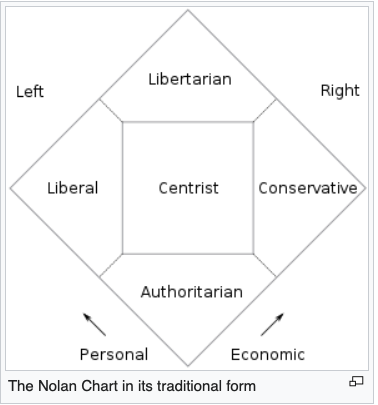
David Nolan is one of the many people who sensed a big problem with this left-right way of thinking. He offered a two-dimension chart that capture much more complexity: https://en.wikipedia.org/wiki/Nolan_Chart Many others have offered more nuanced (and I would argue, more accurate) ways to characterize political outlooks of our 300+ citizens, but the traditional and highly inaccurate one-dimensional (Left-Right) still dominates the political and journalistic landscape. We seem to prefer simplistic over accurate.

We’ve got the same problem with many other categorizations we blithely make. I resist categorizing people in terms of “race,” because long experience has proven to me that the way a person looks has very little to do with who they are. Using immutable physical traits as a proxy for one’s a stereotyped content of character often wildly inaccurate. When I evaluate a person for character, I consider many factors, dozens of dimensions, such as the “Big Five”:

• openness to experience (inventive/curious vs. consistent/cautious) • conscientiousness (efficient/organized vs. extravagant/careless) • extraversion (outgoing/energetic vs. solitary/reserved) • agreeableness (friendly/compassionate vs. challenging/callous) • neuroticism (sensitive/nervous vs. resilient/confident)

I consider manny other dimensions, including creativity, credibility, grit, acts of altruism, credibility and intelligence, and intelligence can be broken into many sub-categories. For instance, Psychologist Howard Gardner argues that there are multiple types of intelligence, such as:

  • Musical-rhythmic and harmonic
  • Visual-spatial
  • Verbal-linguistic
  • Logical-mathematical
  • Bodily-kinesthetic
  • Interpersonal
  • Intrapersonal
  • Naturalistic
  • Existential

Gardner’s declaration that these are separate intelligences is controversy in psychological circles. That said, these traits that he describes are some of the things I consider when evaluating another person, regardless of any “race.”

There are dozens of other dimensions I might use when evaluating any other person, but many people are willing to divide other people into “white” and “Black,” as though this is a meaningful way to evaluate another person. Making these “racial” distinctions is as absurd as embracing astrology--using a person’s birthdate as a proxy that persons personal character. To me, it seems bizarre and absurd to divide people into colors. That said, I live in a country where far too many people are enthusiastically willing to judge each other on this single simplistic dimension of “white” verses “Black,” despite the fact that this binary is an even cruder measure than the American political spectrum because it’s not a spectrum at all. It is a switch that is flipped from “white” to “Black,” with nothing in between, even though millions of “inter-racial” people exist. What a bizarre stilted binary, on so many levels! How is it possible that this racialized way of dividing people has any intellectual or political traction in modern times?

Here’s another popular binary: socialism versus capitalism. Many people are content to jam complex economies into one of these two boxes despite the overwhelming complexities and nuances of all existing economies. As though libraries are not filled to the brim discussions of the complexities of every economic system, where not a single real life system is declared to be purely socialist or purely capitalist.

I’ve been thinking about these false and limited ways of thinking for a long time. I was reminded of this issue when listening to The Portal, Eric Weinstein’s excellent podcast on Schrodinger’s Cat and the false-binary ways the many people find acceptable for discussing numerous social issues.

Why are we so willing to self-limit the way we think about obviously complex issues? Is it laziness? Gullibility? Social Pressure? We urgently need to reconsider our willingness of categorizing these complex issues, because our one-dimension cartoons are poisoning our ability to talk with one another.  This cartoon-talk is destroying our democracy.

Our willingness to think in terms of these cartoons would seem like an obvious problem for anyone willing to stop and think for even a few minutes, but many of us continue to embrace these cartoonish ways of thinking unabated, perhaps following the lead of our news media, social media and politicians. How can we convince people to stop and smell the nuance? How does one effectively declare that The Emperor has no Clothes in such an intransigent social environment?

Continue ReadingWe Love it That Two (Count’em) Two Cartoon Dimensions Pretend to Describe Complex Political, Racial and Economic Systems

Modern Orwellian, Modern Euphemisms, CRT

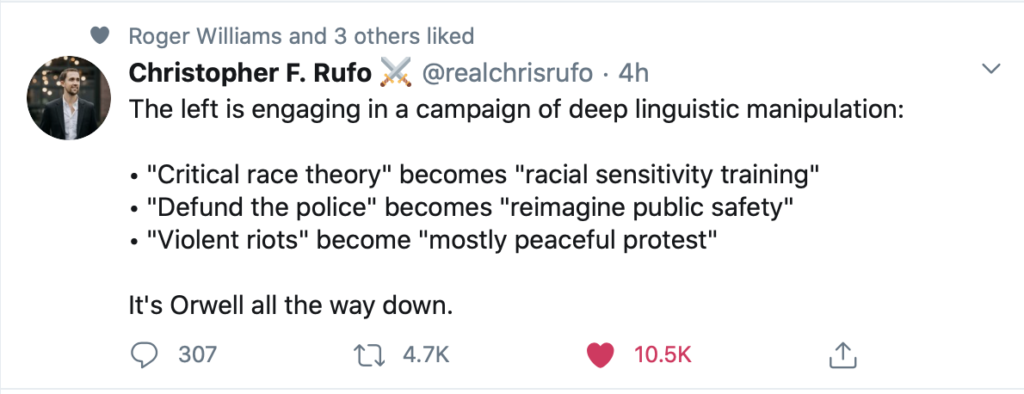
If Americans are getting great at anything other than screen time these days, it is buying into Orwellian definitions. The political right has more than it's fair share, but now the political left is doubling down, as pointed out by Christopher Rufo:

George Carlin pointed out that every euphemism is a red flag:

Here's a Carlin excerpt in transcript form:

I don't like words that hide the truth. I don't like words that conceal reality. I don't like euphemisms or euphemistic language. American English is loaded with euphemisms, because Americans have a lot of trouble dealing with reality. Americans have trouble facing the truth, so they invent the kind of a soft language to protect themselves from it and it gets worse with every generation. For some reason it just keeps getting worse . .

And now, in on of the more notable twists of fate for the insane year of 2020, we have the absolute worst messenger, Donald Trump, leading the charge against Critical Race Theory. Trump, historically tone deaf on this issue if not outright racist, has decided to attack CRT purely for political advantage. Biden has pushed his head into the sand on this issue, along with many other public voices, including the moderator of last night's presidential debate, Chris Wallace. No, CRT is not "racial sensitivity training."  CRT is not the modern version of the Civil Rights Movement.  It is the opposite.  It is a pernicious misguided embrace of racism as a tool for fighting racism. On the political left, this embrace of CRT is a worthy example of kayfabe.

Kayfabe - In professional wrestling, kayfabe /ˈkeɪfeɪb/ (also called work or worked), as a noun, is the portrayal of staged events within the industry as "real" or "true", specifically the portrayal of competition, rivalries, and relationships between participants as being genuine and not staged. The term kayfabe has evolved to also become a code word of sorts for maintaining this "reality" within the direct or indirect presence of the general public.

Most of those in the spotlight know that they are speaking nonsense, but they are either cowards or actively pulling political strings. The result is cringe-worthy political theater with no good end in sight. It is my belief that those politicians on the political left, almost without exception, know that CRT is antithetical to the teachings of Martin Luther King and that CRT is setting back the Civil Rights movement by several decades. Dividing people by "race" was a bad idea 400 years ago and it remains a bad idea. One of the worst ideas anyone has ever had.

In my view, the first racist act is choosing to believe that "race" is a real thing and that it should somehow matter for reasons other than setting exposures in portrait photography. Without this starkly wrong initial move, racism would be impossible. The far right and the far left are now in agreement on this unscientific belief and they are acting as equal and opposite forces giving rise to hate and violence throughout the political spectrum.  The last thing we should be doing is covering up a bad idea like CRT with a euphemism, especially when courage and honesty are the best approaches and an important presidential election is only a few weeks away.

Continue ReadingModern Orwellian, Modern Euphemisms, CRT