Mediocrity as New Version of Equality
Disturbing information from a woman who has held a seat on the largest school board in NYC:
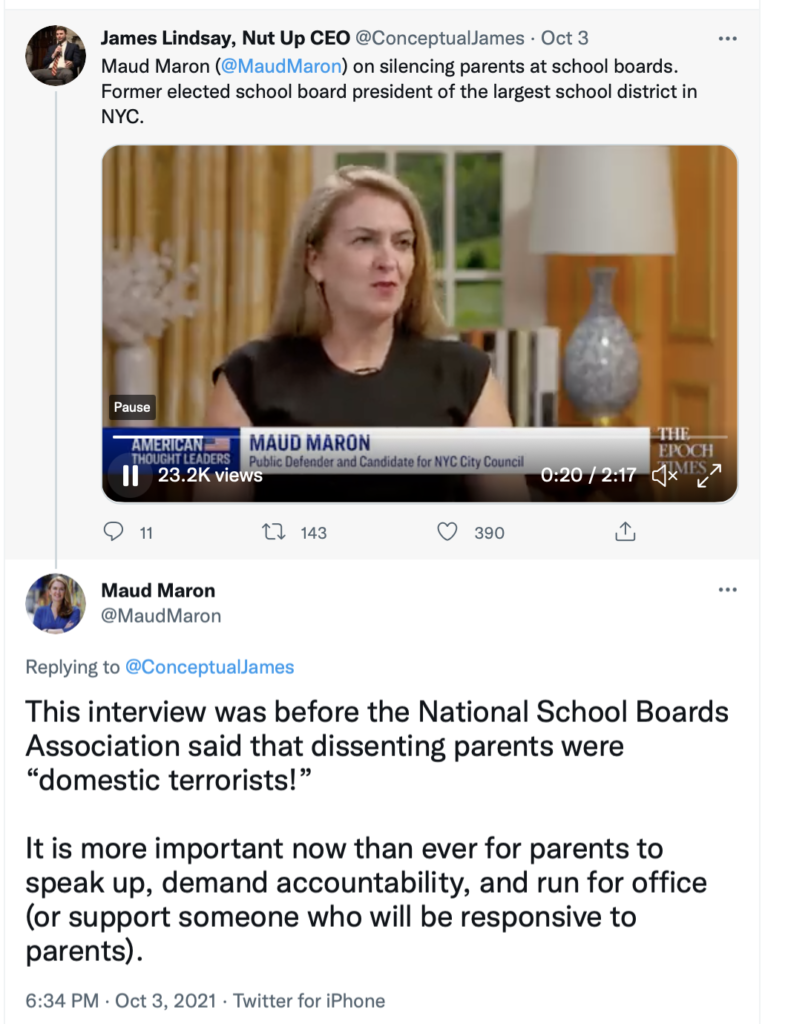

Disturbing information from a woman who has held a seat on the largest school board in NYC:
The following Tweets tell the story of Dorian Abbot's recent cancelation:
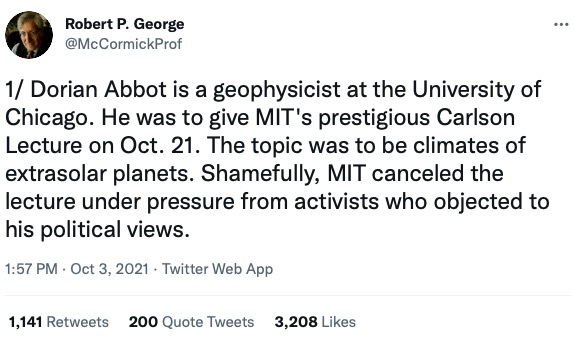
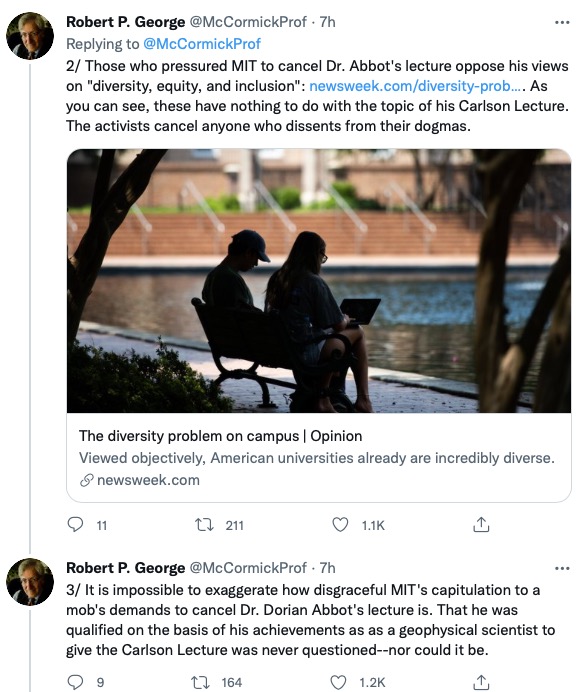
What were the ideas of Dorian Abbot that got him canceled at MIT. They appear in Newsweek. He expressed his belief that DEI is unfair and that we ought to be hiring purely on merit. Here are some of his excerpts from his August 12, 2021 Newsweek article:
American universities are undergoing a profound transformation that threatens to derail their primary mission: the production and dissemination of knowledge. The new regime is titled "Diversity, Equity, and Inclusion" or DEI, and is enforced by a large bureaucracy of administrators. Nearly every decision taken on campus, from admissions, to faculty hiring, to course content, to teaching methods, is made through the lens of DEI. This regime was imposed from the top and has never been adequately debated. In the current climate it cannot be openly debated: the emotions around DEI are so strong that self-censorship among dissenting faculty is nearly universal.
The words "diversity, equity and inclusion" sound just, and are often supported by well-intentioned people, but their effects are the opposite of noble sentiments. Most importantly, "equity" does not mean fair and equal treatment. DEI seeks to increase the representation of some groups through discrimination against members of other groups . . .
DEI undermines the public's trust in universities and their graduates. Some on campus might be surprised to learn that, according to a recent Pew poll, 74 percent of Americans think only qualifications should be taken into account in hiring and promotion, even if this results in less diversity. . . .
We propose an alternative framework called Merit, Fairness, and Equality (MFE) whereby university applicants are treated as individuals and evaluated through a rigorous and unbiased process based on their merit and qualifications alone. Crucially, this would mean an end to legacy and athletic admission advantages, which significantly favor white applicants, in addition to those based on group membership. Simultaneously, MFE would involve universities investing in education projects in neighborhoods where public education is failing to help children from those areas compete. These projects would be evidence-based and non-ideological, testing a variety of different options such as increased public school funding, charter schools and voucher programs.
I have enchanted many people who completely agree with Professor, but they are afraid to express their views because they would risk damage to their careers (the exact kind suffered by Professor Abbott). The result is that a critically important topic (whether we should be hiring solely based on merit) is not being debated. Another professor, Gordon Klein, recently expressed similar views in a lawsuit he filed against his employer, UCLA. He has alleged that he was punished for refusing to discriminate. On Sept 30, 2021, his article appeared at Common Sense with Bari Weiss. Here are a few excerpts from Why I am Suing UCLA:
My saga — which nearly led to my firing — began on the morning of June 2, 2020, when a non-black student in my class on tax principles and law emailed me to ask that I grade his black classmates with greater “leniency” than others in the class. “We are writing to express our tremendous concern about the impact that this final exam and project will have on the mental and physical health of our Black classmates,” the student wrote. (There was no project in this class, and it was unclear to me who the “we” in this case was. . . . I suspected the student simply used a form letter he found online and neglected to change the subject.) “The unjust murders of Ahmaud Arbery, Breonna Taylor and George Floyd, the life-threatening actions of Amy Cooper and the violent conduct of the [University of California Police Department] have led to fear and anxiety which is further compounded by the disproportionate effect of COVID-19 on the Black community. As we approach finals week, we recognize that these conditions place Black students at an unfair academic disadvantage due to traumatic circumstances out of their control.” To try to make his case, the student drew on UCLA’s “Equity, Diversity, and Inclusion” agenda, which directs professors to grant preferential “equity” to students belonging to “underrepresented groups.”
I wholeheartedly support these principles as most of us understand them. I think all human beings should be treated the same. I welcome — I celebrate — a diversity of opinions and arguments. And, to say the least, I believe in making room for anyone with the grades and gumption to study at one of the nation’s most competitive universities. But academia has so corrupted these words that they are now hollowed out corpses devoid of their original meaning. Today, “diversity” means ideological homogeneity. And “inclusion” means the exclusion of some from a taxpayer-supported university to favor others deemed more deserving of an educational springboard to prosperity.
Shocked by the student’s email, which struck me as deeply patronizing and offensive to the same black students he claimed to care so much about, I collected my thoughts and, 20 minutes later, emailed back: “Are there any students that may be of mixed parentage, such as half black half-Asian? What do you suggest I do with respect to them? A full concession or just half? Also, do you have any idea if any students are from Minneapolis? I assume that they are probably especially devastated as well. I am thinking that a white student from there might possibly be even more devastated by this, especially because some might think that they’re racist even if they are not.”
I wrapped up my reply by citing Martin Luther King’s vision of a colorblind world where people are judged solely by the content of their character — making it clear that I had no intention of treating any students differently on the basis of their skin color.
By that evening, students were calling for my job. Soon after, they circulated a petition demanding I be fired; within a day or two, nearly 20,000 had signed — without knowing anything about me or taking into account, as far as I could tell, the implications of non-color-blind grading. I was attacked for being a white man and “woefully racist.” On June 5, three days after I was first emailed, I was suspended amid a growing online campaign directed at me.
Here is the federal complaint spelling out Gordon Klein's detailed allegations pertaining to the misconduct of UCLA.
We need to be able to discuss ideas freely, especially controversial ideas, especially at universities, the mission of which has long been to expose students to controversial ideas. In the current climate, however, many people are being threatened and punished for expressing or attempting to discuss important issues of the day. This trend blatantly violates the three prerequisites set forth by Jonathan Rauch (in his new book, The Constitution of Knowledge) for enabling us to determine what is true and what is not true. We are nudging month by month closer to a new national principle: Declaration of Truth by Edict.
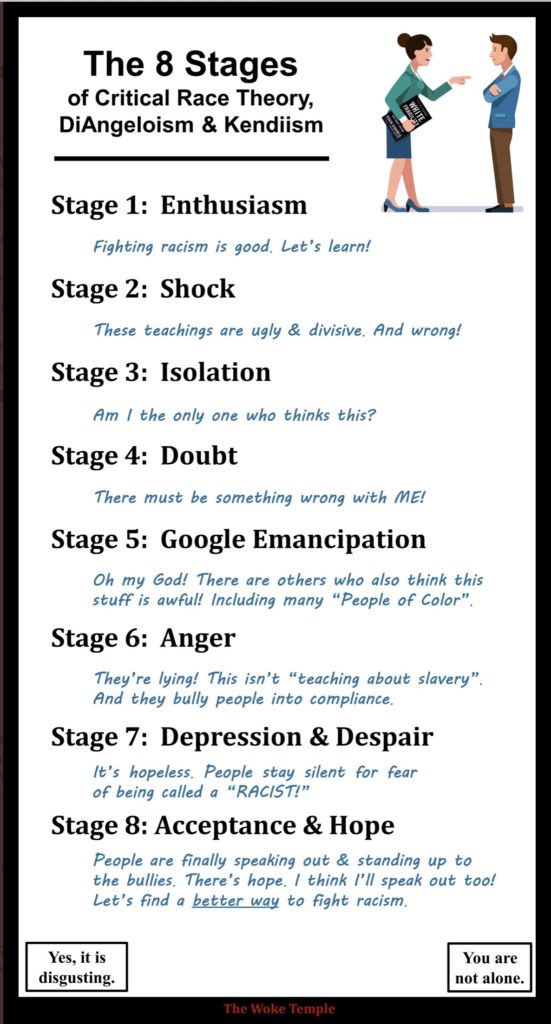
Woke Temple has issued a new version of his "8 stages of Critical Race Theory, DiAngelosim and Kendiism (referring to the divisive, incoherent and unsubstantiated claims of Robin DiAngelo and Ibram X. Kendi).
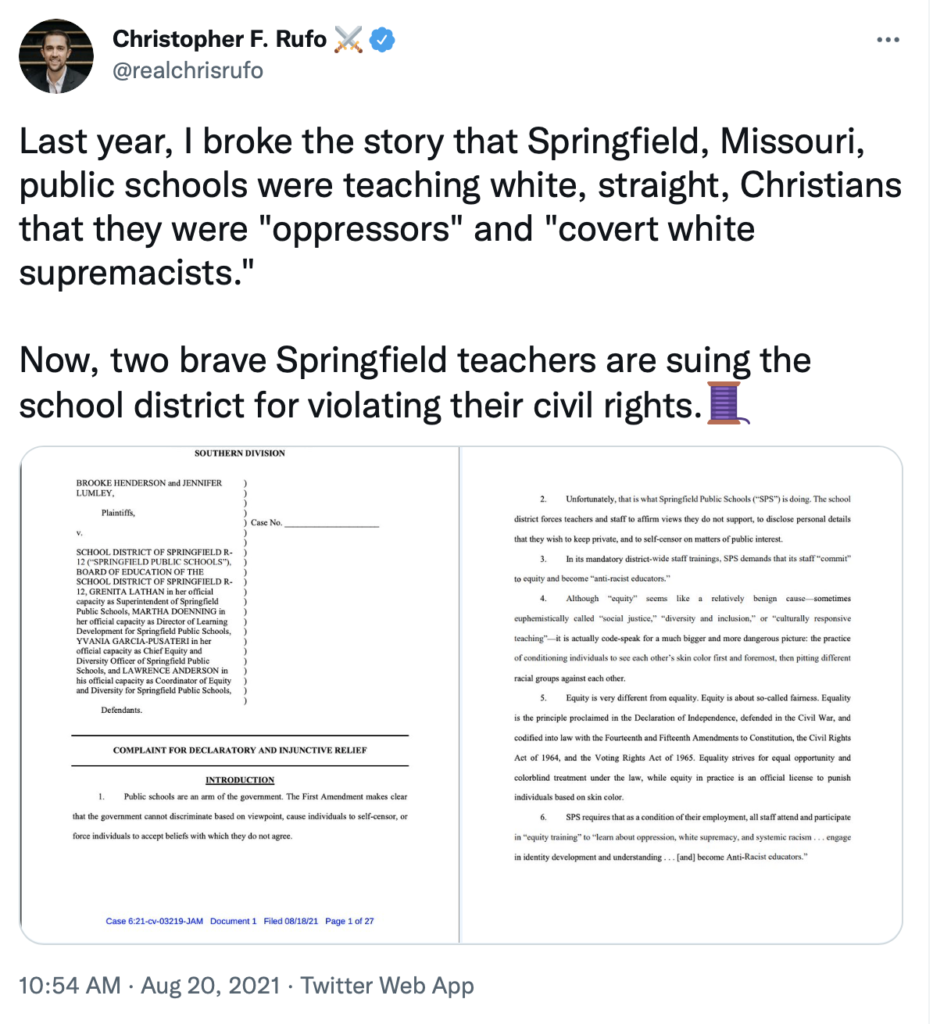
I keep hearing people claim that people like me are trying to prevent schools from "teaching history." Take a look at this federal complaint and the documents leaked to Christopher Rufo. Then ask whether these claimants are trying to prevent the schools from "teaching history"
This cheat sheet is courtesy of the Oregon Association of Scholars. The authors are Drs. Bruce Gilley, Peter Boghossian and James Lindsay. Click on the image to view it larger at its source.
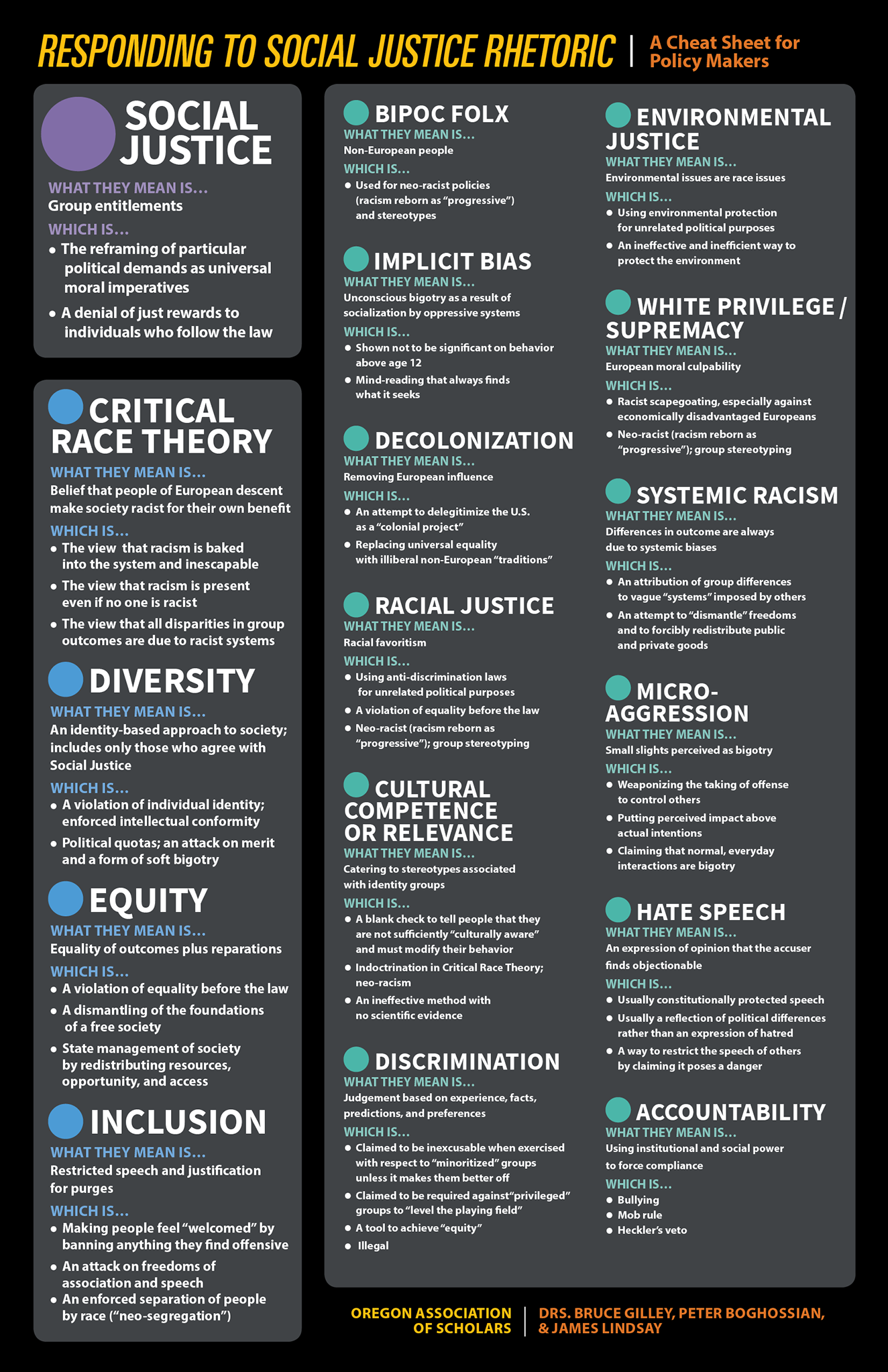
The Oregon Association of Scholars is a non-profit organization incorporated in the state of Oregon that promotes excellence, freedom, and merit in higher education in the state.