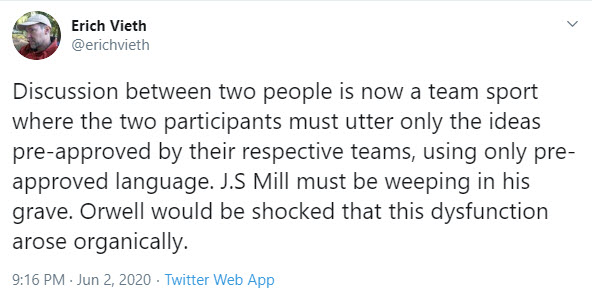
Gottman’s Four Horsemen Running Amok
Millions of us are now enthusiastically employing tactics against each other (Gottman’s “four horsemen": criticism, contempt, stonewalling, and defensiveness) that are guaranteed to destroy marriages.

Millions of us are now enthusiastically employing tactics against each other (Gottman’s “four horsemen": criticism, contempt, stonewalling, and defensiveness) that are guaranteed to destroy marriages.
I'm receiving ever-more angry barking and name-calling instead of explanations from those advocating political positions across the entire spectrum. Also,it seems that we should give the phrase "I don't know" a formal official burial this year. The phrase has disappeared from social media, along with its siblings, humility and self-critical thought.
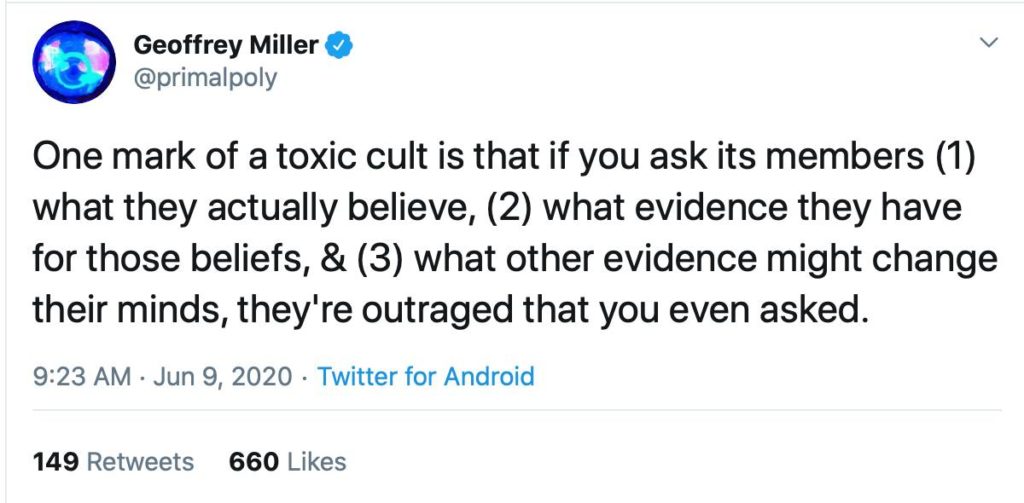
This post was inspired by this Tweet by Geoffrey Miller:
Here’s how I would explain the violent George Floyd protests to a Martian anthropologist.
The U.S. Constitution gives a theoretical “right” to free speech but not a real-life ability to speak powerfully or widely. Whereas money and power give rich people many ways to blast out their messages, ordinary Americans wanting to get out their messages often get eaten in the public square by street vultures. Consider these two examples.
When Donald Trump wants to make an announcement, he commands dozens of types of federal military and police organizations. This allows Trump to calmly walk up to a podium or stroll down the street in order to tell Americans what a smart man he is, or how religious or healthy or whatever. While he stands up there flatulating these lies, no one interrupts Trump because he controls a massively expensive and well-armed system of law enforcement officers and they extend their perimeter so widely that unfriendly others can’t get close. If any protestors try to get close enough to interrupt Trump’s bombastic bullshit, Trump’s police officers and soldiers throw their asses into jail.
Compare this to the George Floyd protests, where many thousands of ordinary Americans took to the streets, but they were then on their own. Ordinary Americans don’t control law enforcement. They cannot control their perimeters in order to safely deliver their message without interruption. As we’ve seen over and over, as soon as the heartfelt protestors get started delivering their messages in the public square, the area becomes an undefended magnet for uninvited masses of miscreants: anarchists, vandals, arsonists, inciters of violence and many others who clearly don’t give a shit about George Floyd. Virtually every time ordinary people gather together by the hundreds or thousands, their message gets corrupted because ordinary Americans do not have the money or power to hire hundreds of law enforcement officers to control their perimeter. Their message gets diluted by broken glass, thrown bricks and burning businesses, as well as horrible injuries, shattered dreams and gruesome deaths. Following this widespread mayhem, the heartfelt protestors get blamed for something they never planned or intended. The many people who simply wanted to bring attention to George’s Floyd’s murder are accused of intentionally destroying America’s central cities. The photos appearing in the mass media are Exhibits A-Z.
That’s how it almost always ends for those without great amounts of money and power. That is how it is in this Land where everyone only has the right to pointlessly yell out their grievances in their own living room or from their front porch. This is the Land where people of modest means can no longer assemble in peace to deliver stinging rebukes to corrupt politicians because they do not have the money or power to control and deliver a message in the public square, no matter how important that message is.
The impeachment hearings offer daily fodder to those who struggle to understand how the human mind works. Many people keep expressing frustration about the lies being told by the politicians. That raises the question: Did the brain evolve as a truth-seeking organ? What if the brain's main function is survival, not truth? What if the brain's main function centers on the "Four F's": Feeding, Fleeing, Fighting and Reproduction? What if Truth is only a fragile, occasional, happenstance by-product of the brain's main evolved function?
That brought this Scientific American article front and center: "Did Humans Evolve to See Things as They Really Are? Do we perceive reality as it is?" Here's an excerpt:
One of the deepest problems in epistemology is how we know the nature of reality. Over the millennia philosophers have offered many theories, from solipsism (only one's mind is known to exist) to the theory that natural selection shaped our senses to give us an accurate, or verdical, model of the world. Now a new theory . . . is garnering attention . . . Grounded in evolutionary psychology, it is called the interface theory of perception (ITP) and argues that percepts act as a species-specific user interface that directs behavior toward survival and reproduction, not truth.
Lindsey Graham is now taking the position that the Impeachment is improper because not actual crimes were committed. The Democrats then carted out Graham's 1999 video where he said the opposite. Every human being watching this drama unfold knows all of the following with a certainty:
How is it possible for Graham to justify these diametrically opposite positions? The function of the human brain is well beyond my understanding, of course. At this time, I would simply point out that one's own farts smell OK, whereas the farts of others are unpleasant. There's actually some science on why our own farts smell OK. I would simply extrapolate: Both our farts and our own dysfunctional thoughts get free passes. Why? Because they are our farts and our thoughts, not those of others. And where our entire tribe farts, that's OK too, because it's our tribe and not some other tribe. Our crappy thoughts constitute our theories, meaning that the confirmation bias kicks in like a powerful optical illusion to help us ignore conflicting evidence.
Hypocrisy is an ancient problem, of course. It goes back at least to biblical times:
Thou hypocrite, first cast out the beam out of thine own eye; ... You hypocrite! First, remove the beam out of your own eye, and then you can see clearly to remove the speck out of your brother's eye.
This hypocrisy continues to modern times:Morality is difficult. As [psychologist Johnathan] Haidt writes on his website, "It binds people together into teams that seek victory, not truth. It closes hearts and minds to opponents even as it makes cooperation and decency possible within groups. . . . Morality binds and blinds. The metaphor [Haidt] uses to describe this idea is that we are 90 percent chimp 10 percent bee. That is to say, though we are inherently selfish, human nature is also about being what he terms "groupish."
The hypocrisy we are witnessing might be a little less distressing to the extent that we can accept the fact that the brain did not evolve for truth, but rather for assimilating resources to assist survival, utilizing the power of one's tribe whenever useful. If we can wrap our heads around this scary fact that the brain is much more geared for social power than truth, the impeachment hearings are nothing extraordinary. These hearings are merely more episodes of watching people gathered in tribes fighting for evolutionary fitness. That said, this is an enormous and distressing price to pay in exchange for understanding. But maybe it's . . . . true. Maybe those moments where human minds transcend daily survival pressures to seek consistent principled truth are extraordinarily precious moments that need to be noted and celebrated. Maybe we will never have a society based on truthful principles unless we work hard together. Nietzsche pointed that being able to see truthfully is a moral issue. He wrote that one is truthful only to the degree that one is courageous. Maybe those fragility of those moments where people work hard and self-critically to embrace truth should remind us to appreciate what we have when politicians show the moral courage to act on principle.