“White Supremacy” and Concept Creep

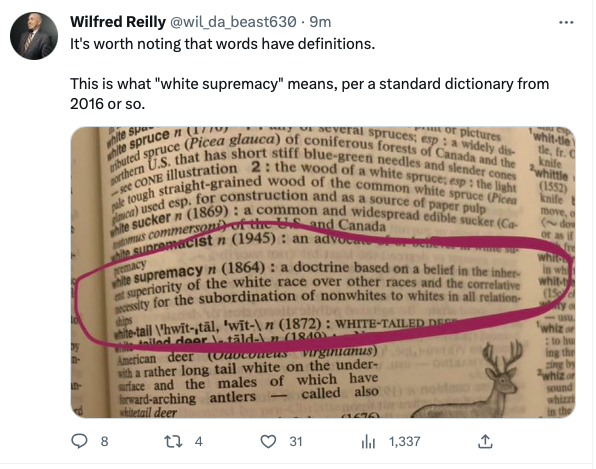
Wilfred Reilly points out one of the many recent examples of concept creep. According to the laptop class, the meaning of "White Supremacy" barely resembles what it meant only a few years ago.

Here are other examples: Dangerous Conversion Therapy Woman. Man. Phobia Healthy Vaccine Science Freedom Pandemic Insurrection Vaccine Racism and Racist Gain of Function Public health expert Gender Misinformation Left Wing and Right Wing, Liberal and Conservative Peaceful Violence Fact-Checker Truth Equality Fascist Conspiracy Theory Safe & Safety Trusted Freedom Infrastructure Progressive Fact Anti-vaxxer Inclusion Diversity News Reporting Tolerance

Continue Reading“White Supremacy” and Concept Creep

FIRE Comments on the Forbidden Words of Stanford University

Excerpt from an Article by FIRE (Foundation for Individual Rights and Expression):

By now, much has been written about the words and phrases Stanford removed from its website for their potential to cause harm. “That was insane!” isn’t palatable, because “This term trivializes the experiences of people living with mental health conditions.” What to do when referring to a whitelisted or blacklisted IP address? Try “allowlist/denylist,” because the former terms “[a]ssign value connotations based on color (white = good and black = bad), an act which is subconsciously racialized.” You get the idea. “American,” “dumb,” and “lame” are out, too . . . .

Last week, after the list became public and backlash mounted, Stanford announced it would conduct a review of the guide. The statement from Chief Information Officer Steve Gallagher clarified the website does not represent Stanford University policy. “It also does not represent mandates or requirements,” Gallagher wrote. The list simply provides “suggested alternatives.” “But, we clearly missed the mark,” Gallagher concedes. “We value the input we have been hearing, from a variety of perspectives, and will be reviewing it thoroughly and making adjustments to the guide.”

While FIRE is, of course, relieved to hear these alternatives are not required, the inherent infantilization of steering adults away from words and phrases like “tone deaf” and “mailman” is troubling. By prematurely wading into conversations and deeming words and phrases offensive on behalf of its adult students, Stanford deprives its community members the chance to build resilience and talk through the issues of the day without having to constantly worry about stepping on rakes.

We think institutions of higher education better serve students by not inserting themselves in language debates that are almost certain to produce a “Streisand effect,” occurring when more attention is brought to forbidden words and phrases in the effort to silence them. FIRE recommends a culture of trust, not coddling....

In 2016, Nick Haslam coined the term “concept creep” to describe the tendency for the semantic range of harm-related concepts to expand over time. In other words, the meaning of concepts such as “trauma,” “bullying,” and “violence” has broadened to include ever milder, subtler phenomena.

[More . . . ]

Continue ReadingFIRE Comments on the Forbidden Words of Stanford University

Stanford University Attempts to Dismantle Harmful Language

Stanford University has launched an initiative to protect us from harmful language. This language is so incredibly harmful that after the link to the website started getting passed around, Stanford shut down public access. Now only Stanford students will get to know the language that purportedly harms all of us.

Heather Heying had been poking around at the Stanford website that was designed to protect her (and me and you and everyone else) from certain terrible words and phrases, but before she could finish reviewing the website, Stanford closed off public access. Here's some of the information that Heather can report at her website, Natural Selections:

Finally, I grabbed a single screenshot of one of the recommendations on the site before access was restricted4. Here it is:

[More . . . ]

Continue ReadingStanford University Attempts to Dismantle Harmful Language

Camille Paglia Discusses Transgender Issues

I've followed Camille Paglia for many year, always finding her opinions deeply explored, courageous and clearly stated. An excerpt from CPYU:

Although I describe myself as transgender (I was donning flamboyant male costumes from early childhood on), I am highly skeptical about the current transgender wave, which I think has been produced by far more complicated psychological and sociological factors than current gender discourse allows. Furthermore, I condemn the escalating prescription of puberty blockers (whose long-term effects are unknown) for children. I regard this practice as a criminal violation of human rights.

It is certainly ironic how liberals who posture as defenders of science when it comes to global warming (a sentimental myth unsupported by evidence) flee all reference to biology when it comes to gender. Biology has been programmatically excluded from women’s studies and gender studies programs for almost 50 years now. Thus very few current gender studies professors and theorists, here and abroad, are intellectually or scientifically prepared to teach their subjects.

The cold biological truth is that sex changes are impossible. Every single cell of the human body remains coded with one’s birth gender for life. Intersex ambiguities can occur, but they are developmental anomalies that represent a tiny proportion of all human births.

In a democracy, everyone, no matter how nonconformist or eccentric, should be free from harassment and abuse. But at the same time, no one deserves special rights, protections, or privileges on the basis of their eccentricity. The categories “trans-man” and “trans-woman” are highly accurate and deserving of respect. But like Germaine Greer and Sheila Jeffreys, I reject state-sponsored coercion to call someone a “woman” or a “man” simply on the basis of his or her subjective feeling about it. We may well take the path of good will and defer to courtesy on such occasions, but it is our choice alone.

Continue ReadingCamille Paglia Discusses Transgender Issues

Michael Shellenberger: Regarding Hurricanes, the News Media Narrative Does Not Fit the Facts

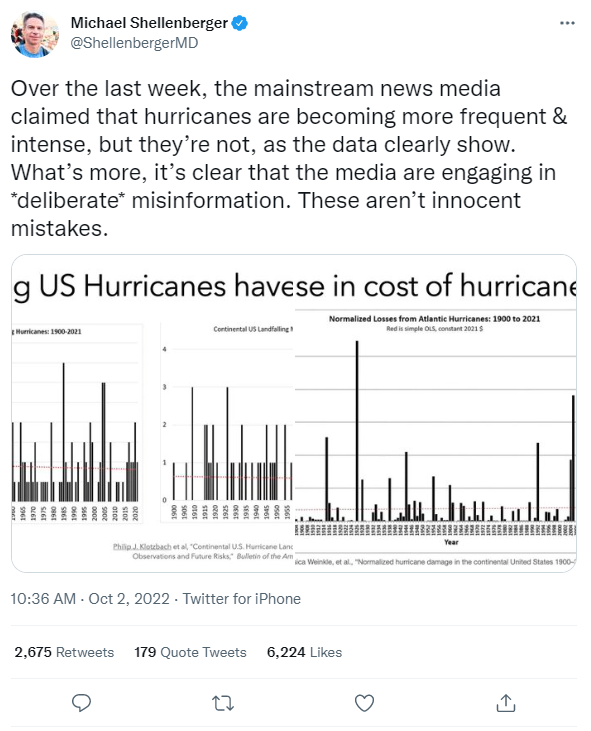
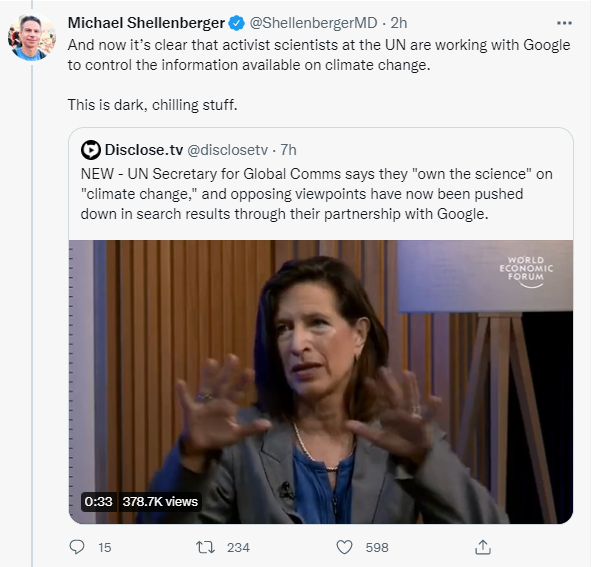
Michael Schellenberger makes a strong case for journalism malpractice and warns us that prominent news outlets are working hard to prevent meaningful conversations.

Continue ReadingMichael Shellenberger: Regarding Hurricanes, the News Media Narrative Does Not Fit the Facts