My Current Default Position About COVID Booster Vaccines

I received two COVID shots as well as a booster. Then, about six months ago I got COVID, which had me feeling down in the dumps for 3 days, which also left me with a loss of strength and balance for a few weeks after that. I'm hearing a lot about the alleged need for all of us to get more and more boosters lately. Should I? I'm not a scientist. I don't know how to read the medical research with confidence. I thought we would all have clear answers about COVID and boosters by now, but it has never been less clear. And now we have Twitter Files indicating that the U.S. government has been warping the conversation about COVID and vaccines, even having a hand in shutting down well-decorated medical professionals who disagree with the national narrative of "get lots and lots of booster shots." I wish we had dependable information about the following:

1. Whether boosters are meaningfully effective

2. Whether boosters are safe; and

3. Whether the risks of boosters (according to some) outweigh the benefits of booster (according to others).

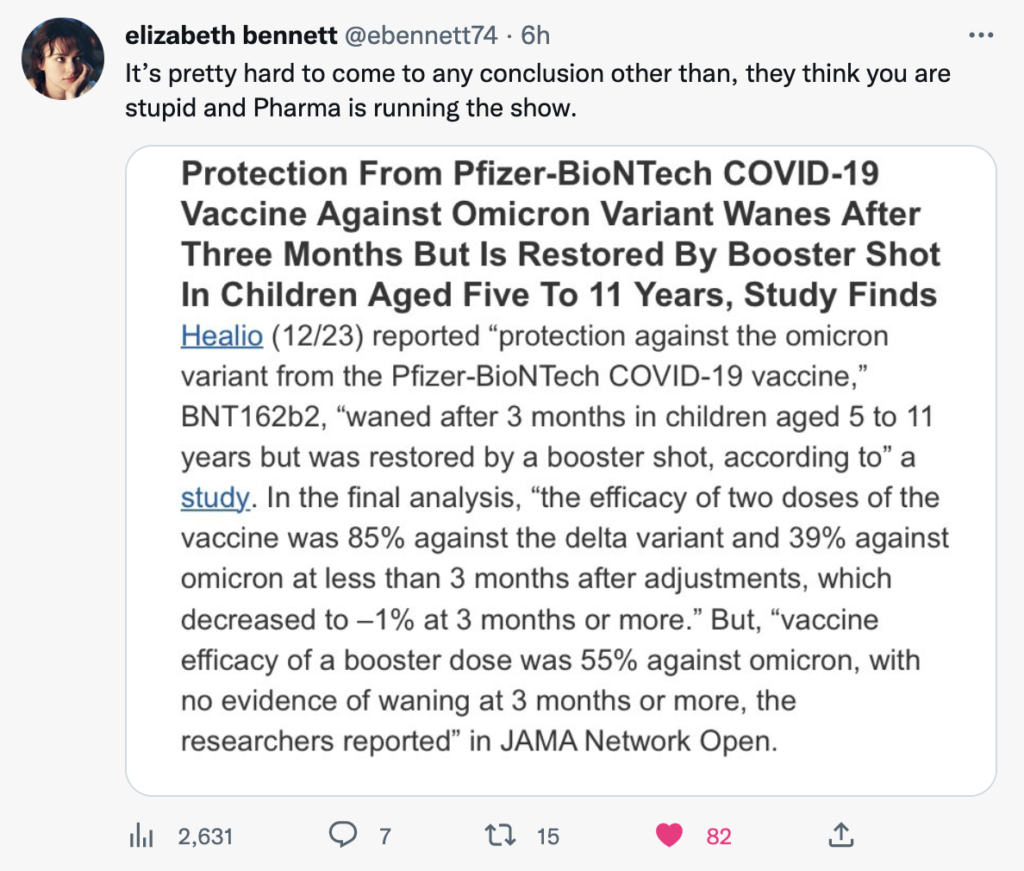
It doesn't help that public health officials and CDC have been so wrong about so many things over the last few years. The evidence on this includes the internal reversals of CDC policy (e.g., No need for a mask, then you must wear a mask; getting the jab will keep you from getting COVID, then not so much). Every time there is a new pronouncement reversing a prior pronouncement, it is presented with equal confidence. Thus, it is not surprising to see recent statistics showing that ever greater numbers of Americans are refusing to get the newest boosters. But also consider comments by doctors such as "Elizabeth Bennett" on Twitter:
I am one of the many people who are now somewhere between disoriented, distrusting and disgusted with the state of COVID information. I am not alone:
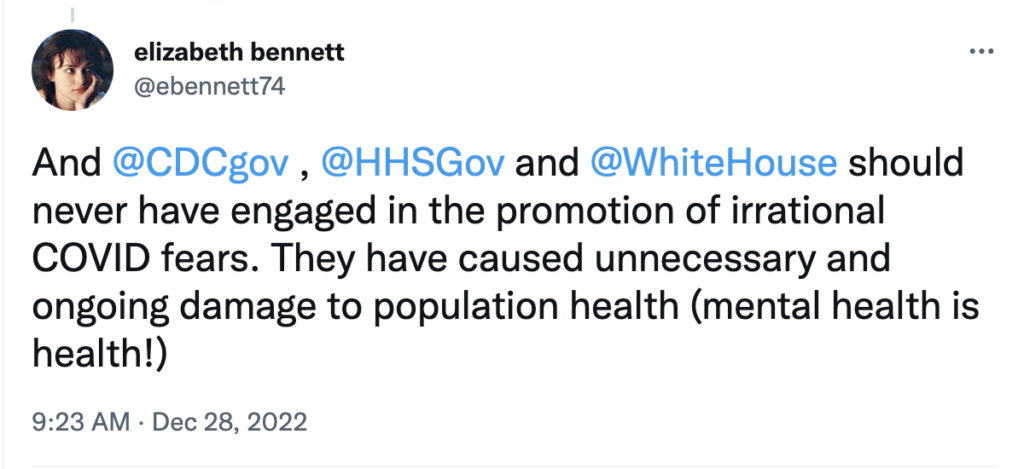
In the absence of reliable information and wide-open vigorous conversation among our medical professionals, the rest of us need to act on assumptions and guesses. I am assuming that I am at more risk if I get yet another new booster than if I refuse it. I'm open to new information, of course, but I'm highly concerned that doctors and researchers with legitimate concerns about the boosters are still being shut out of the conversation. I've seen ample confirmation of this censorship--many doctors and researchers being completely shut down by Twitter for instance.  I also see many serious sounding accusations like these.  I would like to know a lot more information. I would like to have credible answers to these 130 highly specific concerns assembled by Steve Kirsch.

In the meantime, no more boosters for me.
Continue ReadingMy Current Default Position About COVID Booster Vaccines

I’d Like to Be a Fly on the Wall at Google These Days

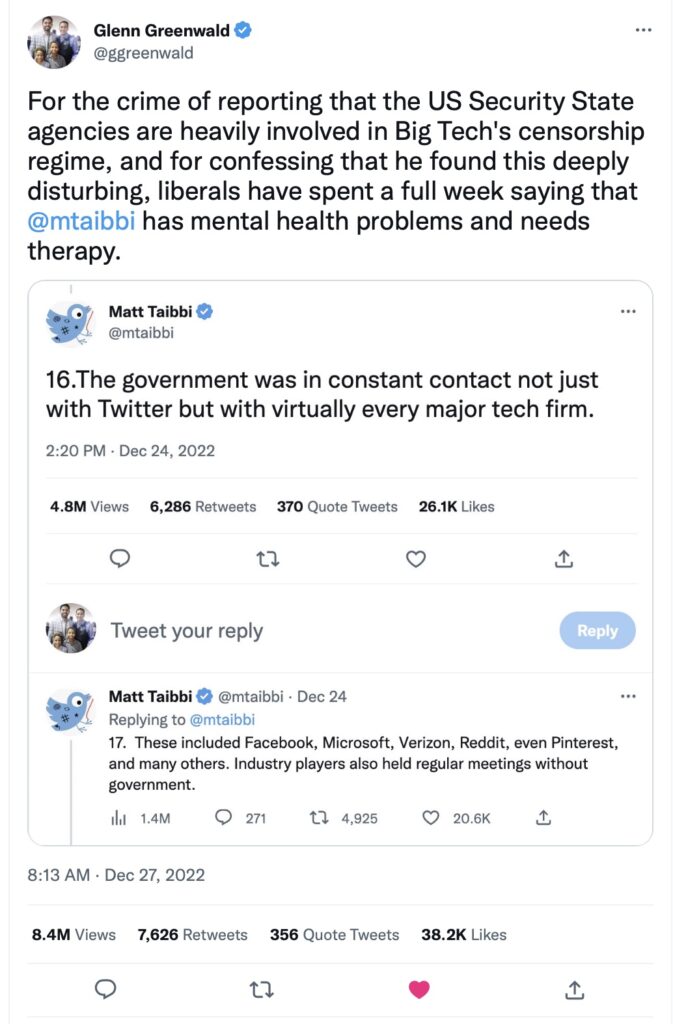
First, a Tweet from Glenn Greenwald, noting what I have been noticing:

Taibbi's revelations should outrage every American. Since when is it the proper role of the U.S. Government to guide and filter conversations of Americans? Taibbi has arguably helped to reveal millions of violations of civil rights, per Bantam Books, Inc. v. Sullivan (1963). The Court’s decision was in favor of group of book publishers who sued a purportedly private "commission" created to “to educate the public concerning any book . . . or other thing containing obscene, indecent or impure language” that could corrupt youth. The Supreme Court held that through its threats of prosecution, the commission engaged in censorship. The Court further held that the commission's actions constituted acts of the state under the Fourteenth Amendment because the commission operated “under color of state law.” The government cannot use private intermediaries to engage conduct that the government cannot do on its own due to U.S. civil rights laws.

Also consider Edmonson v. Leesville Concrete Co., Inc., 500 U.S. 614 (1991): "Although the conduct of private parties lies beyond the Constitution's scope in most instances, governmental authority may dominate an activity to such an extent that its participants must be deemed to act with the authority of the government and, as a result, be subject to constitutional constraints."

Now consider this  follow-up Tweet by Elon Musk:

My thought at this moment. If we had caught merely one FBI agent meddling with a few acts of censorship at Twitter, it would have been a big deal and it would have caused much outrage. Are these disclosures too big, too many to absorb by most Americans? This overwhelming lawlessness brings to mind the quote attributed to Joseph Stalin: "A single death is a tragedy; a million deaths is a statistic."

Continue ReadingI’d Like to Be a Fly on the Wall at Google These Days

Twitter’s COVID Censorship

David Zweig's new article at The Free Press: "How Twitter Rigged the Covid Debate: The platform suppressed true information from doctors and public-health experts that was at odds with U.S. government policy." An excerpt:

The United States government pressured Twitter to elevate certain content and suppress other content about Covid-19 and the pandemic. Internal emails that I viewed at Twitter showed that both the Trump and Biden administrations directly pressed Twitter executives to moderate the platform’s content according to their wishes.

At the onset of the pandemic, the Trump administration was especially concerned about panic buying, and sought “help from the tech companies to combat misinformation,” according to emails sent by Twitter employees in the wake of meetings with the White House. One area of so-called misinformation: “runs on grocery stores.” The trouble is that it wasn't misinformation: There actually were runs on goods.

And it wasn’t just Twitter. The meetings with the Trump White House were also attended by Google, Facebook, Microsoft and others.

When the Biden administration took over, its agenda for the American people can be summed up as: Be very afraid of Covid and do exactly what we say to stay safe.

Continue ReadingTwitter’s COVID Censorship

The Clouds Part and the Twitter Disclosures Stream In

For the past couple weeks, I've been following the release of the Twitter files closely, reading them, piece-by-piece on Twitter (here is Part I of the nine parts so far released). I'm not reading the tamped-down, strategically-filtered and papered-over characterizations of the Twitter files published by self-interested legacy media.

Most people I know are refusing to read the actual Twitter files being dug out of the Twitter archives for us by Matt Taibbi, Bari Weiss and her team, Michael Shellenberger and Lee Fang. They don't understand or care to understand the difference between independent journalists and the big corporations that pretend to employ only serious journalists. Most people I know refuse to read the Twitter files with their own eyes, arguing that they are sure these disclosures are groundless/false/uninteresting/ even though they have not read them. I can understand their hesitancy, given the extent to which they have been misled and betrayed by the "news" outlets they have been trusting. Mark Twain once commented on this challenge: "It’s easier to fool people than to convince them that they’ve been fooled.”

Again, I have read the Twitter files. Every last one of them. Based on these detailed disheartening revelations that our own government has fully and secretly embraced the role of virulently pro-censorship nanny-state, my emotional reaction has been similar to way Matt Taibbi describes his own reaction:

Sometime in the last decade, many people — I was one — began to feel robbed of their sense of normalcy by something we couldn’t define. Increasingly glued to our phones, we saw that the version of the world that was spat out at us from them seemed distorted. The public’s reactions to various news events seemed off-kilter, being either way too intense, not intense enough, or simply unbelievable. You’d read that seemingly everyone in the world was in agreement that a certain thing was true, except it seemed ridiculous to you, which put you in an awkward place with friends, family, others. Should you say something? Are you the crazy one?

I can’t have been the only person to have struggled psychologically during this time. This is why these Twitter files have been such a balm. This is the reality they stole from us! It’s repulsive, horrifying, and dystopian, a gruesome history of a world run by anti-people, but I’ll take it any day over the vile and insulting facsimile of truth they’ve been selling. Personally, once I saw that these lurid files could be used as a road map back to something like reality — I wasn’t sure until this week — I relaxed for the first time in probably seven or eight years.

I'll end with the purported mission statement of Twitter during this lengthy period of abject corruption, government malfeasance and censorship:

The mission we serve as Twitter, Inc. is to give everyone the power to create and share ideas and information instantly without barriers.

In how many ways did Twitter violate its own mission statement. Let us start counting the ways . . .

Continue ReadingThe Clouds Part and the Twitter Disclosures Stream In

The European Union’s Troublesome Plan to Clean Up Social Media

Jacob Mchangama, author of Free Speech: A History from Socrates to Social Media (2022) is warning us of the EU's well-intended "Digital Services Act, enacted in November 2022. The stated purpose of the Act is to require social media platforms to

evaluate and remove illegal content, such as “hate speech,” as fast as possible. It also mandates that the largest social networks assess and mitigate “systemic risks,” which may include the nebulous concept of “disinformation.”

Mchangama is concerned that the EU is ignoring the likely consequences of the Act:

The European law, by contrast, may sound like a godsend to those Americans concerned about social media’s weaponization against democracy, tolerance and truth after the 2020 election and the Jan. 6 insurrection. Former Secretary of State Hillary Clinton enthusiastically supported the European clampdown on Big Tech’s amplification of what she considers “disinformation and extremism.” One columnist in the New Yorker hailed the Digital Services Act as a “road map” for “putting the onus on social-media companies to monitor and remove harmful content, and hit them with big fines if they don’t.”

But when it comes to regulating speech, good intentions do not necessarily result in desirable outcomes. In fact, there are strong reasons to believe that the law is a cure worse than the disease, likely to result in serious collateral damage to free expression across the EU and anywhere else legislators try to emulate it.

Removing illegal content sounds innocent enough. It’s not. “Illegal content” is defined very differently across Europe. In France, protesters have been fined for depicting President Macron as Hitler, and illegal hate speech may encompass offensive humor. Austria and Finland criminalize blasphemy, and in Victor Orban’s Hungary, certain forms of “LGBT propaganda” is banned.

The Digital Services Act will essentially oblige Big Tech to act as a privatized censor on behalf of governments — censors who will enjoy wide discretion under vague and subjective standards. Add to this the EU’s own laws banning Russian propaganda and plans to toughen EU-wide hate speech laws, and you have a wide-ranging, incoherent, multilevel censorship regime operating at scale.

The obligation to assess and mitigate risks relates not only to illegal content, though. Lawful content could also come under review if it has “any actual or foreseeable negative effect” on a number of competing interests, including “fundamental rights,” “the protection of public health and minors” or “civic discourse, the electoral processes and public security.”

The DSA appears to be a blank check written to powerful actors, inviting them vigorously assume the the role of nannies for others, to make sure people in EU all talk properly to each other, as determined and enforced by governments. This is an invitation for powerful actors to embrace unrestrained government-enforced censorship. What could possibly go wrong?

Mchangama warns of the spill-over effect. The Act only applies to the EU on its face, which is bad enough, but it could affect those all over the world, including in the U.S."

The European policies do not apply in the U.S., but given the size of the European market and the risk of legal liability, it will be tempting and financially wise for U.S.-based tech companies to skew their global content moderation policies even more toward a European approach to protect their bottom lines and streamline their global standards. . . . The result could subject American social media users to moderation policies imposed by another government, constrained by far weaker free speech guarantees than the 1st Amendment.

Continue ReadingThe European Union’s Troublesome Plan to Clean Up Social Media