
The 1619 Project is Not History

Creator Ida Bae Wells argues that the 1619 Project should be "taught" yet she also admits that it is not "a history." Is she saying that it is not true? Is she saying that ideology should be taught in our schools?

Here are some of her own words:
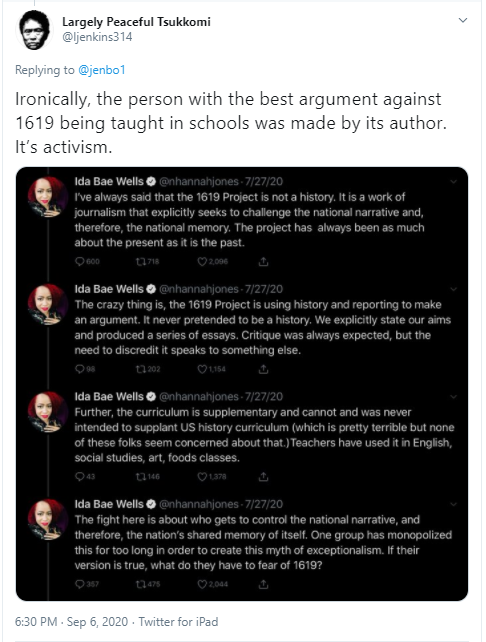
1619 is clearly a false history:

Here is one more Tweet: 1619 is clearly a false history:

The project has sparked criticism and debate among prominent historians and political commentators.[5][6] In a letter published in The New York Times in December 2019, historians Gordon S. Wood, James M. McPherson, Sean Wilentz, Victoria Bynum and James Oakes expressed "strong reservations" about the project and requested factual corrections, accusing the project of putting ideology before historical understanding.

John McWhorter summarizes some of the many problems with the 1619 project:

The New York Times’ 1619 Project is founded on empirical sand. The fundamental claim that the Revolutionary War was fought to preserve slavery simply does not correspond with the facts, too conclusively for the point to be dismissed as mere hair-splitting. The issue is not differing interpretations of history, but an outright misinterpretation of it.

Yet the project lives on. Its spearheaders blithely dismiss the charges of inaccuracy as mere natterings that at least verge on racism, while school districts nationwide eagerly received pedagogical materials based on the idea of offering students a fresh, revealing take on American history.

We must ask: Is there some broader aspect of the 1619 Project that justifies a certain slippage between its claims and actual fact? Just what does this project have to teach students? What does it have to teach us? And if the answer to those questions is “nothing much,” then how is it that brilliant, high-placed people can be so serenely unruffled in promulgating this material to innocent young minds?

In the end, the 1619 Project is more than a history lesson. It is founded on three basic principles, none expounded with a great deal of clarity, but all of them pernicious to a truly constructive black American identity.

...

To accept the implication of the 1619 ideology that heroic figures should be dismissed for not fully understanding the horrors of slavery, and that the American story is defined by nothing except the treatment of black people, would be to disrespect them as infantile minds. As such, we must evaluate the project on what it portends for forging socio-political change. Sadly, here the project would seem to yield nothing. A revivification of the reparations argument is longer on theatre than politics. The concern with whites understanding that “It isn’t our fault” may seem a form of political engagement but in fact is quite irrelevant to change in actual lives. . . . evaluated honestly, the 1619 Project is a kind of performance art. Facts, therefore, are less important than attitude. Hannah-Jones has predictably dismissed serious and comprehensive empirical critiques, as if for black thinkers, truth is somehow ranked second to fierceness and battle poses. For many, questioning the 1619 Project elicits irritation, of a kind that suggests personal insult rather than difference of opinion. This is because the 1619 Project is indeed all about personality, a certain persona that smart black people are encouraged to adopt as a modern version of being a civil rights warrior.

For this 2.0 version of civil rights warrior, authentic blackness, significant blackness, requires eternal opposition, bitter indignation, and claims of being owed. Whether all of this is rooted in reality in a way that can create change for actual human beings is of less concern than whether all of this is expressed, on a regular basis. It keeps The Struggle going, we are told.

Continue ReadingThe 1619 Project is Not History

The Problem with Stifled Dissent

Why should we care about suppressed and chilled speech on important issues of the day? Emily Elkins of the Cato Institute offers the statistics and a clear analysis in "Most Americans Are Scared Stiff to Talk Politics. Why?"

There are many reasons to resist this authoritarian urge to squash dissent. The first is that scientific progress, and by extension, the improvement of human well‐​being generally, requires free thought and open discourse. As Jonathan Rauch explains in his book, “Kindly Inquisitors,” the scientific method breaks down when people become reluctant to ask questions, be creative, challenge each other, and seek out and understand evidence.

Further, as Thomas Chatteron Williams explained in a New Yorker interview, the culture of canceling signals to people what the boundaries of “acceptable” ideas are or else suffer severe economic and emotional punishment. Thus many “steer far clear of the boundary,” causing a “narrowing…stifling effect on not just speech but on thought,” he explained.

Yet silencing people and stifling free thought isn’t an effective long‐​run strategy. It rarely changes minds. It just shuts down civil discourse and prevents people from having opportunities to modify their ideas in the face of new information. Instead, people hold onto their opinions, and just sweep them under the rug.

Political opponents’ disengagement doesn’t necessarily mean victory. Americans still vote. And their political views, silent or expressed, affect how they vote. Persuasion is necessary to change how people think and thus who and what they vote for. But persuasion is hard and requires open dialogue.

Social psychologists have found evidence that we aren’t very good at updating our opinions by ourselves. We need other people we respect to ask us to explain our views and then challenge us with new considerations. It’s typically through this back and forth process that we update our views when people we trust present us with new, compelling information.

But this only works when we feel comfortable to engage in a dialogue. Thus it is only with open dialogue that people’s opinions can be examined, understood, or reformed. Thereby, the best long‐​term strategy is persuasion, not silencing. And persuasion requires open debate.

Continue ReadingThe Problem with Stifled Dissent

Commonalities Between Woke Culture and Religion

From a recent article by psychologist Valerie Tarico titled, "The Righteous and the Woke – Why Evangelicals and Social Justice Warriors Trigger Me in the Same Way."

It occurred to me recently that my time in Evangelicalism and subsequent journey out have a lot to do with why I find myself reactive to the spread of Woke culture among colleagues, political soulmates, and friends. Christianity takes many forms, with Evangelicalism being one of the more single-minded, dogmatic, groupish and enthusiastic among them. The Woke—meaning progressives who have “awoken” to the idea that oppression is the key concept explaining the structure of society, the flow of history, and virtually all of humanity’s woes—share these qualities.To a former Evangelical, something feels too familiar—or better said, a bunch of somethings feel too familiar.

Tarico then lays out many of the similarities in detail. The similarities include:

Righteous and infidels

Insider jargon

Born that way

Original sin

Orthodoxies

Denial as proof

Black and white thinking

Shaming and shunning

Selective science denial

Evangelism

Hypocrisy

Gloating about the fate of the wicked

Continue ReadingCommonalities Between Woke Culture and Religion

“Race” is Like Astrology

The concept of using "race"--physical appearance--as a proxy for character is as absurd as astrology. I'm well aware that people look different from each other, but the concept of "race" is scientifically baseless. The concept of "race" embraces the logic of astrology: shoving individual people (each of whom is complex) into a handful of simplistic superficial categories and then drawing conclusions that are evidence-free (or often, contrary to evidence) based upon these unwarranted simplistic cartoon-like categorizations. The concept of "race" should be constantly ridiculed the same way that intelligent people ridicule astrology. Any attempt to classify another human being by "race" or birthdate is a lazy ham-handed anti-scientific and pernicious claim that one knows what it is impossible to know--the complexity of that human being--without investing time and effort to get to known them. That is the point of Morgan Freeman:

This enormous flaw with the modern use of the concept of "race" is a conceptual hole so vast that one could easily drive a truck through it. Yet the concept of "race" is rarely attacked at the root.  The first racist act is categorizing people by dividing them into simplistic categories such as white or Black. Without this first move, racism would be impossible.  What is especially distressing is that this widespread exuberant willingness to mis-categorize people into simplistic categories is embraced by both White Supremacists and those who claim to be seeking social justice by embracing critical race theory. These two groups are now in complete agreement that we can somehow know people merely by looking at their physical appearance.

There is only one way to get to know a person, and that is to take the time to learn about them, one by one, by talking with them, getting to know what they've done with their lives, reading about them or watching them interact with others. Complicating things, people change over time, so getting to know who they are requires non-stop effort.  Getting to know someone else requires careful consideration of real world facts and this takes considerable and concerted effort. Taking the time to get to really know other people before casting judgment on who they are is incompatible with making snap judgments but, as we are increasingly being tuned by social media, we are increasingly people who insist on making snap judgments.

Every day, "race" arguments wildly launch off into a thousand directions like fireworks. The basic premise of most of these arguments is the incoherent concept of "race," a concept so completely and irrevocably broken that most of these discussions are a waste of time before the discussion even begins. Imagine the time we could save--time we could redirect to working on solving the immense social problems that are very real indeed (many of them correlated to the physical appearance of groups of people)--if only we cut off most discussions of "race" at the root by calling out the invalidity of the concept of "race."

I will be writing more on this emotionally-charged topic in coming months. At this point I should make two things clear.

A) As I hope I've made clear, "race" is a irretrievably flawed pernicious concept. I believe that the concept of "race" should be thrown in the dustbin of history and we should all enter a new post-racial era. Unfortunately, other people continue to believe in the reality of "race." This idiotic willingness to divide complex people into simple colors makes racism possible. For this reason, I fully acknowledge the existence and destructiveness of racism. Many people mistreat others based upon physical appearance. To do this is unfair. It hurts people, sometimes badly, sometimes leading to deaths. Racism oppresses entire groups of people and has done so systematically over long stretches of time, through the entire history of the United States and many other places. Wherever we encounter racism, we should attack it vigorously in two ways: socially (by calling it out publicly and condemning those who mistreat other people in this way) and through the use of the legal system (e.g., through civil rights laws).

B) The concept of "race" itself is bad science, and this problem needs to be pointed out whenever discussing racism. Every single time.  Even young children know that "race" makes no sense but we socialize them to think otherwise. To fail to point out the absurdity of the concept of "race" whenever discussing racism will lead to more of the same. We will never be able to solve the "race" problem as long as we assume that there is such a thing as "race." One way to do this is to consistently put the word "race" in scare quotes, which is now my habit.  Every time we discuss "race," we need to call out that the the casual, unthinking idea that there is such a thing as "race" is reckless and dangerous. We need to constantly call out that it is impossible and destructive to judge other people by the use of immutable physical appearance. It is, indeed, as insane as believing in astrology, phrenology or palm reading. The unthinking use of the word "race" is utterly unscientific and destructive, even when used by well-intentioned people. The concept of "race" is a mental virus that hurts people and most of those who are infected are unable to see that they are infected. To use "race" uncritically (or "critically," as is de rigeour among the Woke) is to succumb to the banality of evil--unthinking destructive acquiescence to bad ideas.

In sum, racism exists because millions of misguided people believe in the incoherent and unsubstantiated notion of "race."  It will take great effort to break this bad habit because many well-meaning people who are (oftentimes heroically) fighting racism refuse to jettison the concept of "race."  Until large vocal swaths of society simultaneously and consciously embrace both A and B (above), racism will tear us apart.  I'm not optimistic.

Continue Reading“Race” is Like Astrology

The Best Kind of Free Speech is Antithetical to Cancel Culture

From FIRE's Website:

"FIRE is a free-speech organization, but we’ve always interpreted “free speech” to mean something larger, older, and bolder than just your legal rights. Given that we are also concerned with academic freedom, I’ve also focused on how to make discussions productive, and how to promote tolerance for people you disagree with. Of particular importance in higher education is determining how to keep an atmosphere of robust debate, thought experimentation, and innovation alive and healthy.

From a very early stage, FIRE advocated for what could roughly be called a “culture of free speech,” where we seriously consider the ideas most opposed to our own, debate and persuade those who disagree with us, consider people’s intentions, and give space for error and forgiveness when faced with mistakes. This is the antithesis of cancel culture, which attempts to reduce individuals to a singular offensive statement or action, remove them from mainstream society, and inflict grave social costs on anyone who might defend them."

What can you do to promote these ideas? Read "What you can do right now to help protect you or your campus from cancel culture." at the same website.

Continue ReadingThe Best Kind of Free Speech is Antithetical to Cancel Culture