
About Honey Badgers

Amazing footage of honey badgers:
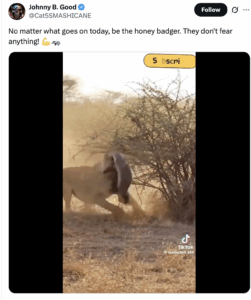
I asked Grok about their fearlessness:

Honey badgers (Mellivora capensis), also known as ratels, have earned a legendary reputation for their fearlessness, often described as one of the toughest and most aggressive animals in the wild despite their relatively small size—typically weighing 20-35 pounds and measuring about 2-3 feet long. This boldness stems from a combination of physical adaptations and behavioral traits that allow them to confront much larger predators and threats without hesitation.One key factor is their thick, loose skin, which acts like natural armor. This rubbery hide is resistant to bites, stings, and even arrows or machetes in some cases, enabling honey badgers to shrug off attacks from lions, hyenas, leopards, or venomous snakes.

The looseness of the skin also lets them twist around in a predator's grip to counterattack, turning defense into offense. They're equipped with powerful jaws capable of crushing tortoise shells or bones, sharp claws for digging and fighting, and a ferocious bite that they use relentlessly.

Behaviorally, honey badgers display an almost reckless aggression. They don't back down from confrontations, often initiating fights with animals many times their size, such as African rock pythons or even packs of wild dogs. This is partly due to their solitary, nomadic lifestyle and a diet that includes dangerous prey like cobras and beehives—hence the "honey" in their name, as they raid hives fearlessly despite thousands of stings, thanks to a partial resistance to bee venom. They also have a high pain tolerance and can endure severe injuries, sometimes continuing to fight even after being bitten by venomous snakes, as they possess some immunity to certain toxins.

When threatened, they emit a foul-smelling secretion from anal glands to deter enemies, much like a skunk, and produce loud, intimidating growls or screams. This combination has led to honey badgers being named the "World's Most Fearless Creature" by the Guinness Book of World Records, a title that captures their indomitable spirit in folklore and viral videos alike.

However, their "fearlessness" isn't mindless; it's an evolutionary strategy for survival in harsh African savannas, where they have few natural predators as adults. While they can be aggressive when cornered or protecting food, they're not always seeking conflict—much of their boldness comes from necessity rather than choice.

Continue ReadingAbout Honey Badgers

People Tend to Value Pets More than They Value People

I've often assumed that many people have pets instead of riskier potentially unmanageable children.  And sometimes I've assumed that many people cherish pets more than they cherish people.  If a dog and a person fell overboard and you could only save one, who are you going to save?

Now we have this study: "Pet owners often see dogs as soulmates and value them more than human lives."

Abstract:

Dogs have ascended to core family members in American households. Across three studies, we show that modern dogs now occupy roles historically reserved for close human relationships and often receive greater moral concern than people. Approximately three out of four dog owners view their dogs as primary sources of emotional support and companionship, and this “soulmate” bond is associated with a tendency to prefer and prioritize dogs over people. Childless dog owners are especially likely to view their dog as a soulmate, and national and county-level analyses further reveal that declining birth rates are strongly associated with increased pet-related spending. This suggests that dogs may fulfill caregiving roles once reserved for children and close kin. To assess the implications of this shift, we presented dog owners with moral dilemmas pitting the welfare of dogs against humans. Owners who viewed their dogs as soulmates were more likely to feed, fund, and save the life of a dog over a person. More than half of dog owners chose to save their dog over a human stranger, one in five chose to save an unfamiliar puppy over a person, and one in four chose to give money to a puppy in need over a child in need. The moral elevation of dogs may reflect—and potentially contribute to—declines in human social connection.

Is there a downside to this pet worship?

This same study points out:

While dogs may seem easier than human relationships, favoring them could come at the cost of human connection. Research suggests that social connection can be zero-sum; forming deep bonds with some often results in less concern for others. Reflecting this phenomenon, owners strongly bonded to their pets often socialize less, opting instead to stay home with their pets.

Increased attachment to dogs may also have ethical consequences. Animals, especially dogs, are frequently cast as helpless victims and receive greater concern than vulnerable humans. Many report feeling more distress for dogs than for adult people, and dog owners in particular often prioritize their pet over a human stranger in life-or-death scenarios.

Continue ReadingPeople Tend to Value Pets More than They Value People

About Rattlesnakes

Did you know this about rattlesnakes?

In one study published in the journal Biology of the Rattlesnakes, Morris rigged up a fake leg to test what happens when humans step on a rattlesnake. The results? Most of them either slithered away, froze or wriggled in place. Of the 175 stepped-on snakes, only six struck the leg's boot and just three of them went into a coil position.

Continue ReadingAbout Rattlesnakes