Exhibit Opening: “Cast and Recast: St. Louis Type Past and Present”

Place: Gallery 210, University of Missouri, St. Louis: 1 University Blvd, St. Louis, MO 63121 (it’s in the same building as the UMSL Police Department).

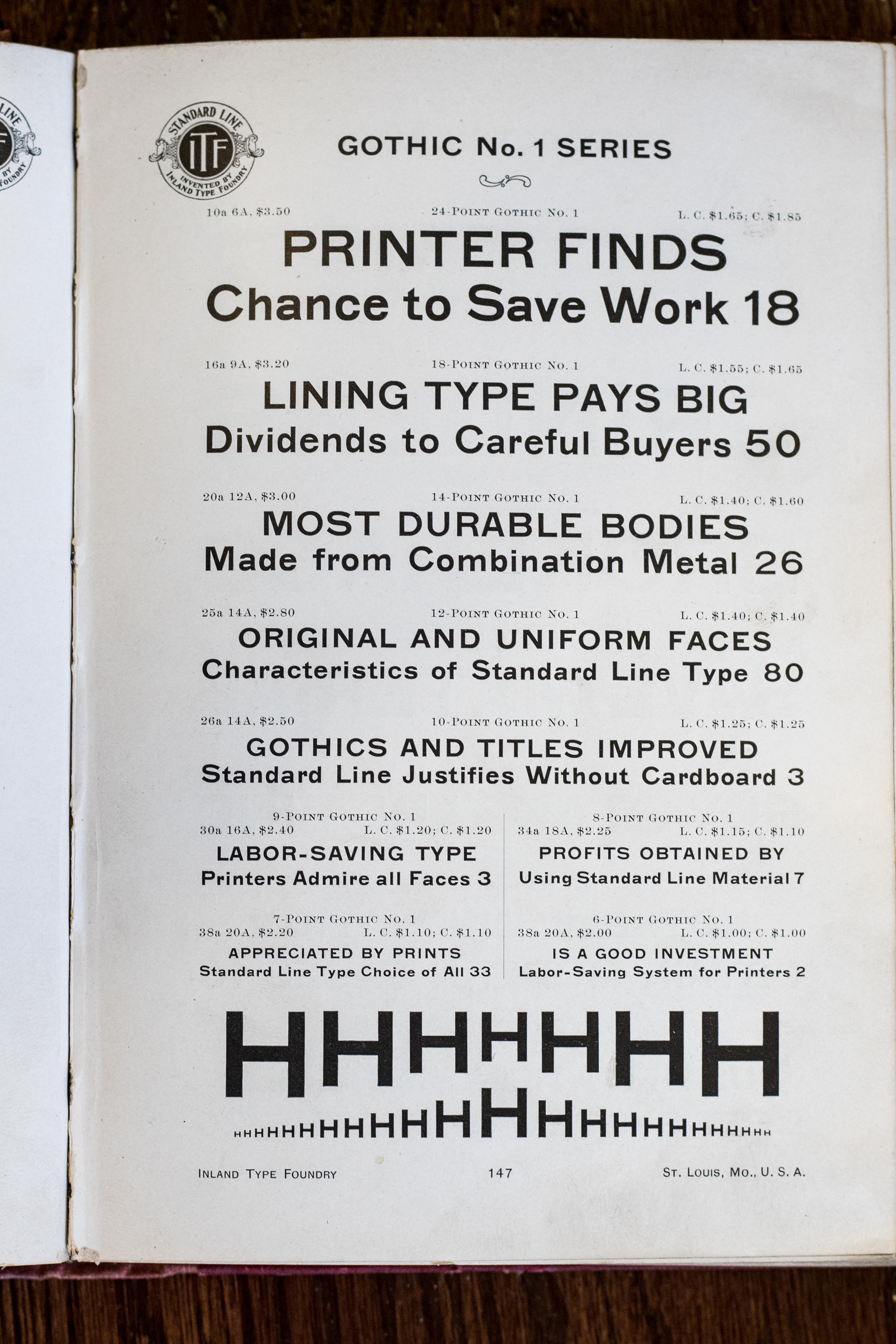
Opening: Saturday, March 19, 2016 from 5pm to 7pm. Exhibit runs through June 25, 2016. The story of St. Louis type design closely mirrors the history of graphic design in the United States. This exhibit is the story of a public thirsty for high quality printed words, and the technology and design advancements that responded to this thirst. Type was cast in St. Louis foundries and sent to printers to the west and south, along with shipments of printing equipment. This exhibit also is the story of businesses realizing that better advertisements increased profits. You will also learn of the rise of "art printing," which later becomes Graphic Design and Printing. Also featured is the public's delight with beautiful new typefaces that responded to contemporaneous fashions. The typefaces featured in this show were designed in St. Louis for Central and Inland Type Foundries by talented artisans drawn from the printing and engraving industry.
GN6A9020 Recast

Continue ReadingExhibit Opening: “Cast and Recast: St. Louis Type Past and Present”

Why the Milgram subjects acted heinously

A recent article in Scientific American explains the biology of why people are so willing to follow orders: Milgram's research tackled whether a person could be coerced into behaving heinously, but new research released Thursday offers one explanation as to why. In particular, acting under orders caused participants to perceive…

Continue ReadingWhy the Milgram subjects acted heinously

Post-Citizen’s United Confessions of a retiring member of the House

"A fund-raising consultant advised that if I didn’t raise at least $10,000 a week (in pre-Citizens United dollars), I wouldn’t be back." There it is: the most important task for members of the house of representatives, according to this NYT article by Steve Israel. It gets even worse: There were hours of “call time” — huddled in a cubicle, dialing donors. Sometimes double dialing and triple dialing. Whispering sweet nothings and other small talk into the phone in hopes of receiving large somethings. I’d sit next to an assistant who collated “call sheets” with donor’s names, contribution histories and other useful information. (“How’s Sheila? Your wife. Oh, Shelly? Sorry.”) . . . I’ve spent roughly 4,200 hours in call time, attended more than 1,600 fund-raisers just for my own campaign and raised nearly $20 million in increments of $1,000, $2,500 and $5,000 per election cycle. And things have only become worse in the five years since the Supreme Court’s Citizens United decision, which ignited an explosion of money in politics by ruling that the government may not ban political spending by corporations in elections. Title of the article: "Confessions of a Congressman."

Continue ReadingPost-Citizen’s United Confessions of a retiring member of the House

Health insurance no longer effective safety net

I often wonder about studies showing that Americans are spending less on health care. It seems to me that many of us are now buying cheaper health policies with huge deductibles, then putting off health care because much of it is coming out of pocket. This NYT article was thus interesting to me.

The number of uninsured Americans has fallen by an estimated 15 million since 2013, thanks largely to the Affordable Care Act. But a new survey, the first detailed study of Americans struggling with medical bills, shows that insurance often fails as a safety net. Health plans often require hundreds or thousands of dollars in out-of-pocket payments — sums that can create a cascade of financial troubles for the many households living paycheck to paycheck. These financial vulnerabilities reflect the high costs of health care in the United States, the most expensive place in the world to get sick. They also highlight a substantial shift in the nature of health insurance. Since the late 1990s, insurance plans have begun asking their customers to pay an increasingly greater share of their bills out of pocket though rising deductibles and co-payments. The Affordable Care Act, signed by President Obama in 2010, protected many Americans from very high health costs by requiring insurance plans to be more comprehensive, but at the same time it allowed or even encouraged increases in deductibles.

Continue ReadingHealth insurance no longer effective safety net