Psychics Failed to Predict the 2020 Pandemic

What if, on Dec 31, 2019 you interviewed the 100 most prominent self-described psychics, astrologers and fortune tellers and asked then to tell you what the biggest thing in the world would be over the next year. I suspect that none of them would have mentioned a pandemic. I haven't done the research, and I don't know who the best-known psychics are, but I do know that "Psychic Nikki" struck out.  None of these Vox writers got it right, probably because they are not professional psychics. Sylvia Brown is causing a stir among those fans who only look at the parts of the pandemic that she got right.  And I see that Psychic Rick Tobin made his predictions about the pandemic on March 24, 2020.

Continue ReadingPsychics Failed to Predict the 2020 Pandemic

What to Say When You Notice Someone Sneezing in the Age of COVID-19

The traditional response to noticing another person sneeze has never worked well for me. Why would I invoke the name of a deity in such a situation?

Even if a such deity actually existed, why would he/she/it/they care about someone sneezing? Path dependance explains a lot of things we do and the "God Bless You" people often say (often with a concerned look) is one of those many things we do merely because we've always done it that way. 

COVID-19 has made our concerns about sneezing much more legitimate. I noticed this yesterday while I was outside in my backyard (alone) eating pretzels. I had a mouthful of pretzel when I had a strong urge to sneeze came upon me. Maybe God made me do it. I didn't hold back, even with my mouth filled with mostly-chewed pretzel. It was a world class sneeze, I can proudly say, but it was also a science experiment. I watched as the pretzel particles sprayed several feet from me. If I were contagious, that would have been pretzels AND COVID-19 micro-particles and I assume that the virus would have sprayed even much farther than the pretzel dust. This was a visual reminder that it is good advice to sneeze into your elbow these days, if you can't hold back your sneeze while with others.

I've had long been puzzled about the traditional sneeze response ("God bless you"). A bit of research today showed me that the phrase might have first been uttered around 600 A.D. to try to protect people from the plague.  For many years, however, we've used that same expression when there was no fear of any plague.  

In modern pre-COVID times, however, the phrase has been an overly-quaint response to a perfectly natural and harmless bodily action, especially around allergy season. Sneezing is one of those fascinating complex series of coordinated actions that our bodies do (along with swallowing, vomiting, and orgasms) where our animal bodies seem to take on a life of their own for a short period, independent of our control once they reach the point of no return.

But what, exactly, is it that a God would supposedly do by "blessing" me following a sneeze? The obvious answer (it would seem) is to help me to stop sneezing in the future. Armed with this speculative conclusion a few years ago, I asked my nephew Dan whether he could help me with a new logical yet pretentious thing to say to a person who just sneezed. Dan had recently majored in Latin as well as computer science. His suggestion was to say: "Consiste sternuere!" He assured me that this phrase is Latin for "Stop sneezing!"  If you say this phrase with a stern face, carefully pronouncing each syllable, it might appear (to certain credulous people) that you are saying something useful and that you might even be wielding other-worldly powers.

If you are interested in joining me to help to make this new cutting edge expression viral, simply utter "Consiste sternuere!" instead of "God bless you." It is pronounced. ConSIStay stern-you-AIR-eh.

Thank you, Nephew Dan.

Continue ReadingWhat to Say When You Notice Someone Sneezing in the Age of COVID-19

Bill McKibben: COVID-19 Is Presenting Us With an Opportunity to Reconceptualize Our Social Lives

It's awkward to discuss silver linings while so many people are suffering and when things might get much worse before they become better. That said, COVID-19 appears to be presenting us with an opportunity to reboot how we should be interacting with each other. Bill McKibben discusses this opportunity at Yale365:

[As Society Reopens], we might actually find ourselves embracing gregariousness. In truth, we began social distancing a long time ago. First came the move to the suburbs: In the postwar years, America spent the bulk of its prosperity on the task of building bigger houses farther apart from each other. This caused environmental woes — all those big houses to heat and cool and migrate between — but it also meant that we simply ran into each other less. The average size of a new house has doubled since 1970, even as the number of people living in it has steadily shrunk — the average density of most recent housing developments is about two people per acre, down from about 10 persons per acre for cities, suburbs, and towns in 1920. Between 1974 and 1994 the fraction of Americans who said they frequently visited with their neighbors fell from almost a third to barely a fifth. That number has kept dropping, now less because of suburbanization than because of screens: If you look at teenagers, for instance, a wild behavioral shift is noticeable beginning about 2012 when the numbers of Americans with a smartphone passed the 50 percent mark. The number of young people who got together with their friends in person every day dropped by 40 percent from 2010 to 2015, a curve that seems to be accelerating according to Jean Twenge, a psychology professor at San Diego State University.

Photo by Erich Vieth

Continue ReadingBill McKibben: COVID-19 Is Presenting Us With an Opportunity to Reconceptualize Our Social Lives

You Are a Pulsating Universe

Human animals are amazing on many levels. Have you recently contemplated the beauty of your hand? Have you marveled at the fact that you can open it, grab something tightly, sense temperature, gently touch your lover's hair? And if you burn it or bruise it, it will usually heal all by itself. All of those things are so natural that it's easy to forget how miraculous hands are. You would never be able to create a device that replicates all of these extraordinary functions.

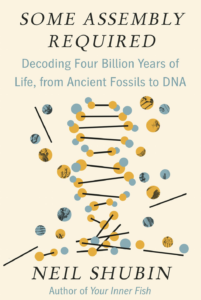
But let's dig a bit deeper by reading Neil Shubin's new book,Some Assembly Required: Decoding Four Billion Years of Life, from Ancient Fossils to DNA (2020).  The hand is made of cells, and there are parts to each of those cells, and the genetic code for you can be found in each of those cells.  But how does that information contained in your DNA become you?  How is it possible for your genetic blueprint to build and maintain your body?  Shubin's book describes this process beautifully.  I offer the following excerpt.  If this kind of writing inspires you like it does me, I urge you to obtain a copy of Some Assembly Required and find a quiet place to allow your DNA powered body to read your biography. This book is about inspiring science and scientists, but it is, at bottom, about who you are.
New microscopes that allow us to see DNA molecules themselves also let us see what happens as genes turn on and off. For a gene to become active, a molecular game of Twister needs to happen. Inactive regions of the genome are tightly coiled upon themselves, bundled around other small molecules to fit inside the nucleus. These regions are closed off and so are relatively inert. Before a region of the genome can become active, it needs to uncoil and open itself up to make a protein. These are only the first steps in a finely choreographed dance that turns genes on and off. For a gene to activate, its switch needs to contact other molecules and attach to an area adjacent to the gene itself. . . .

So here are the full steps of the dance that goes on when genes turn on: the genome opens, revealing the gene and its control region, parts attach, and a protein is made. This happens in every cell, with every protein. A six-foot-long string of DNA is coiled until it is smaller than the size of the head of a pin. Conjure the image of it opening and closing in microseconds, writhing and turning to activate thousands of genes every second. From the moment of conception and throughout our adult lives, our genes are continually being switched on and off. We begin as a single cell. Over time, cells multiply, while batteries of genes are activated to control their behavior to form the tissues and organs of our bodies.

As I write this book, and as you read it, genes are switching on in all four trillion of our cells. DNA contains many supercomputers’ worth of computing power. With these instructions, a relatively small parts list of twenty thousand genes can build and maintain the complex bodies of worms, flies, and people using control regions spread across the genome. Changes to this incredibly complex and dynamic machine underlie the evolution of every creature on Earth. Always coiling, uncoiling, and folding, our DNA is like an acrobatic maestro, a conductor of development and evolution.

Shubin, Neil. Some Assembly Required (p. 73).

Continue ReadingYou Are a Pulsating Universe