Read more about the article Wilfred Reilly is Keeping Score on those Twitter “Conspiracy Theories”
Wilfred Reilly: Twitter's Shadow-Banning Exposed

Wilfred Reilly is Keeping Score on those Twitter “Conspiracy Theories”

Wilfred Reilly is a fact-driven political scientist. And I'm referring to old-fashioned kinds of facts. I have followed him for several years and I enjoy his comments and candor. At The National Review, Reilly recently commented on the supposed conspiracy theories involving Twitter, which repeatedly denied that it was shadow-banning users:

What is newsworthy, however, was that the Big Lie of information neutrality was just that: a lie. Probably for decades now, conservative and heterodox thinkers have been called weird paranoids for doubting “the science ™,” “the experts,” “the trends,” “the (new) dictionary definitions,” “what the search results obviously show,” and so forth. We now know that those lonely cynics were largely correct: the Great Barrington Declaration and the Hunter Biden laptop, among many other things, never “trended” because they were not allowed to. More broadly, almost all of the information we see on a daily basis is greatly shaped by the people who allow access to it. This is not a “conspiracy theory” — it is a fact.

Definitely don’t stop tweeting and searching and reading the morning paper with your eggs — but also never forget that fact, consider the DuckDuckGo option that actually shows you all of the results, and remember also that libraries still exist. And, if I can give one last piece of takeaway advice in this first column: Buy a hard-copy dictionary and encyclopedia from before about 2012, and never let those bad boys go.

Continue ReadingWilfred Reilly is Keeping Score on those Twitter “Conspiracy Theories”

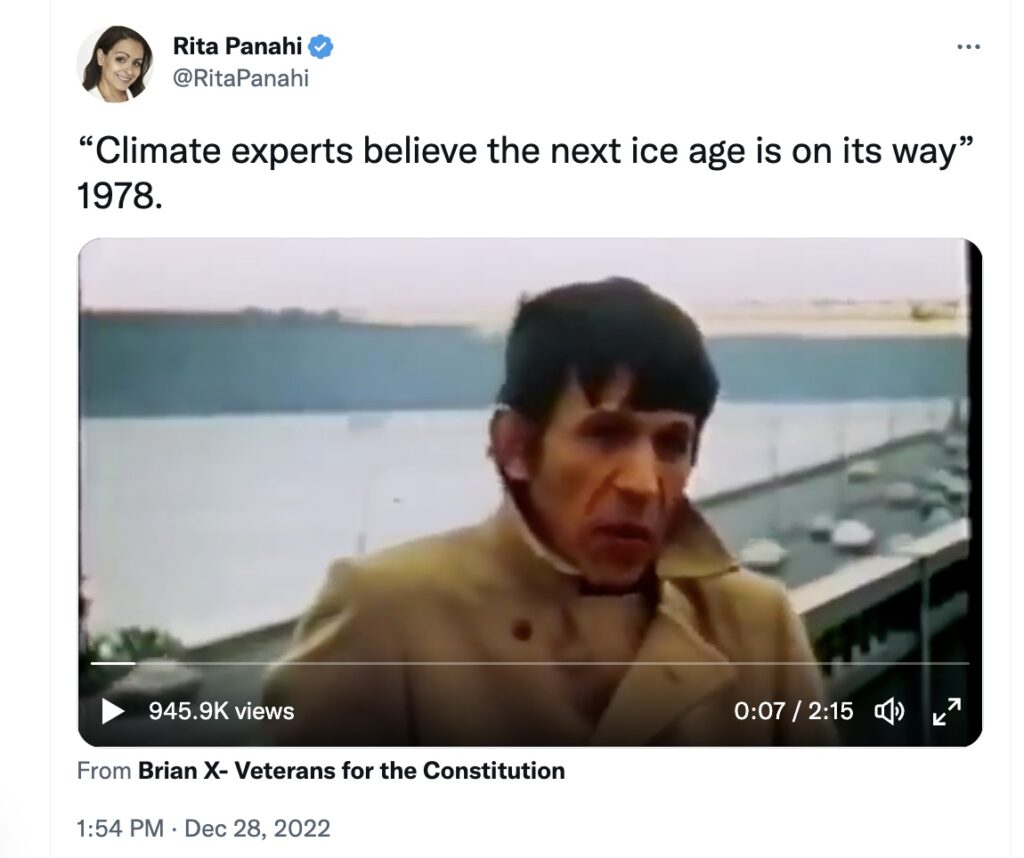
Leonard Nimoy’s 1978 Warning: The Imminent Ice Age

Things looked icy and bleak in 1978. But then it didn't happen, like so many other things that have been predicted. What is the lesson we can learn from this failure? When we make predictions regarding complex adaptive systems, perhaps we need more humility. Perhaps we shouldn't act like we are sure of things when we aren't.

Continue ReadingLeonard Nimoy’s 1978 Warning: The Imminent Ice Age

The Hate Speech Exception to the First Amendment

Contrary to the title of this post, there is no hate speech exception to the First Amendment.

FIRE explains

There is no “hate speech” exception to the First Amendment. So, many Americans wonder, "is hate speech legal?"

Contrary to a common misconception, most expression one might identify as “hate speech” is protected by the First Amendment and cannot lawfully be censored, punished, or unduly burdened by the government — including public colleges and universities.

The Supreme Court of the United States has repeatedly rejected government attempts to prohibit or punish “hate speech.” Instead, the Court has come to identify within the First Amendment a broad guarantee of “freedom for the thought that we hate,” as Justice Oliver Wendell Holmes described the concept in a 1929 dissent. In a 2011 ruling, Chief Justice John Roberts described our national commitment to protecting “hate speech” in order to preserve a robust democratic dialogue:

Speech is powerful. It can stir people to action, move them to tears of both joy and sorrow, and—as it did here—inflict great pain. On the facts before us, we cannot react to that pain by punishing the speaker. As a Nation we have chosen a different course—to protect even hurtful speech on public issues to ensure that we do not stifle public debate.

In other words, the First Amendment recognizes that the government cannot regulate “hate speech” without inevitably silencing the dissent and dialogue that democracy requires. Instead, we as citizens possess the power to most effectively answer hateful speech—whether through debate, protest, questioning, laughter, silence, or simply walking away.

Continue ReadingThe Hate Speech Exception to the First Amendment