From a friend of mine:
You know how every once in a while you come across a piece of writing that is spot-on, so much so that you sit back and think, “Wow, that really captures it well.” This just happened to me in reading Halberstam’s book, War In A Time Of Peace (2001). Here’s the quote:
“(In 1992) Ed Rollins, the former Reagan political consultant, had an epiphany about how dramatically American culture had changed in the twelve years since Reagan’s first election. Driven by various technological, social, and economic forces, that change was now being seen in American politics. Reagan, Rollins believed had been the final political reflection of the popular culture of his time, derived primarily from the movies of John Wayne, Jimmy Stewart, and Gary Cooper days when the American self-image called for one lonely man to stand up and do the right thing, whether it was popular or not. That self-image during the Cold War was comforting; it might not be true, but as they used to say in the west, when there was any difference between the truth and the legend, print the legend. Clinton, by contrast, was the political extension of a new popular culture, the age of empathy television, symbolized by Oprah Winfrey, the need to feel better about yourself in a difficult, emotionally volatile world where the greatest daily threat was posed not so much by the nuclear warheads of a foreign power, or by severe economic hardship, but by the inner demons produced by an unhappy childhood” (p. 108)
Reading this quote brought to mind George Lakoff's two basic ways of portraying government which, in both cases, is metaphorically conceived as a family. Conservatives see government as run by a strict father figure while Progressives tend to see government a nurturing parent. Here's a excerpt from
Wikipedia:
Lakoff argues that the differences in opinions between liberals and conservatives follow from the fact that they subscribe with different strength to two different metaphors about the relationship of the state to its citizens. Both, he claims, see governance through metaphors of the family. Conservatives would subscribe more strongly and more often to a model that he calls the "strict father model" and has a family structured around a strong, dominant "father" (government), and assumes that the "children" (citizens) need to be disciplined to be made into responsible "adults" (morality, self-financing). Once the "children" are "adults", though, the "father" should not interfere with their lives: the government should stay out of the business of those in society who have proved their responsibility. In contrast, Lakoff argues that liberals place more support in a model of the family, which he calls the "nurturant parent model", based on "nurturant values", where both "mothers" and "fathers" work to keep the essentially good "children" away from "corrupting influences" (pollution, social injustice, poverty, etc.). Lakoff says that most people have a blend of both metaphors applied at different times . . .

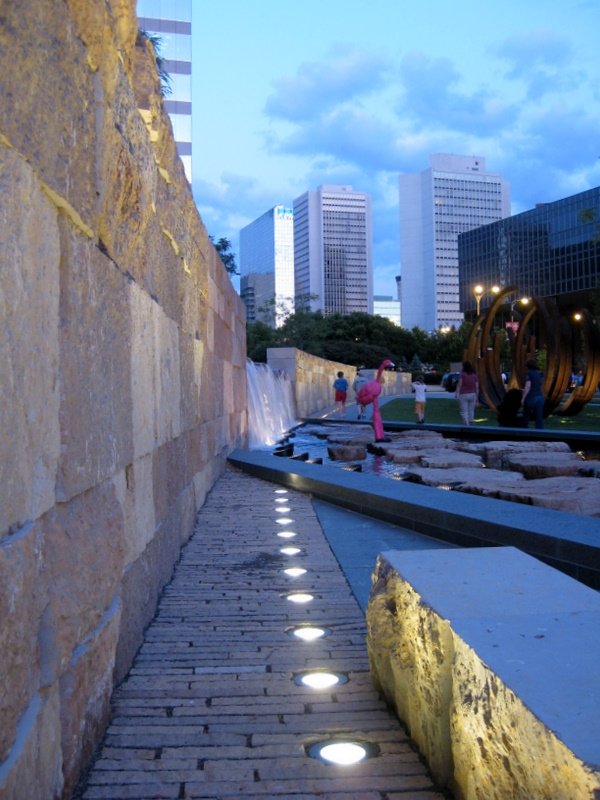 What used to be a bunch of office buildings (many of them less than inspiring) were transformed into a deeply beautiful and light-hearted extension of "City Garden," a modern sculpture park occupying two city blocks. I probably took about 150 photos tonight, but I'll give you my favorite 16 [If you don't see the gallery, click here ].
I'm shaking my head, thinking that the creators really nailed it. In my mind, the function of art is to challenge but to also draw an audience. This new park has succeeded in transforming dozens of sterile buildings into the all-too-willing background for a place that beckons people of all ages to come play, to walk, to talk, to ponder, to touch the sculptures and to stand back and admire.
[Epilogue 7/9/09: City Garden has turned out to be a powerful people magnet. Works of art draw in people, who draw in more people. It is truly one of the most remarkable transformations to hit downtown St. Louis. What used to be two big starkly empty lots is now a comfortable and beautiful place, open every hour of every day, for people to view the sculptures, to find themselves and to find each other. A big congratulations to the Gateway Foundation!]
What used to be a bunch of office buildings (many of them less than inspiring) were transformed into a deeply beautiful and light-hearted extension of "City Garden," a modern sculpture park occupying two city blocks. I probably took about 150 photos tonight, but I'll give you my favorite 16 [If you don't see the gallery, click here ].
I'm shaking my head, thinking that the creators really nailed it. In my mind, the function of art is to challenge but to also draw an audience. This new park has succeeded in transforming dozens of sterile buildings into the all-too-willing background for a place that beckons people of all ages to come play, to walk, to talk, to ponder, to touch the sculptures and to stand back and admire.
[Epilogue 7/9/09: City Garden has turned out to be a powerful people magnet. Works of art draw in people, who draw in more people. It is truly one of the most remarkable transformations to hit downtown St. Louis. What used to be two big starkly empty lots is now a comfortable and beautiful place, open every hour of every day, for people to view the sculptures, to find themselves and to find each other. A big congratulations to the Gateway Foundation!]