
Daniel Dennet discusses “The Computational Perspective” to evolution

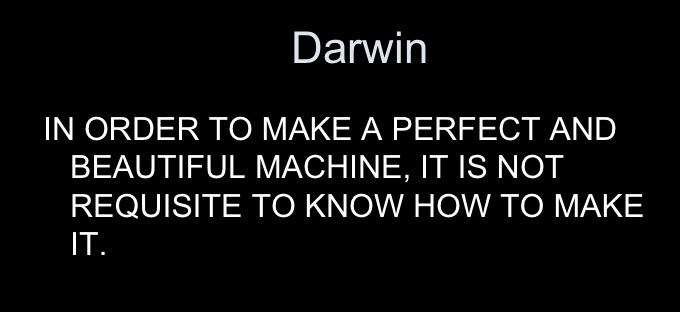
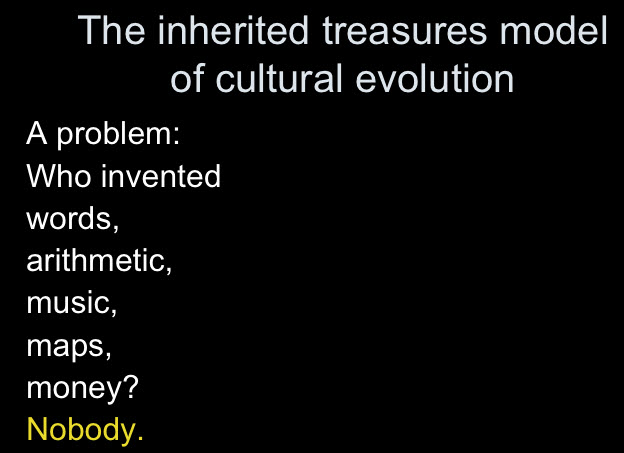
Edge.org recently posted Daniel Dennett's discussion of "The Computational Perspective." At the linked site, you'll find the video of Dennett's lecture, along with Dennett's PowerPoint slides. Dennett's focus was whether things that are more complex can result from less complex things. Dennett assures us that the answer is yes, and that this is exactly what Darwin demonstrated. darwin-insight-we-dont-need-to-know-how-to-make-machines This same principle was demonstrated by Alan Turing: turing-insight The net result is "competency without comprehension." For the second half of his talk, Dennett applied this same principle to the magnificent aspects of human culture, including the words of our languages, which have "tremendous replicative power." culture Dennet concludes that humans are the effect of the purposes of life, not the causes. We tend to project our views back onto nature, and we have the capacity to "discover the reasons everywhere in the tree of life." Looking forward, we are also "the first intelligent designers of the Tree of Life." At the this same page at Edge.org, you can also view 45-minute lectures regarding evolution by Alvaro Fischer, Leda Cosmides, John Tooby, Steven Pinker, Matt Ridley, Helena Cronin, Nicholas Humhrey, Ian McEwan.
Continue ReadingDaniel Dennet discusses “The Computational Perspective” to evolution

History of Thrifty

If you want to study the history of thriftiness (and the lack thereof), check out "Saving Yourself," an article by Daniel Akst that appears in the Wilson Quarterly. One of the key figures in Akst's article is Thorstein Veblen:

Thorstein Veblen, the peripatetic Norwegian-American economist (he died in 1929, shortly before the great crash that might have brought him grim satisfaction), is best known today for his theory of conspicuous consumption, which argued that a lot of spending is just a wasteful attempt to impress. In effect, Veblen explained consumerism in terms of status and display, bringing evolutionary ideas to bear on economics and consumer behavior to powerful effect. Reading Veblen is a little like reading Freud or Darwin, albeit on a smaller scale: Do so and you’ll never look at the world in quite the same way again. As you might imagine, the iconoclastic Veblen took a dim view of all the conspicuous consumption around him, regarding it as a species of giant potlatch in which competitive waste had run amok. You might call Veblen’s the voice of thrift, and it is still heard today from leftist intellectuals who, from their tenured pulpits and Arts and Crafts homes, reliably denounce the spending of others. The truth is that nobody listens to these people, except to submit to their periodic floggings as a kind of penance for sins we have no intention of ceasing.
Where are we now? Akst points out some good news:
Conspicuous consumption, like tobacco, has fallen into social disrepute, a change that removes some of the pressure felt by many families to keep up with the Joneses (who may well have been foreclosed by now).
Akst ends his article with lots of avuncular advice on surviving our current and future materialist downsizing. A lifetime thrifty person, Akst is not pessimistic: "Thrift is far from the worst thing we can have thrust upon us."

Continue ReadingHistory of Thrifty

Burning American tax dollars to incarcerate Canadian seed sellers

We're about to spend hundreds of thousands of American dollars incarcerating a Canadian who was busted for selling marijuana seeds. He never set foot in the United States, but he's being extradited. Who did he hurt?

"There isn't a single victim in my case, no one who can stand up and say, 'I was hurt by Marc Emery.' No one."
Here's the conclusion of an article by Ian Mulgrew of the Vancouver Sun:
Emery is facing more jail time than corporate criminals who defraud widows and orphans and longer incarceration than violent offenders who leave their victims dead or in wheelchairs. Whatever else you may think of him — and I know he rankles many — what is happening to him today mocks our independence and our ideal of justice.
Emery's crime is so incredibly serious that he would have spent an entire month in a Canadian prison for his crime. But, apparently, we have nothing better to do with American tax dollars than incarcerating people who sell marijuana seeds to people who want to buy them.

Continue ReadingBurning American tax dollars to incarcerate Canadian seed sellers

Michael Moore: The current proposals can’t fix health care

Michael Moore gives 13 reasons why the current proposals don't get to the heart of the problem. His conclusion:

We may be slow learners, but the rest of the industrial world has figured it out: Universal, single-payer or national health care systems. That's the reason why all those other countries cover everyone, have better patient outcomes, cause no one to declare bankruptcy or lose their homes because of medical bills, and spend less than half per capita on health care than we do. We could do it too, by reducing the starting age for Medicare from 65 to 0. There's still time to act.

Continue ReadingMichael Moore: The current proposals can’t fix health care

The need to really look at the evidence in Iran.

Amidst new reports that Iran has not been forthcoming about its nuclear program, Glenn Greenwald urges that we do what the Chinese are doing, as reported by the NYT:

The Chinese, one administration official said, were more skeptical [of recent reports], and said they wanted to look at the intelligence, and to see what international inspectors said when they investigated.

What Greenwald is suggesting is common sense. He might need to repeat his advice endlessly, though, because we live in a country where the gold standard for the news media is hyped up conflict and because we are a country that doesn't seem to "get" common sense anymore.

Continue ReadingThe need to really look at the evidence in Iran.