
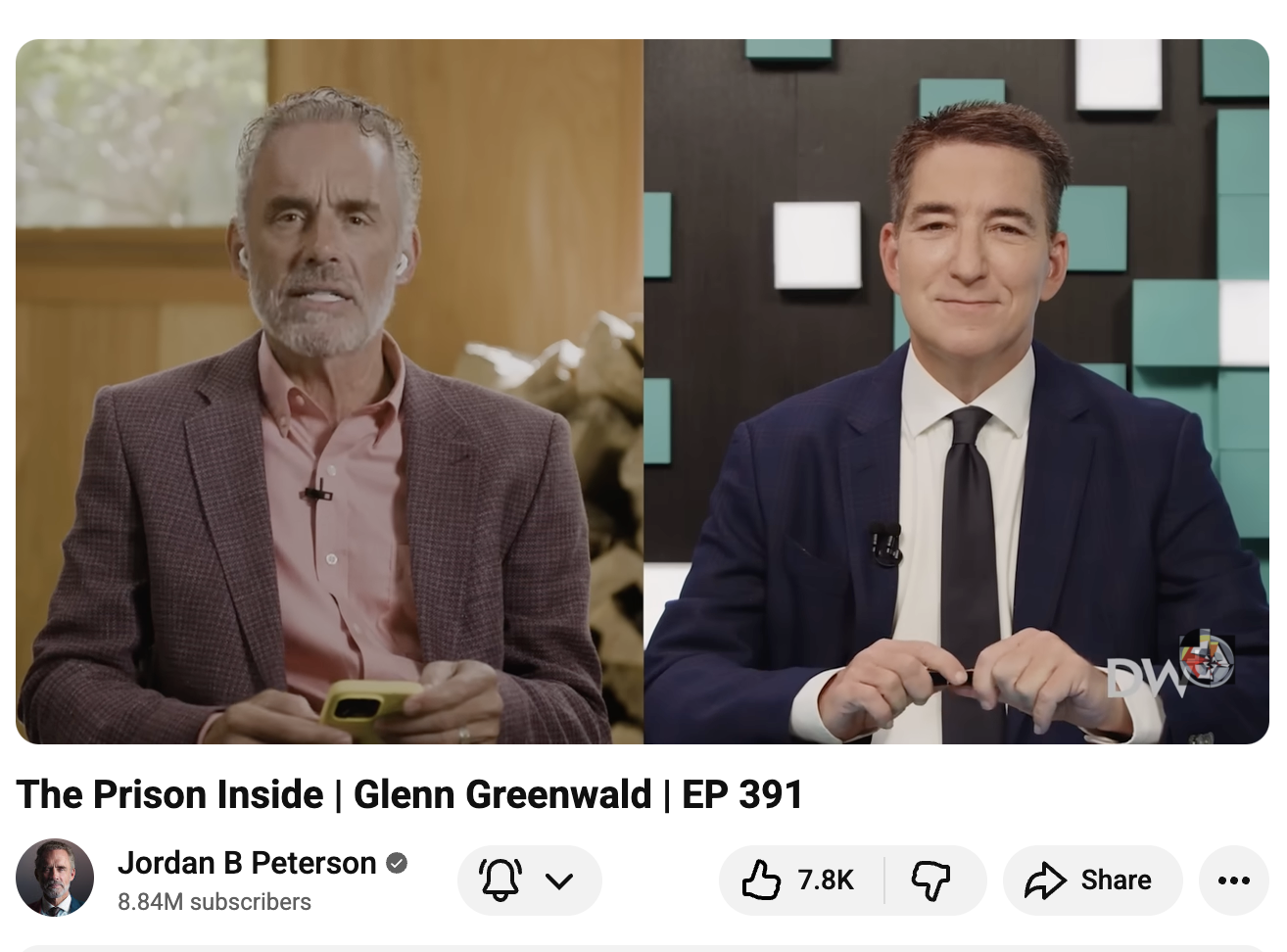
I’ve listened to this podcast several times. It’s long, but it is extremely thoughtful, engaging, disturbing, but also hopeful and celebratory of the human spirit. It involves Jordan Peterson and Glenn Greenwald. These are two of my most cherished thinkers. I am inspired and provoked by many of the topics that they explore here. Topics include censorship, propaganda, the history of these things in the United States. Also, the relationship between religion and politics, and what goes wrong when religion is absorbed into politics. And there’s even some meaning of life moments. I took the time to transcribe a large chunk of this discussion, and I am sharing it with the hope that those of you who listen to it or read it will also find it worthwhile.
I asked Grok to crank out a basic table of contents to this interview:
Min 21:30
1
Glenn Greenwald
Censorship of RFK Jr. by Google and the tactic of starting with hated figures like Alex Jones
2
Glenn Greenwald
Expansion of censorship to mainstream voices, including Devin Nunes and Rand Paul
3
Glenn Greenwald
Reasons for increasing censorship: Generational shifts in values among Millennials and Gen Z, and the impact of Trump’s election
4
Glenn Greenwald
Depiction of Trump as an existential evil justifying extreme measures, including the Hunter Biden laptop scandal and Sam Harris’s views
5
Jordan Peterson
Connection to post-9/11 clampdown on civil liberties, transformation of airports into authoritarian spaces
Min 27:35
6
Glenn Greenwald
Reflections on 9/11 trauma, the war on terror, and how airport security conditioned obedience to authority
7
Jordan Peterson
Threats to liberty from fear rather than greed; free speech as equivalent to free thought and essential for adaptation
8
Glenn Greenwald
George Orwell on tyranny through mind control; the internet’s shift from liberation to control, Snowden revelations
9
Jordan Peterson
Biblical phrase “render unto Caesar”; collapse of religious domain into politics leading to unsophisticated good vs. evil wars
10
Glenn Greenwald
Personal background on religion; hubris in censorship; human need for spirituality, politics as a substitute for religion
11
Jordan Peterson
Discussions with Douglas Murray on humanism needing a religious framework; Carl Jung on rationality bounded by the dream
12
Glenn Greenwald
Grappling with ethics and morality without religion; necessity of spirituality to avoid nihilism
13
Jordan Peterson
Response to materialist atheists; human relationship with the larger whole; introduction to the story of Abraham
These excerpts start at Minute 21:30 of the above video.
Glenn Greenwald
20% of Democratic Party voters say they intend to vote for RFK, Jr. for president. And the most powerful corporations, or one of the richest and most powerful corporations ever to exist, Google sweeps in and says, This is something that you are not permitted to be heard.
Glenn Greenwald
And what happened was, what always is the tactic of sensors is they always pick a test case in the beginning that they believe is someone who is sufficiently hated or disliked so that everybody will acquiesce to the precedent, simply because their emotions for that person are so high. So the first person to really be deplatformed in this collusive effort by Silicon Valley was Alex Jones. And Peter Thiel was on the board of Facebook at the time. Mark Andreessen in Silicon Valley, and a few other people stood up at the time and said, no matter how much you hate Alex Jones, this precedent is going to work its way slowly, or maybe not even so slowly, to expand into the kinds of voices that you probably think shouldn’t be censored. And by the point that you cheer the precedent in the first instance, because you allow your emotional dislike for this person to outweigh your rational capacities, it will be too late the precedent is already implemented, and then you’re left to just bicker about its application, rather than the principle itself.
Glenn Greenwald
And that’s precisely what has happened. They began quickly censoring mainstream conservative voices. Devin Nunes went to rumble in part to escape from Google censorship, and then a huge stream of people did as well. One of the most shocking things that happened along those lines, Rand Paul questioned a couple of epidemiologists, scientists who were testifying before the US Senate about the possible efficacy of ivermectin and other alternative medication for covid. It was a Senate hearing, a hearing in the United States Senate. Rand Paul put it on his YouTube channel as a excerpt of this hearing, and Google decided that was something that ought not to be heard as well.
Glenn Greenwald
So as for the question of why this is happening. Think it’s twofold. I think one is that millennials and now Gen Z are very much steeped in the idea that the gravest danger is not empowering centralized authority to dictate what we have to think and what we can and can’t hear, but instead is the danger that comes from ideas that they dislike. And as you said, it is true a lot of times the ideas that are being censored are ideas held by the majority. I still regard them, though, as marginalized ideas, because what matters more than the numbers is often who’s in power. And the elite people, who are the guardians of elite discourse, have views that are increasingly at odds with the majority of the population. And those are the views that get passed on as from on high as kind of the mandated orthodoxy. And the views held by the majority of people end up being treated as marginalized or dissident views that get silenced simply by virtue of the fact that the majority has no power and the elite has so much power.
Glenn Greenwald
So I think part of it is just this generational cultural sense that began with millennials, has gotten worse with Gen Z. If you look at polling data, you see this clearly, that free speech is not really a paramount value anymore, that there are other values in their views that outweigh free speech or the right to have debate and be heard.
Glenn Greenwald
But I really think the accelerant to everything was the election of Donald Trump. I think Donald Trump’s election was such a gift to the American establishment because it enabled them to depict Donald Trump, not as what he was, which is a continuation of the American tradition as a symptom of the failures of the neoliberal elite, of the anger that neoliberalism has produced all around the world.
Glenn Greenwald
They instead depicted him as this kind of singular, unprecedented evil, this never before encountered menace and threat to all things decent, including democratic values. And if you can convince people that they’re not just engaged in ordinary political conflict, but instead kind of an existential, overarching, historic battle of good versus evil, kind of like giving it religious overtones, which is what our politics has, has absorbed.
Glenn Greenwald
On some level, everything and anything becomes justifiable in the name of prosecuting that cause. And a lot of people got convinced that the evils of Trump and his movement were so overarching that everything had to be thrown out the window, the role of journalism, the virtue of free speech, the idea of due process, they really believe they’re they’re confronting this insurrectionary, criminal fascist movement that wants to install a white supremacist dictatorship.
Glenn Greenwald
This is how they think and if you convince enough people of that, and that is what the elite class really believes. I don’t think they’re pretending to believe that. I think they genuinely believe that. They’re constantly reinforcing each other in this sort of herd behavior. It is not that far of a leap then to start saying things like, well, however bad censorship is, or however bad disinformation is, or however bad punishing people is without due process, the threat that we’re combating is even worse, and therefore the means just the ends justify the means.
Glenn Greenwald
You probably saw that Sam Harris video that went viral where he was asked about the Hunter Biden disinformation campaign that emanated from the CIA. They just lied to the public and said that Hunter Biden’s laptop was Russian disinformation. It came from the CIA. Corporate media repeated it. Big tech adopted it. It was a massive scam that they perpetrated on the American public right before the 2020 election, one of the biggest journalistic scandals, I think, in the history of our country. And when Sam Harris was asked about that being the kind of cogent candid thinker he is, he essentially gave voice to the idea that I still think the evils of Trump outweigh everything. That even lying in censorship of that kind is justified in the name of the cause of stopping Trump, and I think that has become the predominant ethos of our elite class, and that’s where the censorship support is coming from.
This part of the transcript starts at Minute 27:35 of the video:
Jordan Peterson
Do you see it as well as part of the cascade of processes that began to make themselves manifest after 911 and this is partly when you got interested in the clamp down on civil liberties. And you know, one of the things that I observed at that time, which I don’t think has gone away in the least, was the transformation of airports into micro fascist states. And I thought that was a really bad idea, because by treating everyone like a potential perpetrator, which is exactly what’s happened in the airports and has never gone away, you essentially train people to adopt that mindset. Because everybody goes through airports and once it’s okay there, well, then why isn’t it okay everywhere? I mean, there’s lots of buildings in the UK now where you basically have to undergo an airport style search before you go into the building. And of course, you have to do that in many of the government buildings in Washington, which also think is an appalling idea, so is there an additional thread that’s promoting this top down, clamp down. That do you think is a consequence of what occurred after 911 Yeah,
Glenn Greenwald
I think it’s a really important observation. I was in Manhattan on 911 I lived and worked in New York at the time. I remember, as well as anybody, the vividness of that trauma. It was a very traumatic event. It was frightening, it was terrible. I understand that people’s fears were activated in a way that made them be willing to support things they never would have supported otherwise. I ended up supporting things that I ordinarily would have recoiled from, like most people in the United States did. It’s just that, even with the war on terror, even with an attack that cataclysmic, that just wiped out 3000 lives and one of the most horrible ways imaginable. I think while the extremism that emerged from that, I remember Newt Gingrich wrote an article in 2006 advocating the first amendment be amended to constrict free speech in the name of stopping Muslim extremism, or whatever he was calling it, jihadism or Sharia law, those ideas ultimately didn’t go as far as they might have, because the sense of what American democracy means kind of got reawakened.
And I think people did start drawing lines, and President Obama ended up winning in 2008 on a pledge to close Guantanamo and reverse the kind of more extremist measures of the war on terror, even though he did none of that. That was what his campaign that was successful was based on. But I think what you’re saying about the airport is exactly right, if you go look at the debates and the 90s, after the Oklahoma City bombing, the bombing at the Oklahoma City courthouse that Timothy McVeigh was convicted of perpetrating. There was an attempt by the Clinton administration to usher in a lot of these same extremism measures that ended up being implemented after 911 they wanted, for example, the keys to the internet, a back door to all of the encryption used by the Internet and the Republican Party, including people like John Ashcroft, who became George Bush’s Attorney General in the wake of 911 and the champion a lot of a lot of these similarities assaults led the way and said, We’re not giving the federal government the ability to read our communications, to spy on our conversations. This is too anathema to the American way of law. Life, and so quickly after 911 the exact same faction in the Republican Party and American conservatism traumatized by the attack on 911 again, for understandable reasons, but ultimately went so far in implementing what became an authoritarian mentality.
And if you go to the airport, of course, all of us now are so acclimated to it. It seems normal. But the idea that everybody just so dutifully takes off their shoes and takes off their belt, and the climate there is you just do what you’re told. You know, it’s kind of, it seems trivial, and it’s the form of, it’s a kind of petty authoritarianism. No one’s being imprisoned for it, no one’s being shot. But what it is is all it’s almost more insidious because of that, because exactly as you say, it started conditioning people that, in the name of safety, we need to unquestioningly obey authority, kind of submit to whatever humiliations, whatever orders we’re told to do, and to watch the American conservative movement that was so steadfast In their opposition to the idea of federal government power in the 1990s immediately turn around and start meekly taking off their shoes at airports and doing everything that they were told and going through these machines in the name of safety. I think was was quite transformative, and I do think it started training Americans to accept the kinds of infringements on their autonomy in the name of safety that even just a couple of years earlier would have been unthinkable.
Jordan Peterson
Well, you know, I think maybe the critics on the left, I’ll specify them to begin with, have always been concerned that the fundamental threats to liberty, and let’s say equality would emerge as a consequence of greed and the desire for power, you know, and it’s obviously the case that there are valid criticisms that can be levied against gigantic organizations that tilt towards regulatory Capture, with regards both to their greed and their desire for undeserved power.
Jordan Peterson
But I think that the left has radically underestimated the threat that fear poses to liberty, and I guess that’s probably true of the right as well. And and what what you’re laying out is a case where the excuse for interfering with fundamental liberties is always something like a higher or is very frequently something like a compassionate concern for safety. And so maybe it’s the Neo Nazis that we have to be afraid of, or maybe it’s the Muslim jihadists and or maybe it’s the bloody pandemic, or maybe it’s the looming environmental apocalypse, but there’s always some terrible catastrophe that’s looming so intently that this is finally the time when an assault on our civil liberties to be can be justified. And my sense of that is that the reason we made these rights axiomatic, or actually the reason they are axiomatic, not that we made them that way, is because there isn’t any circumstances under which there’s a better approach than to leave people to hell alone, to let them say what they need to say. And that’s partly because, you know, one of the things I think conservatives do extremely badly is to try to protect free speech, as if it’s just another freedom. You know, it’s like a hedonic freedom. Well, of course, you get to say what you want to say, because you want to say it, and it’s, you know, you enjoy it, and it’s annoying not to be allowed to say it.
Jordan Peterson
And that’s not really the issue here at all. The issue is that, for most people, there’s no difference between speaking and thinking. Even for that small number of people who can, in fact, think, and that’s actually quite rare, most of those people think by speaking. They just speak internally. I mean, you can speak, you can think in images too, but really detailed thought really requires words, and so freedom of speech is exactly equivalent to freedom of thought. And the reason that you think is so that you don’t do stupid things carelessly, right?
Jordan Peterson
Alfred North Whitehead famously said that we think so that our thoughts can die instead of us. And If thought is the process by which we renew our misapprehensions and adapt to the world at large and transform our institutions, if you interfere with free speech, you Doom your institutions to stagnation and corruption. And so then you have to say, Well, if you’re going to be afraid, let’s say you’re afraid of the coming environmental apocalypse. You might want to be equally afraid of the measures that people take to deal with that Apocalypse that are going to interfere with freedom of speech, because that’ll interfere with our ability to adapt, and that’ll be far worse than anything we can conjure up on the environmental front. And so I think that’s part of the reason that these rights are self evident, right? Is that the whole bloody game will grind to a halt if we ever allow them to be interfered with. And that means ever. And that basically means your neurotic catastrophe is not sufficient justification for your desire to infringe on my free speech. I don’t care what your bloody emergency is.
Glenn Greenwald
You know, I think this is something I’ve come to conceptualize better over the years, and it’s very much based in the psychological dynamic you’re describing. George Orwell has this Preface. I believe it was 1984. I mean, I don’t remember the exact details now and originally when the book was published without the preface, was intended for the preface, ended up not being published. It was right around the time of World War Two, and it was kind of considered heretical, because its argument was that we think about tyranny in these melodramatic terms. Despotism means that if you say something against the government, armed men in black suits, black costumes show up at your house and put guns to your head and haul you off to prison, when in reality, the much more effective kind of despotism is not the use of brute force in that way. It’s really the transformation of the mind. The prison ends up being something that’s constructed inside of your brain through extremely effective propaganda, which in turn requires that that propaganda never be questioned.
Glenn Greenwald
If you can control a population based on how they think, you essentially eliminate the possibility of dissent. So you can make dissent on paper legally permissible, but anyone who does dissent will be so instantaneously marginalized because of the efficacy of propaganda that it’s a much more effective way of controlling human beings, because you’re controlling the thoughts that they have. And that, in turn, requires the ability to ensure you control the flow of information.
Glenn Greenwald
And this is the thing that I find so alarming. If you go and look at the literature in the mid 1990s about the advent of the internet, I think people in Silicon Valley really had this libertarian ethos. They thought they were actually producing a technology that was going to be revolutionary. The spirit behind it was we’re going to emancipate people from centralized state and corporate control. They’re going to be able to communicate. People are going to be able to communicate with one another without relying on the mediation of giant corporations, which, in turn, are controllable by this state. It was kind of this wild West Frontier, free of control, free of regulation.
Glenn Greenwald
And when I worked with Edward Snowden, and we did the Snowden reporting in 2013 in the archive that he provided to me. As I began to look at it, revealed that, in fact, the internet had become the exact polar opposite. It had become the single greatest means of coercion and control ever invented in human history, because the ability to control the flow of information and to monitor whatever all of us are doing, not just what we’re doing in terms of where we’re going, but in terms of what we’re reading and what we’re saying in private, or what we think is In private, and therefore what we’re thinking, what kind of personality is shaping us, and the ideas that are motivating us, and then the ability that is accompanied by that knowledge, to be able to then control and manipulate, creates this kind of closed propaganda system that is infinitely more powerful than, say, having a Stasi that is able to read everybody’s mail in East Germany, or have their neighbors report on them.
Glenn Greenwald
In fact, during the Snowden reporting, there were ex-agents of the Stasi who were saying, This enables the state to do things we never dreamed of being able to do. You know when it was why? I don’t know if you remember, but there was one of the reports was about how the NSA was spying on Angela Merkel, at the time, the Chancellor of Germany. She grew up in East Germany under the Stasi behind the Iron Curtain. And she was particularly enraged by it. By all accounts. She called Obama in a rage and said essentially that this is what the Stasi tried to do, and technologically, were kind of impeded from doing. There were workarounds to it. If you were a dissident in East Germany, there were dissidents behind the iron curtain in Soviet communism, whereas this kind of makes it impossible.
Glenn Greenwald
And increasingly, what’s relied on is, as I was saying earlier, I think these elites who believe that Trump is the singular evil, that everything is justified in the name of stopping him. I say they genuinely believe it, because even people who are reasonably intelligent, who have been educated, all of that, are very prone to propaganda.
Glenn Greenwald
Propaganda is a weapon that has been developed over many decades that is designed to cater specifically to what our needs. are psychologically. It creates a reward system, a punishment system. It’s very powerful. I think all of us probably have the experience of having been propagandized in one way or the other, when we come to realize we believe something that we’ve never really critically assessed, that we’ve kind of just absorbed in the ethos.
Glenn Greenwald
I know I’ve had that experience many times before, and I think that is really what the censorship regime is about. It’s not necessarily to punish dissidents, although that is part of it. It’s really to ensure that people are only getting exposed to a flow of information that serves the interest of a small elite, so that you don’t have to kill and punish dissidents. You just eliminate dissent and the few people who are for whatever reason, kind of resisting it, end up just so marginalized that it doesn’t matter anyway. And on some level, it’s almost better to have them, because it casts the illusion that there’s still some lingering freedom.
Jordan Peterson
I’d like to share with you some thoughts I’ve been developing, and you tell me what you think about them, okay? I’m still working this out. So you know, there’s a gospel phrase that you’re to render unto Caesar, what is Caesar’s? And unto God, what is God’s? And one of the ideas there, is that there are separate conceptual domains for different kinds of concerns, and that the and so the way I read that, at least in part, I’ll tell you a backstory. Now and then, when I was working as a clinician, I would have clients tell me things that were truly terrible, like multi generational, murderous, terrible, you know, long family histories of hidden sexual abuse, lies so deep that you can hardly imagine them way out on the pale beyond the pale, right?
Jordan Peterson
For me, that was the land of good and evil. And one of the things that would happen if I was discussing things that were deeply affecting enough to give the people who had had the experience of Post Traumatic Stress Disorder is that the the tenor of the conversation and the language itself would almost inevitably become religious.
Jordan Peterson
And it helped me understand that part of what religious language does is enable us to conduct a dialog about about what’s truly malevolent, right? Beyond the political and so. And that made me wonder. If the religious collapses so that you can no longer render unto God. What is God’s let’s say, because that entire belief system disappears, then maybe everything that should be attributed to God, so to speak, is now played out in the political realm. You get a collapse of the religious into the political. And the reason that that’s a catastrophe is because then you can no longer conduct the political as political.
Jordan Peterson
It degenerates into a war of good against but also a very, I would say, unsophisticated war. So I’ll just close with this, and then you can comment, if you would. So one of the things that happens as the Judeo Christian corpus of what would you say of conceptualization of good and evil. As it develops, the notion is, is that spiritual battle between good and evil is something that should be conducted on an individual basis and within. So that if you want to constrain evil. You don’t search for it in the external world, because that can make you a persecutor and an accuser. You attempt to bind its manifestation in the confines of your own life. And that’s partly what takes it out of the political realm.
Jordan Peterson
And so if you don’t do that, and it collapses into the political then you start looking for demonic enemies everywhere to account for malevolence. And the problem with that is that it turns you into a sensorial, self-righteous persecutor. Now, you wrote a whole book about, you know, the good versus evil mentality destroying the Bush presidency, and you talked about the religious overtones that are associated, for example, with with justification of censorship on the oh my god, this is finally the apocalyptic threat basis. Like I’m curious about what you think of the conceptual scheme that I just laid forward that we need a language for dealing with good and evil per se and a separate political language. And if we don’t keep those separate, well, one collapses into the other. It doesn’t disappear.
Glenn Greenwald
Yeah, you know, it’s interesting. I as I listen to that, you know, I mean, I grew up without a lot of religion, like many people days in the West do. My grandparents were steeped in Judaism, but it wasn’t very extreme. It was more cultural, I would say, than religious. My parents less so. And then by the time we got to my brother and myself, it was almost non existent.
Glenn Greenwald
And, you know, like in early adulthood, I kind of considered that a source of pride, like so many people do. It’s some hallmark of sophistication and modernity that you’ve discarded these archaic conceptions. And we’re now advanced and all of that. And obviously technologically, we are more advanced than the generations that came before us.
Glenn Greenwald
But I think a lot of times with that comes a certain hubris that because we’re more technologically advanced, it means we’re more advanced in every way. And one of the things that I have worked hard is to lose that hubris. And I think you know for me, when I see people who believe in censorship, believe in the idea that certain views are so wrong they that it ought to be prohibited. To me, what’s driving that, more than anything, is hubris, because the whole history of humanity is error. What is considered proven truth in one generation is then regarded as grievous error the next.
Glenn Greenwald
That’s true across every field of discipline and morality and ethics, and the idea that somehow we have escaped from that, and we are now no longer prone to error, that we have apprehended truth that is just so absolute that no one should be even allowed to question it is just never an impulse I ever have. And I believe in a lot of things passionately, very strongly. It’s not like I walk around doubting everything. I just never would find the level of arrogance to believe that my convictions, even the ones I hold most strongly, are so self evidently and permanently true that any questioning of them should be prohibited, barred.
Glenn Greenwald
And I think hubris is at the root of that. I think the same is true with the idea of religion, there is a reason, I think, that human beings, across millennia and across culture and across every other conceivable line, have sought out religion. I believe it’s something we need. It’s intrinsic to us, whether you want to call it religious or spiritual. However you describe it, it’s something that is a part of us and that we’re going to seek out, one way or the other, because it, I believe, is a human need.
Glenn Greenwald
It’s something I’ve started looking for myself as I get older. Now that I have kids. It’s something that has become a bigger part of my life. And if you don’t have that in the form that people have traditionally had it, with the established religions of Judaism or Christianity or Islam or Hinduism, or even smaller more more modern religions like Mormonism, I think people are going to find a way to express that. And these days, they use politics as their vehicle for it.
Glenn Greenwald
And that is what’s so dangerous, is exactly what you’re describing, because the fanaticism and the faith and the righteousness that comes from that religious and spiritual expression can be extremely dangerous if imported into politics, which as you say, for me, this religious and spiritual exploration is about what we do internally. How we understand ourselves and our relationship to the universe, and whether there’s something bigger than ourselves and our purpose. It’s a very introspective and personal endeavor.
Glenn Greenwald
Whereas politics is about wielding power in a way that controls and influences the lives of other people, and if you import this religious component into it and cease having empathy for other people’s experiences and ideas and [you] just are always convinced that whoever is on the other side of your tribe is intrinsically evil and you’re intrinsically good, again, it’s going to devolve into that ends justify the means mentality and in politics that is historically an extremely dangerous way of navigating the world.
Speaker 1
I’ve been talking to Douglas Murray about this topic quite extensively, I would say, over a number of years. And Douglas was raised in a more religious family than you were a Christian family, and his parents were avid church attenders, but he dispensed with all of that and toyed for a while even with explicit allegiance with the, you know, with the Hitchens, Dawkins, Harris, crowd, Dennett as well, the four Horsemen of the Apocalypse. But Douglas has become more convinced that the humanist endeavor cannot maintain its ethos without it being embedded in an underlying, let’s say, narrative metaphysics, which is, for all intents and purposes, a religious framework. And the religious framework. Work also no it, it always borders on the transcendent and the unknowable. I suppose that’s a good way of thinking about it.
Jordan Peterson
So Carl Jung thought, for example, the psychoanalyst, he sort of believed that our rationality was necessarily bounded by the domain of the dream, right? If you think about how we adapt to the world, we have our explicit ways of representing the world that can be encapsulated semantically, and those would be our stateable propositions. But that’s never complete, right? And so outside of that is everything we don’t know. And from the perspective of Jung and the psychoanalysts who adopted his viewpoint, the dream was the mediator between what we knew explicitly and what we did not yet know. It was a buffer zone, and the the transcendent characters of the dreamscape were essentially deities and religious figures.
Jordan Peterson
And that strikes me as correct. I think that’s in keeping with how we what we now understand about how the brain functions and about how we process information when we first come across it as anomalous, for example, but it does beg the question, you know, Douglas has told me pretty straightforwardly that he thinks that any ethical system that Isn’t grounded in a transcendent metaphysics, whatever that means, is going to degenerate into a propagandistic ideology and well, I’m wondering like, are those thoughts that you said that you’ve been seeking more now at this stage in your life than you had been previously? Do those sorts of reflections ring true to you? Or do you? Do you see a flaw in that line of reasoning?
Glenn Greenwald
So this is an idea I have grappled with a lot. I think a lot of people who pass through a kind of atheistic passage in life, have had to grapple with it as well. I remember being something even going back to studying philosophy in undergraduate school, was always a question, which is, if you believe there’s nothing to life but our material existence that is finite, that we’re born and then we die, and that’s the end of everything. There’s no greater power. The challenge is, how do you have any kind of an ethics or a morals that make any sense?
Glenn Greenwald
If all there is is materiality, it seems like you could justify being driven by nothing other than material gain and no basis for any kind of ethical or moral constraints, since that’s what religion has typically offered. That there’s a God, that there’s a morality and or an ethics that they pass down. And if you remove that, what is the basis for this ethical code, or for this morality?
Glenn Greenwald
And I do think I even remember when I was so sure of myself my early 20s, finding that a uncomfortable and difficult question, because it is not an easy one to answer. And I think as I’ve gotten older, I’ve also started viewing spirituality and religion, and I kind of use that interchangeably, as necessary for a complete human existence.
Glenn Greenwald
And I know that has become the foundation for my own ethics, from my own morality, the sense of empathy and compassion that you have for other people, my view that that becomes a necessity to honor that, to be guided by it. And I do really wonder how it’s possible if you live your entire life without that to avoid turning to nihilism.
Glenn Greenwald
I think a lot of people do turn to nihilism when Western society tells them there is nothing spiritual or religious that’s valid, and we see it in all the mental health indices. As you know better than anyone, in terms of the data you’ve studied and talked a lot about just kind of a lack of purpose and higher meaning that people are left with in their lives when you strip away everything other than material existence.
Well, the the materialist atheist types, I suppose, would object and and I try to make the argument as powerful as possible, that just because you come up with a hypothetical practical necessity for a certain kind of belief–let’s even call it a certain kind of delusion or illusion, right? That that doesn’t justify the hypothesis of something supernatural or transcendent.
Jordan Peterson
But I would respond to that perhaps as follows. The first is, is that we have some relationship with the whole because we’re a part of a larger whole. And we don’t know what that relationship is, but there has to be some relationship. And I suppose your relationship with that larger whole, you know, existence as such, could be positive or negative, and it’s conceivable at least, that that’s a decision of faith.
Jordan Peterson
You know whether you’re going to act in accordance with the principle that being itself is essentially good, and to try to understand from that what ethical obligations that lays on you. But I’ve also been going through the biblical corpus, trying to understand, in some ways, what it means to believe in a transcendent relationship, and so I’ve been writing about the story of Abraham. So let me just tell you what I’ve found in that, and you tell me what you think about that . . .

