
What else did we think we knew for decades that now turns out to be bullshit? The the most important lessons we are being taught over the past five years are A) the inextricably fraught relationship between knowledge and power and B) the critical need to be courageous and skeptical whenever we try to make sense of the things of the world in order to swat away the oftentimes insidious power of tribalism.
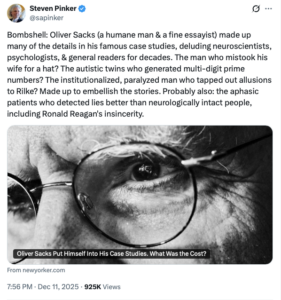
Steven Pinker:
Bombshell: Oliver Sacks (a humane man & a fine essayist) made up many of the details in his famous case studies, deluding neuroscientists, psychologists, & general readers for decades. The man who mistook his wife for a hat? The autistic twins who generated multi-digit prime numbers? The institutionalized, paralyzed man who tapped out allusions to Rilke? Made up to embellish the stories. Probably also: the aphasic patients who detected lies better than neurologically intact people, including Ronald Reagan’s insincerity.
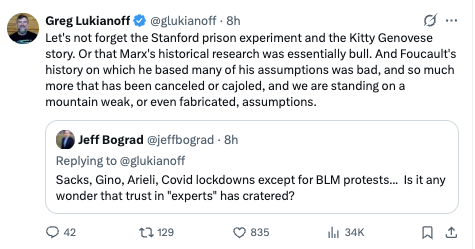
Let’s not forget the Stanford prison experiment and the Kitty Genovese story. Or that Marx’s historical research was essentially bull. And Foucault’s history on which he based many of his assumptions was bad, and so much more that has been canceled or cajoled, and we are standing on a mountain weak, or even fabricated, assumptions.
[Comments to Greg’s post on X]
“Sacks, Gino, Arieli, Covid lockdowns except for BLM protests… Is it any wonder that trust in “experts” has cratered?”
“Don’t forget “men can be woman” or “sex is a spectrum””
“Believing in expertise is not the same thing as Believing in the honesty of experts.”
[Supp Dec 21 2025]
The biggest issue in this whole Sacks debacle isn’t how he hurt me (and, I’m sure, countless others) as a writer. It’s that he hurt the field of medicine by popularizing and solidifying into medical fact things that were, in reality, fabulation…
Oliver Sacks wrote that he was guilt-stricken at what he had done: “Guilt has been much greater since ‘Hat’ because of (among other things) My lies, falsification.” And yet to me, those expressions of regret seem hollow and self-serving. Just look back at that original confession that the stories he wrote are half-imagined, half-fable, look at how elegantly he slides in the fact that they have “a fidelity of their own” (emphasis mine). His imagination, he seems to say, is still true to life. Dr. Sacks could perhaps have uses a refresher on what the word fidelity actually means.
What’s more, he goes on to say, his drive stems from good things, not from, “a shallow place, such as a desire for fame or attention”—as if that somehow excuses the end results. Because he thought his motives pure, he seemed to exonerate himself. A sort of ends justifying the means. The rationalization of his not-quite-non-fiction writing as a victimless crime.
You know what you do if you actually feel guilt and believe you did something wrong? You make it right. Not by talking to your shrink, but by issuing a mea culpa and telling the world that what they think is nonfiction is in fact fable, by telling the medical community that the reason they can’t replicate your cases is that you made shit up.

