
Greg Palast Discusses the Many Big Problems with Mail Voting

Greg Palast is keeping me up at night. Here's an excerpt from his discussion with Mike Papantonio:

Papantonio: Let’s start with the elephant in the room, the vote by mail. A lot of developments there in the past few days. Tell us what this administration's done and give us the whole Greg Palast vote by mail 10,000 foot, so we can move on to the next question. What's your take?
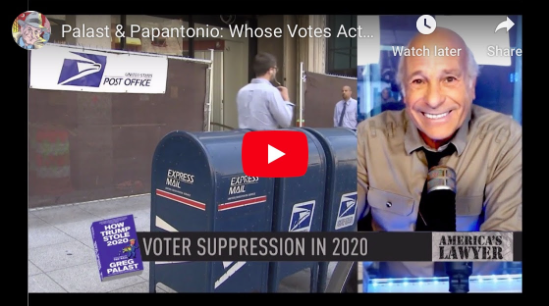
Palast: Wow. Okay. Here's the problem. 22% of all mail in ballots don't get counted. That's an MIT study. That's not Greg Palast. A one in five ballots is junked. Now, how does that happen? One in 10 people never get their ballot who've asked for them. By the way, that’s why we had those long lines in Georgia, those are African Americans in Atlanta who never got their mail in ballots, but it requested them. Including, by the way, the husband of the head of the ACLU in Georgia. So people don't get their ballot, that's number one. And number two, once you send them in, one in 10 is junked for any type of reason. Anyone can challenge your ballot in America. They don't like your signature, you didn't put your middle initial when you signed and you registered with the middle initial. Postage due cost a hundred thousand votes in 2016. 3.3 million ballots in 2016 that were mailed in were never counted…

Papantonio: What we have here is an election that's tightening up. The Democrats thought they had the leisure of Biden's double digit lead. It's shrinking as we speak. It’s shrinking in states that really matter, swing States. But the Democrats, I literally heard James Carville say, well, Biden can just stay down in the cellar and he's going to win this election. Doesn't that sound a lot like what they were talking about with Hillary Clinton? So I wonder, the vote by mail could be important. How safe is vote by mail? How safe is it?

Palast: Not in the least and this is the big problem. Because you can have all these jerks in Hawaiian shirts, the Boogaloo Boys, the Proud Boys, they're going to go in… Trump’s calling for 50,000 volunteers. It's not an intimidation army. People have that wrong. The real danger’s that are going to go in and say, I don't like that signature on that ballot. That ballot was taped shut instead of a sealed shut by licking the envelope. I'm not kidding. And if you think it's just Republicans who do that, in New York this past last week the Democratic Party challenged the counting of 28,000 mail-in ballots, — the Democratic Party. Once they established that precedent, how many ballots do you think Trump's people will challenge? How many millions I should say. So it's not safe to mail in your ballot.

Continue ReadingGreg Palast Discusses the Many Big Problems with Mail Voting

The Problem With Our Political Primaries

I will vote for Biden/Harris even though there is no rational way to justify how Biden should be the Democrat nominee. He is cognitively rickety and burdened with a long history of being on the wrong side of history (albeit with some notable positives). Today, Joe Biden is not among the best and brightest. I will vote for him anyway because Trump is much worse in terms of factual understanding, moral character and temperament. That said, what we're about to witness leading up to November is Kabuki Theater rather than a meaningful election because the corrupt primaries set the stage. But how did we get here, again? How dysfunctional were the primaries? Is there any expectation that the 2024 presidential primary will better reflect the will of the voters? No way, unless we dramatically reform the system from the bottom up.

Eric Weinstein nailed it on Episode 37 of his excellent podcast, "The Portal." I have taken the time to transcribe Eric's introduction to this episode. High school teachers should throw away their Civics coursebooks and start the court by making Eric's statement required reading:

Hello, it's Eric with a few thoughts this week on the coming US election before we introduce this episode's main conversation. Now, I should say upfront that this audio essay is not actually focused on the 2020 election, which is partially concluded, but on the election of 2024 instead. The reason I want to focus on that election is that precisely because it is four years away, we should know almost nothing about it. We shouldn't know almost anything about who is likely to be running or what the main issues will be. And we should be able to say almost nothing about the analysis of the election. Unfortunately, almost none of that is true. Now, obviously, we can't know all of the particulars. However, we still know a great deal more than we should. And that is because the ritual is not what many suppose it to be: a simple nationwide open contest to be held on a single day after several unrestricted long form debates with unbiased rules enforced by trusted referees.

What is most important is that prior to the 2024 election, there will have to be an appearance of a primary election. So what actually is a primary election and what function does it serve? It's hard to say, but if you think about it, this is really the awkward disingenuous and occasionally dangerous ritual by which a large and relatively unrestricted field of candidates needs to be narrowed to the subset that is acceptable to the insiders of the parties, their associated legacy media bosses in the party mega-donors. Now the goal of this process is to--in the famous words of Noam Chomsky--manufacture consent from us, the governed, so that we at least feel like we have selected the final candidates who, in truth, we would likely never have chosen in an open process. I've elsewhere compared this ritual to the related process referred to by professional illusionists as "magicians choice," whereby an audience member is made to feel that they've selected something like a card from a deck out of their own free will, but that the magician has actually chosen from a position of superior knowledge and control long before the trick has even begun.

In the modern era, of course, consent has become a much more interesting word, especially of late. And perhaps that fact is important in this context too. The constellation of issues carry over surprisingly well. To bring in more terminology from the national conversation on consent, the party rank and file are groomed, if you will, by the party-affiliated media as to who is viable and who should be ignored and laughed at through a process of what might be termed political negging. The candidates are also conditioned by being told that they can only appear in party-approved debates, which must be hosted exclusively by affiliated legacy media outlets, which emphasize soundbites and theatrical gotcha moments over substance, despite the internet's general move towards in-depth discussion made possible in large part by the advent of independent long-form podcasts like this one. Thus, both voters and candidates are prevented from giving informed and uncoerced consent by the very institutional structures most associated with democracy itself.

Continue ReadingThe Problem With Our Political Primaries

Resigning Psychologist: Anti-Racism Replaces Science at the Academic Excellence National Association for Gifted Children (NAGC)

Russell Warne has resigned from NAGC. He explains:

[A] recent turn of events has made me unable to continue to be part of NAGC. On July 14, 2020, the organization’s board announced its “Expanded Vision for NAGC.” This document is the board’s plan “to confront systemic racism and advance equity for Black students in gifted education.” While I support diversifying gifted programs and providing educational opportunities to children from all demographic groups, this document sacrifices open scholarly inquiry on the altar of social justice activism.

Continue ReadingResigning Psychologist: Anti-Racism Replaces Science at the Academic Excellence National Association for Gifted Children (NAGC)

How the Lack of Money and Power Corrupt the Message of People Trying to Protest the Murder of George Floyd

Here’s how I would explain the violent George Floyd protests to a Martian anthropologist.

The U.S. Constitution gives a theoretical “right” to free speech but not a real-life ability to speak powerfully or widely. Whereas money and power give rich people many ways to blast out their messages, ordinary Americans wanting to get out their messages often get eaten in the public square by street vultures. Consider these two examples.

When Donald Trump wants to make an announcement, he commands dozens of types of federal military and police organizations. This allows Trump to calmly walk up to a podium or stroll down the street in order to tell Americans what a smart man he is, or how religious or healthy or whatever. While he stands up there flatulating these lies, no one interrupts Trump because he controls a massively expensive and well-armed system of law enforcement officers and they extend their perimeter so widely that unfriendly others can’t get close. If any protestors try to get close enough to interrupt Trump’s bombastic bullshit, Trump’s police officers and soldiers throw their asses into jail.

Compare this to the George Floyd protests, where many thousands of ordinary Americans took to the streets, but they were then on their own. Ordinary Americans don’t control law enforcement. They cannot control their perimeters in order to safely deliver their message without interruption. As we’ve seen over and over, as soon as the heartfelt protestors get started delivering their messages in the public square, the area becomes an undefended magnet for uninvited masses of miscreants: anarchists, vandals, arsonists, inciters of violence and many others who clearly don’t give a shit about George Floyd. Virtually every time ordinary people gather together by the hundreds or thousands, their message gets corrupted because ordinary Americans do not have the money or power to hire hundreds of law enforcement officers to control their perimeter. Their message gets diluted by broken glass, thrown bricks and burning businesses, as well as horrible injuries, shattered dreams and gruesome deaths. Following this widespread mayhem, the heartfelt protestors get blamed for something they never planned or intended. The many people who simply wanted to bring attention to George’s Floyd’s murder are accused of intentionally destroying America’s central cities. The photos appearing in the mass media are Exhibits A-Z.

That’s how it almost always ends for those without great amounts of money and power. That is how it is in this Land where everyone only has the right to pointlessly yell out their grievances in their own living room or from their front porch. This is the Land where people of modest means can no longer assemble in peace to deliver stinging rebukes to corrupt politicians because they do not have the money or power to control and deliver a message in the public square, no matter how important that message is.

Continue ReadingHow the Lack of Money and Power Corrupt the Message of People Trying to Protest the Murder of George Floyd

Election Hacking by Russians 2020

Warning: Reading Franklin Foer's excellent highly detailed article in The Atlantic might ruin your day: "Putin is Well on his Way to Stealing the Next Election." One can only hope that the U.S. response to the upcoming attempts to hack with our elections are more competent than the U.S. response to COVID-19. Here are a couple excerpts:

Less than six months before Election Day, the government will attempt to identify democracy’s most glaring weakness by deploying college kids on their summer break.. . . .Podesta fell victim to a generic spear-phishing attack: a spoofed security warning urging him to change his Gmail password. Many of us might like to think we’re sophisticated enough to avoid such a trap, but the Russians have grown adept at tailoring bespoke messages that could ensnare even the most vigilant target. Emails arrive from a phony address that looks as if it belongs to a friend or colleague, but has one letter omitted. One investigator told me that he’s noticed that Russians use details gleaned from Facebook to script tantalizing messages. If a campaign consultant has told his circle of friends about an upcoming bass-fishing trip, the GRU will package its malware in an email offering discounts on bass-fishing gear.

Wikipedia offers much more information and many links for those who would like to review the Russian tactics used in 2016. The Russian government denies official involvement in these activities:

The Internet Research Agency (IRA), based in Saint Petersburg and described as a troll farm, created thousands of social media accounts that purported to be Americans supporting radical political groups, and planned or promoted events in support of Trump and against Clinton; they reached millions of social media users between 2013 and 2017. Fabricated articles and disinformation were spread from Russian government-controlled media, and promoted on social media. Additionally, computer hackers affiliated with the Russian military intelligence service (GRU) infiltrated information systems of the Democratic National Committee (DNC), the Democratic Congressional Campaign Committee (DCCC), and Clinton campaign officials, notably chairman John Podesta, and publicly released stolen files and emails through DCLeaks, Guccifer 2.0 and WikiLeaks during the election campaign. Finally, several individuals connected to Russia contacted various Trump campaign associates, offering business opportunities to the Trump Organization and damaging information on Clinton. Russian government officials have denied involvement in any of the hacks or leaks.

According to U.S. intelligence agencies, the operation was ordered directly by Putin. The Federal Bureau of Investigation (FBI) opened the Crossfire Hurricane investigation of Russian interference on July 31, 2016, including a special focus on links between Trump associates and Russian officials and suspected coordination between the Trump campaign and the Russian government. The FBI's work was taken over in May 2017 by former FBI director Robert Mueller, who led a Special Counsel investigation until March 2019.[1] Mueller concluded that Russian interference was "sweeping and systematic" and "violated U.S. criminal law", and he indicted twenty-six Russian citizens and three Russian organizations. The investigation also led to indictments and convictions of Trump campaign officials and associated Americans, for unrelated charges. The Special Counsel's report, made public on April 18, 2019, examined numerous contacts between the Trump campaign and Russian officials but concluded that there was insufficient evidence to bring any conspiracy or coordination charges against Trump or his associates.

Continue ReadingElection Hacking by Russians 2020