
The strong stench of corruption at Freddie Mac and Fannie Mae

What does it tell you when there is no independent Inspector General for a federal agency that oversees $6 trillion in mortgages? This is not a thought experiment. It is undisputed reality. And there is good reason to suspect that something utterly corrupt is going on at Fannie Mae and Freddie Mac. There are pointed allegations jointly made by progressive blogger Jane Hamsher and fiscal ultra-conservative Grover Norquist, who don't see eye to eye on much of anything. But they have come together to urge that we allow the light of day to fall onto Fannie Mae and Freddie Mac. The allegations are detailed, and you can read them here. The center of the storm is the current White House Chief of Staff, Rahm Emanuel. A rejected FOIA request only makes these allegations more troubling. The allegations are exacerbated by the fact that the Acting Inspector General was dismissed early this year through the effects of legislation pushed through by Rahm Emanuel. The fact that $800 Billion in taxpayer funds is at stake (more than $7,000 for each one of the 111,000,000 American households) makes this all the more surreal. To put this $800B number in perspective, the Defense Secretary just made a big announcement that we should set aside a "mere" two billion dollars for "nation building." A second set of allegations has also been made: that the White House is facilitating the cover up of potential malfeasance at Fannie Mae and Freddie Mac until the 10-year statute of limitations has run out on Rahm Emanuel. All of this incredibly disturbing. If Mr. Obama is the man he portrayed himself to be during the campaign, he will immediately appoint an independent Inspector General in order to get to the bottom of this.
Continue ReadingThe strong stench of corruption at Freddie Mac and Fannie Mae

Veteran speaks out about the military’s greatest weapon: racism

In this video, a military veteran named Mike Prysner spoke out about the military's main weapon: racism. He argues that without racism, none of the military's expensive weapons could ever be used, and there would be no chance that the working people of one country would be convinced to kill the working people of another country. His argument regarding the power of racism is another way of pointing out the explosive power of ingroups and outgroups and the curing power of diversity--a willingness to embrace the humanity of people unlike ourselves. For more on the often-used recipe for going to war, see this post on "War Made Easy."

Continue ReadingVeteran speaks out about the military’s greatest weapon: racism

Imagine trying to pass the Civil Rights Act of 1964 using the legislative techniques of 2009

The Civil Rights Act of 1964 is an impressive piece of legislation, but it would never pass today, certainly not in anything like the form in which it currently exists. Note: The actual Civil Rights Act of 1964 (which can be found here) is only 56 pages long (double spaced in 12 point Times Roman font). It contains clearly written provisions throughout its ten titles. For example, see the following language from Title II, SEC. 201.:

(a) All persons shall be entitled to the full and equal enjoyment of the goods, services, facilities, and privileges, advantages, and accommodations of any place of public accommodation, as defined in this section, without discrimination or segregation on the ground of race, color, religion, or national origin.

But what would it have been like if present-day legislative techniques had been used by those attempting to pass the Civil Rights Act of 1964? Most significantly, using modern strategies means that the proponents would be much more interested in passing legislation that sounded like it prevented discrimination, than passing legislation that actually prevented discrimination. Here are some specific differences. If the 2009 legislative techniques were being used back in 1964:

-The Civil Rights Act would have been thousands of pages long, so long that most legislators would not be well-versed regarding its terms.

-Key deliberations and debate regarding the Civil Rights Act would have been conducted entirely in secret.

-The Civil Rights Act would've been filled with terms that the citizens themselves would not understand the effect of the bill. If asked about the bill, most American citizens would say something like, "I think it has something to do with discrimination but I'm not quite sure what the new law allows or prohibits.

Continue ReadingImagine trying to pass the Civil Rights Act of 1964 using the legislative techniques of 2009

Will the federal government continue coddling AIG?

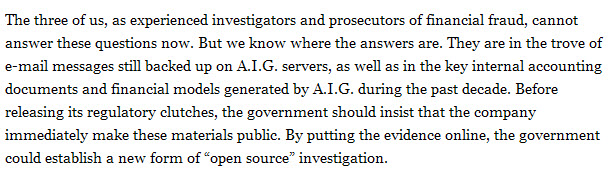
Fascinating Op-Ed in today's NYT, written by three former prosecutors (ELIOT SPITZER, FRANK PARTNOY and WILLIAM BLACK) who are demanding that AIG be forced to release voluminous emails in its possession that would allow the public to understand the economic meltdown that cost taxpayers hundreds of billions of dollars, including 180 billion dollars to AIG. I agree entirely. There is no reason for delay. It's time to turn AIG inside out, that much is clear. The only thing that is unclear is whether the politicians in Washington DC can muster up the courage to represent the taxpayers rather than the big banks. Here's an excerpt from the Op-Ed piece:

aig-emails

Continue ReadingWill the federal government continue coddling AIG?

Time for a national usury law?

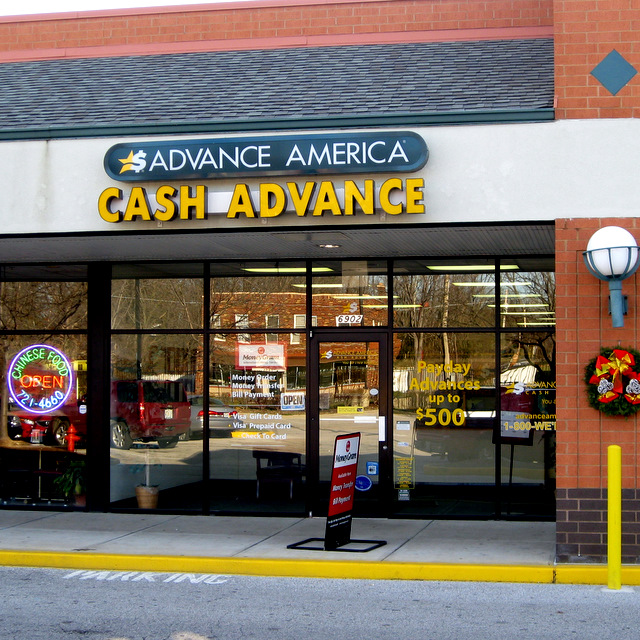
First Premier Bank has just introduced its new 79% interest rate sub-prime credit card. No, that's not a typo, and some experts expect to see more credit cards with sky-high interest. Which makes me again bring up the topic of a national usury cap. Thomas Geoghegan recommended such a cap last year, in his article in The American Prospect. He suggested a credit card interest cap of 12% and a law completely barring payday loans.img_1180 I have filed several class action suits against large payday lenders (here's a post on one of those suits). These lenders often argue that people need these 400% interest loans for short term emergencies. At what cost, though? In my experience, these lenders are commonly stretching out these "short term" loans for many months. People who borrow $500 will pay $2000 in interest over the year and they will STILL OWE THE $500. Many states allow payday lenders to charge in excess of 1000% interest. These loans suck the very life out of working class folks. They amount to financial crack cocaine, because people often end up taking out a second, and a third payday loan in order to pay off the first one. It's a terrible mess and it's ruining lives. That's why 13 states have passed laws making sure that payday lenders cannot operate in those jurisdictions. It's time for the other states, and Congress, to get with the program. To put this all in perspective, remember the stories about "loan sharks?" Those were the good old days. "Simple nominal annual interest rates on extortionate mafia loan shark debts averaged 250%." Syndicate Loan-Shark Activities and New York's Usury Statute, 66 Colum. L. Rev. 167, 167 (1966). And here's another irony. The Bible clearly holds that usury is a sin comparable to murder. Usury is prohibited by Exodus 22:25: "If thou lend money to any of my people that is poor by thee, thou shalt not be to him as an usurer, neither shalt thou lay upon him usury.” Usury is also prohibited by Leviticus 25:35-37. In spite of these Bible quotes, if you want to find lots of payday stores and payday lenders, look for geographical areas where you'll also find conservative Christians. That is the finding of Steven M. Graves and Christopher Peterson, in a law review article entitled "Usury Law and the Christian Right: Faith-Based Political Power and the Geography of American Payday Loan Regulation," 57 Cath. U. L. Rev. 637, 640 (2008):

We conclude, with a high degree of statistical certainty, that states with powerful conservative Christian populations tend to host relatively greater numbers of payday loan locations per capita as well as a greater commercial density of payday lenders. These findings propound a tragic and sad irony. Those states that have most ardently held to their pious Christian traditions have tended to become more infested with the progeny of money changers once expelled by Christ from the Hebrew temple. Legislators in those states, who have effectively used biblical principles to shape their legislative agenda on social and cultural issues, have failed to consistently apply biblical principles to economic legislation.

All it would take for Congress to outlaw payday loans is to write up a bill, have a majority of members of Congress approve of it, and then refer it to the President to sign it. But that can't happen these days because the financial services industry pays our politicians huge amounts of money so that they WON'T sign these sorts of bills. And, of course, with regard to Congress, the banks "frankly own the place."

Continue ReadingTime for a national usury law?