Keira Bell’s Case is Unfreezing News Media that Have Been Reluctant to Discuss Rampant Transgendering of Teenaged Girls

The legal proceedings regarding Keira Bell are forcing the reluctant news media to begin discussing this serious issue regarding a vulnerable population of teenage girls being cajoled into harsh medical treatment for undiagnosed gender dysphoria. The silence of the news media has found synergy with bad science and dangerous medical practices.  Here's an excerpt from Quillette article titled "Like It Or Not, Keira Bell Has Opened Up a Real Conversation About Gender Dysphoria":

The policy reckoning we are now beginning to observe has been a long time coming. And Ms. Bell’s role is an important one, as trans activists have long sought to discredit or ignore the growing ranks of desisters—those, such as Ms. Bell, who once presented sincerely as trans, but later reverted to an identity consistent with their real biological sex. Even media that formerly had toed the progressive line on the issue of gender dysphoria are now finding the courage to run articles about vulnerable girls—many of them autistic, depressed, or socially insecure—who suffer regret after a period of trans self-identification.

Continue ReadingKeira Bell’s Case is Unfreezing News Media that Have Been Reluctant to Discuss Rampant Transgendering of Teenaged Girls

Planned Parenthood Falsely Suggests that Doctors “Assign” a Baby’s Sex at Birth

In his recent article, "Is Sex 'Assigned' at Birth?," evolutionary biologist Colin Wright criticizes Planned Parenthood's claims that a doctor "assigns" a baby's sex at the time of birth. As Wright points out, a doctor merely notices and reports the baby's sex. Planned Parenthood's website makes as much sense as claiming that an obstetrician "assigns" a baby's two-leggedness or "assigns" the eye color of a newborn.

There's good reason to believe that Planned Parenthood intentionally misused the word "assign," given that this word appears 19 times on Planned Parenthood's highly problematic webpage, "Sex and Gender Identity." Here is an excerpt:

Sex is a label — male or female — that you’re assigned by a doctor at birth based on the genitals you’re born with and the chromosomes you have. It goes on your birth certificate . . . . Instead of saying “biological sex,” some people use the phrase “assigned male at birth” or “assigned female at birth.” This acknowledges that someone (often a doctor) is making a decision for someone else. The assignment of a biological sex may or may not align with what’s going on with a person’s body, how they feel, or how they identify.

Wright's article is a patient and focused response to yet another instance where activists are attempting to use ideology to rewrite biology. Wright's counter-measure consists of serving up the kind of accurate biology lesson that most high school science teachers have uncontroversially delivered over many decades. That lesson goes something like this: "Here's a male mouse. Notice the penis. Here's a female mouse. Notice the vagina. Here's a diagram of a male human and a female human. Same thing. Quiz tomorrow."

Real-life biology is something that many Critical Justice Activists have self-trained themselves to find irrelevant. They also find real-life biology incomplete--those biology books keep forgetting to talk about feelings when they discuss gonads! Many of today's Woke students don't like hearing any blunt talk that they are human animals or that it is Nature (not a doctor) that calls the shots regard to a baby's sex. Wright explains:

The claim that biological sex is “assigned at birth” is very misleading as it draws a false equivalence between transgender and intersex people, and suggests that identity, as opposed to reproductive anatomy, defines one’s biological sex.

Rather than being “assigned” at birth, sex is simply recorded at birth using genitalia as a very reliable predictor of underlying gonad type. The fact that doctors, on very rare occasions, are wrong in their assessment does not therefore immediately call everyone’s sex into question.

Planned Parenthood employs many highly educated and careful writers, so the wording on its website was not an accident. Planned Parenthood consciously decided to use the word "assigned" to falsely suggest that arrogant doctors steeped in scientism shoot from the hip whenever they designate a baby's sex. That's how I read their ideologically-laced webpage. They take this position despite the fact that the sex of almost every baby is determined about nine months prior to the birth. And once the baby is born, figuring out whether Nature chose pink versus blue is truly simple. Truly, a doctor merely needs to take a quick look. This process of sexing was perfected thousands of years before the patriarchy got around to inventing the multitudes of modern baby doctors, those people who arrogantly determine one's sex by looking at gonads.

I can feel Wright's frustration as he spells out the facts of life for activists (as well as for those of us who are unnerved by the vocal Woke mobs). This effort by Wright is merely the most recent of a series of basic sex-ed lessons he has been offering (see also here and here). It's unfortunate that any of his articles were necessary, but I'm relieved to see that he is out there offering accurate biology bit by bit, to try to keep us all on the rails.

What is my main reason for writing this article? Because new parents should never be made to feel any hesitation or shame when they announce "It's a girl!" or "It's a boy!" We have all heard many people announcing and celebrating the sex of their newborns. On every occasion that I've heard such an announcement, I'm certain that there was no hint of any animosity toward people who have undergone the process of transgendering. Announcing a baby's sex is always a perfectly appropriate thing to do, no footnotes and no asterisks needed. These joyous moments have no relevance to the hyper-sensitive feelings of transgender activists. In fact, if there were activists in my presence right now, I would urge them to each put one finger in one their own ears so the following information might stick: "When new parents joyously exclaim 'It's a girl!', this is an undeniable biological fact that has absolutely nothing to do with you. It's about the baby."

Since Planned Parenthood twice mentioned "intersex" on the above webpage, it's worth asking how often doctors get it wrong when they tell the parents what sex they have observed in the newborn baby. The answer: almost never. As Wright discusses, the reproductive anatomy of a baby is unambiguously male or female over 99.98 percent of the time. Many activists seem to think that it is insensitive to bluntly announce the sex of a baby because of "intersex." They claim this even when only 2 out of 10,000 newborns are diagnosed with intersex conditions. They claim this despite the fact that intersex conditions have absolutely nothing to do with the issue of transgendering. I suspect that transgender activists keep bringing up intersex conditions because it confuses and extends what would otherwise be swift endings to bad arguments.

Planned Parenthood, an organization claiming an expertise in medical matters, needs to get its medical facts right, then revise its webpage accordingly. There's a lot of work to do. One thing they desperately need to be add is this: For the great majority of people, biological sex robustly aligns with gender. This fact is not something shameful, insensitive or mean-spirited. It accurately describes most human beings, except in Planned Parenthood's namby-pamby world of biology where this is a fact that must not be uttered. [More . . . ]

Continue ReadingPlanned Parenthood Falsely Suggests that Doctors “Assign” a Baby’s Sex at Birth

Intersex Conditions Are Not Nearly as Common as Red Hair

I subscribe to evolutionary biologist Colin Wright's new Substack Newsletter, Reality's Last Stand. In his most recent article, "Intersex Is Not as Common as Red Hair," Wright deals with a claim commonly heard from LGBTQ+ activists, the claim that 1.7% of people have intersex conditions, supposedly making it as common as having red hair. Most activists make this claim without any ill-intent. They want to show that intersex conditions are common and the people with these conditions should not be seen as abnormal. The "facts" touted by the activists, however, don't add up.

Many LGBTQ+ activists get their information from a book titled Sexing the Body, by Anne Fausto-Sterling (2000), who got her number from a study asking people to physically describe "idea" males and "ideal" females.  For example,

Their “ideal female” has two X chromosomes, functional ovaries that result in normal feminizing puberty, intact oviducts attached to a functional uterus, cervix, and vaginal canal. This ideal female must also have labia minora and majora present, and a clitoris that ranges between 0.20 and 0.85 cm in length at birth.

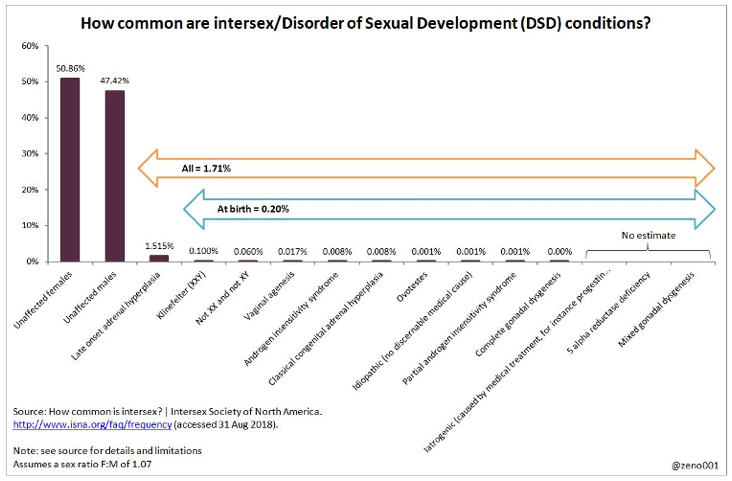
These "ideal" definitions fails because they include "many conditions that cannot be considered intersex in any clinically relevant sense." The central error was to equate “differences of sexual development” (DSDs) with “intersex.”  To illustrate Wright referred to a chart of Fausto-Sterling's data (that was created by Twitter user @zeno001):

Using this data, Wright points out how misleading the 1.7% claim is.

. . . 88% of Fausto-Sterling’s 1.7% figure is taken up by one condition: late-onset adrenal hyperplasia (LOCAH). These individuals have completely normal male or female genitalia at birth that align with their sex chromosomes. The sex of these individuals is not ambiguous, so to label LOCAH as an intersex condition is a far cry from what most people and clinicians conceptually envision the term to capture.

The next most prevalent DSD on Fausto-Sterling’s list iclude any chromosomal deviations from classical XX and XY (e.g. Klinefelter syndrome, Turner syndrome, etc.). However, these conditions do not result in ambiguous genitalia and therefore cannot be considered intersex in any clinically relevant sense. . . . .

Lastly, vaginal agenesis, the next most common DSD on the list, is not generally considered an intersex condition, as girls with this condition are genotypically XX, possess perfectly normal ovaries, and can even become pregnant and birth their own children following vaginoplasty. They are unambiguously female.

When these common DSDs are removed, and intersex conditions are more precisely defined as “conditions in which chromosomal sex is inconsistent with phenotypic sex, or in which the phenotype is not classifiable as either male or female,” Fausto-Sterling’s 1.7% figure drops dramatically. According to Sax, “Applying this more precise definition, the true prevalence of intersex is seen to be about 0.018%, almost 100 times lower than Fausto-Sterling's estimate of 1.7%.”

With Wright's facts-first approach, the 1.7% claim commonly touted by activists bears no resemblance to reality.  As Wright reassures readers, this overstated statistic has no bearing on our duty to treat all intersex people as fully human. They are due the same kindness and respect as any other person. That should never be an issue for anyone, of course.

Continue ReadingIntersex Conditions Are Not Nearly as Common as Red Hair

There Are Still Only Two Human Sexes

It baffles me that, in furtherance of Woke ideology, so many people are somehow willing to pretend that human animals come in more than two sexes. These pretensions are part of an "antiscientific trend toward the outright denial of biological sex." These arguments often take one of two forms: the argument from intersex conditions and the argument from secondary sex organs/characteristics. At Quillette, Colin Wright, who holds a PH.D. in evolutionary biology, explains that both of these arguments fail. His article is titled "JK Rowling Is Right—Sex Is Real and It Is Not a “Spectrum”:

[Both arguments involve] fundamental misunderstandings about the nature of biological sex, which is connected to the distinct type of gametes (sex cells) that an organism produces. As a broad concept, males are the sex that produce small gametes (sperm) and females produce large gametes (ova). There are no intermediate gametes, which is why there is no spectrum of sex. Biological sex in humans is a binary system.

It is crucial to note, however, that the sex of individuals within a species isn’t based on whether an individual can actually produce certain gametes at any given moment. Pre-pubertal males don’t produce sperm, and some infertile adults of both sexes never produce gametes due to various infertility issues. Yet it would be incorrect to say that these individuals do not have a discernible sex, as an individual’s biological sex corresponds to one of two distinct types of evolved reproductive anatomy (i.e. ovaries or testes) that develop for the production of sperm or ova, regardless of their past, present, or future functionality. In humans, and transgender and so-called “non-binary” people are no exception, this reproductive anatomy is unambiguously male or female over 99.98 percent of the time.

The binary distinction between ovaries and testes as the criterion determining an individual’s sex is not arbitrary, nor unique to humans. The evolutionary function of ovaries and testes is to produce either eggs or sperm, respectively, which must be combined for sexual reproduction to take place. If that didn’t happen, there would be no humans. While this knowledge may have been cutting edge science in the 1660s, it’s odd that we should suddenly treat it as controversial in 2020.

More recently, in an article titled "Sex Chromosome Variants Are Not Their Own Unique Sexes," Wright responded to a Tweet by a purported biologist named McClean, making an unusual claim.

McLean, who prominently lists five degrees after his name and claims to be a human evolutionary geneticist, took issue with that claim and forwarded a very common—and very wrong—portrayal of biological sex: that different sex chromosome compositions beyond the standard XX and XY each represent their own unique sex. In fact, Dr. McLean appears to suggest in his tweet that there may be as many as 10 biological sexes!

It especially concerned Wright that McClean's groundless claim was retweeted more than 4,000 times. There is apparently a hot market for bad biology.

First, Wright restates McClean's claim:

The argument that individuals with sex chromosomes that deviate from the typical (46, XX and 46, XY) arrangements, such as those with Klinefelter syndrome (47, XXY) or Turner syndrome (45, X0), is common and usually used to argue that there are 6 sexes, though other numbers are frequently thrown around as well.
The proper response to the above claim is, again, that the size of the gametes determine sex. Males produce small gametes (sperm) and females produce large gametes (ova). Since some individuals do not actually produce gametes, we sometimes need to look to the sex organ rather than the gamete.  Once we do that, we can still see that there are only two sexes.  Wright explains:

But on an individual level (since not all individuals may be able to produce gametes) an organism’s sex corresponds to the type of primary sex organs (testes vs ovaries) and individual has developed. In mammals, which includes humans, the Y chromosome carries a gene (SRY) that encodes a testes-determining factor. If an individual has a Y chromosome with a functional SRY gene, they will develop testes and therefore will be biologically male. Absent a Y chromosome and functional SRY gene (unless the SRY gene has been transposed to an X chromosome), an embryo will develop ovaries and will therefore be biologically female. What’s important to note is that the presence of a Y chromosome, or two, or three, etc., all result in the development of testes and therefore these individuals are biologically male. Likewise, individuals with additional or fewer X chromosomes, in the absence of a Y, all develop ovaries and are therefore biologically female. With this in mind, the chart in the above tweet can more accurately be rewritten as:

X – Female XX – Female XXY – Male XY – Male XYY – Male XXXY – Male

Wright concludes that these atypical chromosomal patterns do not result in new sexes, "but rather represent natural variation within males and females."

Ergo, there are still only two sexes.  It's interesting to note that there does not seem to be any confusion about this when discussing any animal other than humans. In this way, the Woke position on "many sexes" reminds me of claims by religious fundamentalists that evolution by natural selection is straightforward until those upstart biologists start trying to apply natural selection to human animals.

I might be wrong, of course.  Therefore, I'll keep an eye out for ferocious arguments from Woke biologists that squirrels, hamsters and flowers come in six sexes (and unlimited numbers of genders).

Continue ReadingThere Are Still Only Two Human Sexes

About “Vulva Owners” and Our Nomenclature Wars.

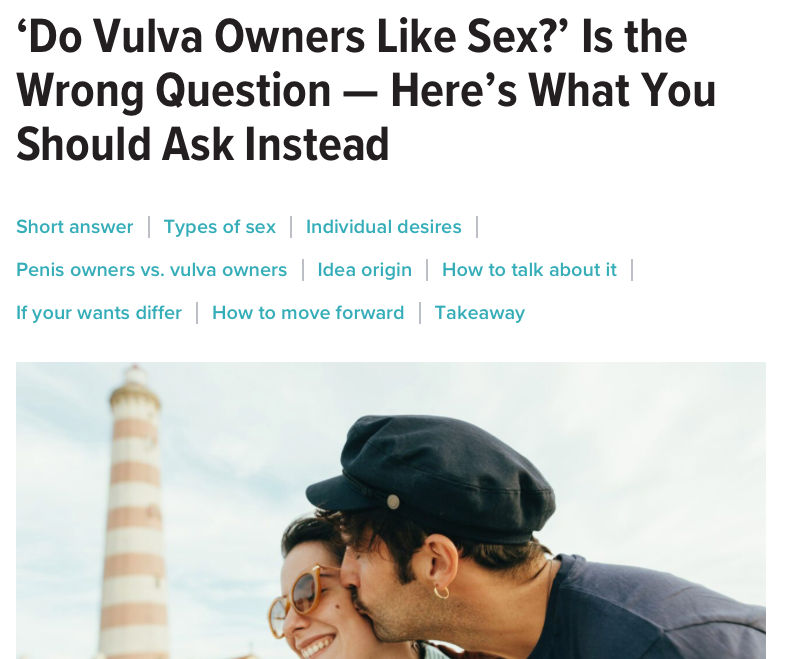
More and more people cannot bear to say words like "men" and "women" anymore. Talk about "objectifying" sexuality . . . Consider this recent article from Healthline:

Here's an excerpt:

‘Do Vulva Owners Like Sex?’ Is the Wrong Question — Here’s What You Should Ask Instead. . . . Some do like sex and some don’t. Just like some penis owners like sex and some don’t.

This question, in and of itself, isn’t great, though. It makes some broad generalizations and assumptions about people and sex in general.

So instead of asking whether vulva owners like sex, you should really be focusing on the person you want to have sex with, and ask them how they feel, what they want, and what they need.

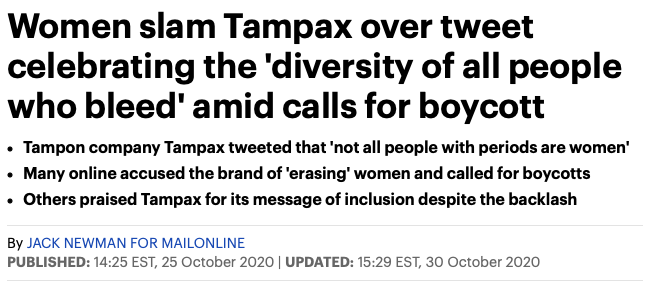
Here's an article about a recent ad by Tampa.  Same issue:

[More . . . ]

Continue ReadingAbout “Vulva Owners” and Our Nomenclature Wars.