The Business Model Driving Youth Transgender Treatment

To what extent are confused teenagers being used by profit-seekers? Catherine Karena of the "LGB Alliance," who has studied many other industries that create demand out of thin air, shines a light on what she terms the "Business Model of Youth Transitioning." She describes the products and services associated with transgender treatment as a 5.2 trillion dollar industry. Watching this video reminded me of the heyday of the tobacco industry.

Here is an excerpt from the opening minutes of this video:

I've studied and worked with tech startups for 21 plus years. Startups are different from established businesses they focus on growth and being game changers they look for a new and unique solution to a problem either a new solution to an old problem for example cds or the cassettes. Or they give you a solution to something you didn't even know was a need. For example when apple gave us the iPod. Or they redefiner problems, where they provide a different solution altogether.

The aim of any software startup is to become a unicorn achieving 1 billion revenue in the first year by aggressively opening up markets for a highly scalable product. Although we've heard that the huge increase in the transgender movement is a grassroots movement or social contagion human rights movement or a typical generational youth rebellion, I'll argue here that the heart of this movement is just business.

The gender identity phenomenon has achieved huge growth by creating a killer brand that can be accessed by consuming medical treatments. The target consumers of this product are teenagers who are forming their identities in an identity-obsessed world market demand is developed through viral marketing and underpinned by legal challenges and social advocacy in the background.

In Karena's model, the skyrocketing alleged rates of gender dysphoria are linked to crass money-making. First, consider the statistics regarding the rates of alleged gender dysphoria. I used the modifier "alleged" because gender dysphoria is often self-diagnosed in modern times. Consider that the DSM-5 In 2013, the DSM-5 estimated that about 0.005% to 0.014% of people assigned male at birth and 0.002% to 0.003% of people assigned female at birth were diagnosable with gender dysphoria. It is now 1000 times greater Consider this:

When [author Abigail] Shrier uses the term “craze,” she means it in the scientific sense. Rapid Onset Gender Dysphoria (ROGD) is what Dr. Lisa Littman calls a “social contagion,” and it primarily impacts young girls. Just a short time ago, only .002 percent to .003 percent of girls in the U.S. identified as transgender. Now, it is up to 2 percent, and Shrier told me that she believes the rate has spiked by thousands of percentage points (in the UK, the number of girls identifying as trans has risen by over 4000 percent). Most trans-identified youth used to be males – that has reversed. In 2016, for example, girls accounted for 46 percent of sex reassignment surgeries in the U.S. One year later, that number had spiked to 70 percent.

In Littman’s much-maligned 2018 study “Parent reports of adolescents and young adults perceived to show signs of a rapid onset of gender dysphoria,” she discovered that a full 70 percent of trans teens belonged to a peer group in which one had already had already come out as trans, and according to parents, a third of these had shown no sign of being dysphoric previously. Despite the insistence of trans activists that this is simply “transphobia” on the part of the parents, 85 percent of the parents surveyed were LGBT-supportive. But for asking questions, for begging their daughters to delay puberty blockers and top surgeries, they are condemned by trans activists as vicious bigots
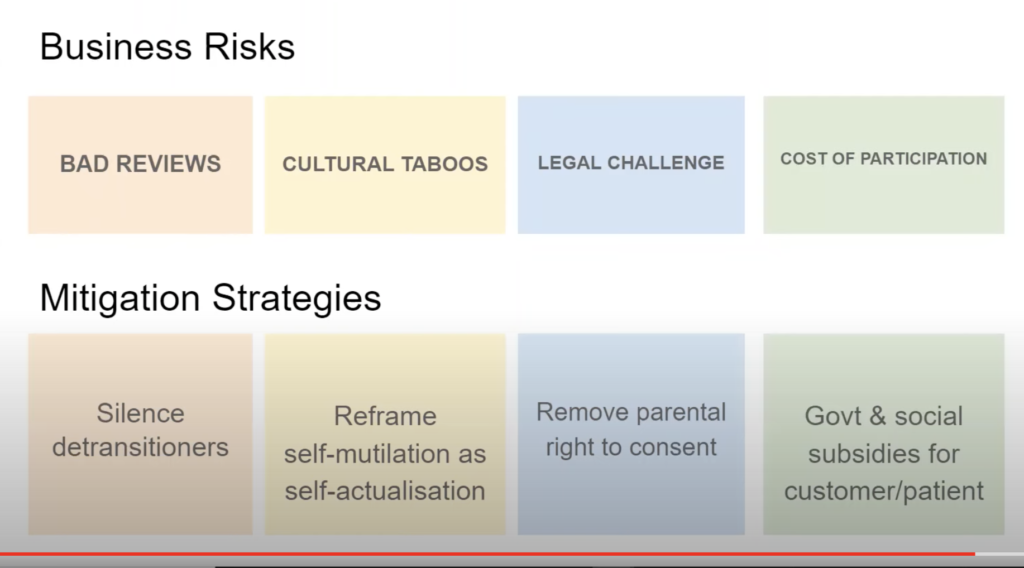
As with any startup, there are business risks that lead to mitigation strategies.  Karena outlines these in one of her graphics:

This is a 9-minute video that succinctly and sharply questions the motives of those making enormous profits off of the bodies of teenagers, even while the "wait and see" approach resolves teenage concerns between 73-98% of the time.

Continue ReadingThe Business Model Driving Youth Transgender Treatment

On the Woke Crucifixion of liberal Jesse Singal . . .

Woke mobs are trying to deplatform and crucify of liberal writer Jesse Singal, not because he has written anything false, but because he has consistently written carefully researched articles on transgender issues. This includes articles describing the situations of some people who have undergone transgender surgery and hormones, but who have then begun to de-transition, people like Kiera Bell. This onslaught by the Woke mob has brought ad hominem attacks to a new level. What should you call people who refuse to engage with the facts, but would rather smear the writer with a torrent of salacious lies in an attempt to end his writing career? And what would you call it when that same mob even attempts to deplatform Singal from his self-publishing work on Substack?

Singal's battle with these sociopaths was analyzed in depth by Glenn Greenwald and Katie Herzog.

Here is an excerpt from Jonathan Kay's recent detailed article on Quillette describing this abysmal situation, "The Campaign of Lies Against Journalist Jesse Singal—And Why It Matters." It's a long read, but worth it.

One of the odd-seeming aspects of progressive cancel culture is that many of the figures targeted by mobs aren’t especially conservative in their views. Rather, the victims tend to be heterodox liberals who simply offer a dissenting opinion on one or more compartmentalized issues—since these liberal targets tend to operate in left-leaning professional and social milieus through which a mob can exercise leverage and demand concessions. There are numerous popular writers and broadcasters who promote deeply conservative themes without attracting any notice from cancel mobs—even as lifelong leftists within such niche genres as Young Adult fiction, LGBT theatre, and knitting-trade journalism are excommunicated on the basis of minor verbal infractions.

In some notable mobbings chronicled by Quillette, in fact, the targeted dissenter wasn’t even offering an opinion per se, but merely highlighting facts we’re all expected to ignore. James Damore wasn’t fired by Google because he gratuitously insulted women, but because he pointed out real differences between the sexes. In Canadian literary circles, Margaret Atwood became reviled among a progressive fringe when she argued (correctly, as it turns out) that falsely accused novelist Steven Galloway should have received due process before being tarred as a rapist. If you grovel enough, woke mobs might eventually forgive you for being wrong—but never for being right.

On the issue of gender, a particularly interesting case study centres on Jesse Singal, a mild-mannered and amiable (I’ve met him) New York-based journalist, book author, and podcaster whom Quillette readers may remember from his 2019 appearance on our own show. As early as 2016, well before the culture war over trans rights reached its crescendo, Singal authored a ground-breaking New York magazine exposé on the cynical takedown of eminent Toronto psychologist Dr. Kenneth Zucker (who was subsequently paid more than half a million dollars by his former employer, the Centre for Addiction and Mental Health, as part of a legal settlement relating to its part in that smear campaign). Two years later, Singal wrote an impeccably researched cover story for the Atlantic titled “When Children Say They’re Trans”—one of the most widely discussed features in the magazine’s recent history. In these articles, and on social media, Singal has dealt with the issue of gender dysphoria with care and sensitivity, documenting the challenges faced by those experiencing the condition. And while he is the furthest thing from an actual transphobe, he acknowledges the plain fact that some children who present as trans later “desist” to an identity that accords with their biological sex.

As anyone who follows this issue closely can guess, Singal’s measured approach doesn’t always sit well with progressive activist and journalistic subcultures . . .

Continue ReadingOn the Woke Crucifixion of liberal Jesse Singal . . .

Slug Love and Snail Love – Happy Valentine’s Day

Do you like slime? On this romantic day, perhaps you might enjoy learning about the extraordinary sex lives of slugs, courtesy of Sir David Attenborough. Feel free to take notes if you'd like to add this to your own repertoire.

And also consider the sex routines of snails, as recounted at Brain Pickings (video available at the website):

This is how it happens: When a snail finds a partner, the two face each other, gently touching their tentacles together to feel if they like each other. And if they do, they glide their bodies alongside one another in a slow double embrace, until their baby-making parts fit together like puzzle pieces. Then, they gently pierce each other with tiny spears called “love darts,” which contain their genes.

Continue ReadingSlug Love and Snail Love – Happy Valentine’s Day

What is Passing for Science These Days at Scientific American . . .

If you are looking for science at Scientific American, you'll need to look a litter harder. This is from a Scientific American article titled "It's Time to Take the Penis off Its Pedestal: A culture of phallus worship has slanted the science in crucial and sometimes unexpected ways."

Yet thanks to the assumption that anything large and powerful must be male, a phallus with more imposing qualities—like the hyena’s—gets dubbed a “pseudopenis,” "masculinized" or “malelike.” Those who spend a lot of time with human genitalia see it differently. “What I’ve come to realize is that everything a man has a woman has; everything a woman has, a man has, anatomically,” says Dr. Marci Bowers, a gender affirmation surgeon in Palo Alto who has done more than 2,000 male-to-female surgeries. “The penis is just a large clitoris. In fact, I don’t know why they don’t just call it a large clitoris.” Here’s why: because human biases shape scientific knowledge, and much of what we know about our nether regions has been shaped by lazy, antiquated stereotypes about what men and women are.

On Twitter, biologist Colin Wright is barely holding it together after spotting this article. That's probably because he specializes in writing "old-fashioned" biology article suggesting antiquated things like his claim that there are two biological sexes and that men are different than women. And see here.

In the meantime, back at Twitter, "M" responded to Wright's Tweet with this:

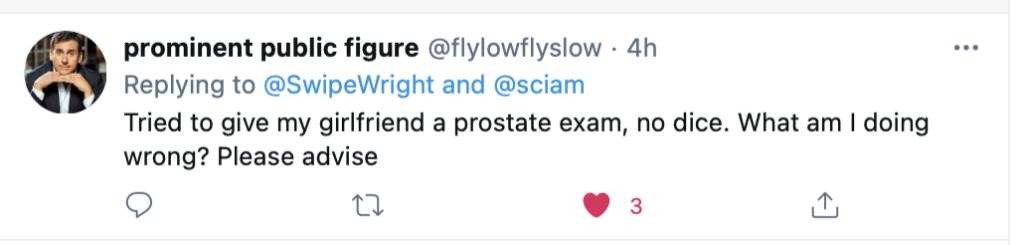
And then "Prominent Public Figure responded with this:

And there were dozens of other responses whose witticisms rivaled in intensity their frustrations of seeing Scientific American's loss of respectability.

Finally, I wanted to know more about Rachel E. Gross, who wrote this "science" article. To my dismay, I noticed that she also wrote for Smithsonian Magazine, though (thankfully) not recently. She has even written about the challenge of getting evangelicals to understand evolution, but that was before her apparent conversation to the religion of Wokeness.

Continue ReadingWhat is Passing for Science These Days at Scientific American . . .

Ninth Circuit Court of Appeals to Decide Who Qualifies as a “Woman” Athlete in Idaho

Is a particular person was a "woman"? For most of my life, everyone I knew would say that the question is answered by considering what kind of genitals that person had. For many people, the answer to that question is no longer answered purely by biology. And to make the discussion all-the-more confusing, transgender activists insist that "intersex" conditions are relevant to this discussion while others consider intersex a red herring.

Lindsay Hecox v Bradley Little [Governor of Idaho] will weigh in on this issue.  This appeal is pending in the Ninth Circuit (and perhaps headed to the United States Supreme Court). The context is transgender sports competition involving students in Idaho. A new Idaho statute is the focus of this lawsuit. The following excerpt is a description of Idaho law taken from the appellate brief of Idaho (the Defendant):

The statute at issue is the Fairness in Women’s Sports Act, Idaho Code §§ 33-6201 through -6206. The Act excludes members of the male sex from participating in sports designated for athletes of the female sex due to males’ physiological advantages, consistent with settled Ninth Circuit law . . . . The Act also permits male and co-ed teams, both of which are open to members of either sex. See Idaho Code § 33-6203.

To ensure the Act’s protections for female athletes, the Act provides that if a dispute arises over a student’s sex and eligibility for female sports, the student may establish female sex in one of three ways: through a high school health examination and consent form signed by a health care provider, which all student-athletes must submit; through another written statement signed by the student’s health care provider; or through a sports physical examination, in which the health care provider relies on one of three specified criteria to determine sex. See Idaho Code § 33-6203(3). See also ER 417-19 (Idaho High School Activities Association Health Examination and Consent Form); IHSAA Rule 13 (requiring high school athletes to submit form). The Act does not provide any sex-verification procedures for male or co-ed sports, because they are open to all, regardless of sex. In support of the bill, the Idaho Legislature made a number of findings based on court decisions, scholarly publications, and scientific studies recognizing the physiological advantages members of the male sex have over their female counterparts. Idaho Code § 33-6202(8)-(11). The Legislature also described the Act’s purpose:

Having separate sex-specific teams furthers efforts to promote sex equality. Sex-specific teams accomplish this by providing opportunities for female athletes to demonstrate their skill, strength, and athletic abilities while also providing them with opportunities to obtain recognition and accolades, college scholarships, and the numerous other long-term benefits that flow from success in athletic endeavors. Id. § 33-6202(12).

Plaintiffs describe the Idaho law at page 8ff of their brief.

A federal trial court granted an injunction, holding that the above law violates federal law. See the Idaho Brief at pp 6-7 and the Plaintiffs' brief, pp. 2-4 for more detail. This is a fascinating set of briefs for many reasons, one of them being that if you read both briefs, it is often hard to believe that they are describing the same lawsuit. That is because the crux of the case is whether one of the two plaintiffs, Lindsay Hecox, is more accurately described as male versus female. Consider Hecox's descriptions in the two briefs:

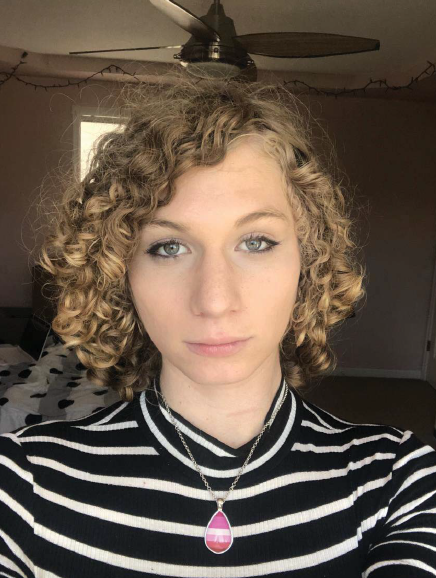
[From the Plaintiffs' Brief, p. 15: "Lindsay is a woman athlete living in Idaho who is transgender." Plaintiffs' brief includes a photo of Lindsay:

[From Defendant Idaho's Brief] "One plaintiff is Lindsay Hecox, who is transgender, and whose sex is male but whose gender identity is female."

Both sides agree that Lindsay is "transgender." As you can see, Plaintiffs claim she is "a woman" while Idaho states that the "sex is male."

I haven't yet read every word of every brief, but I have reviewed a lot of the filings.  In case anyone is interested in following along to see exactly what is being claimed as far as the "facts" or the law, you are welcome to click on the links below.  My focus is biology, but the Plaintiffs claim that biology does is not determinative.

Continue ReadingNinth Circuit Court of Appeals to Decide Who Qualifies as a “Woman” Athlete in Idaho