Richard Vieth was my father. He died on January 14, 2011 at the age of 78, after battling cancer for the past few years. Two days ago I attended his funeral at the Hope Lutheran Church in St Charles, Missouri. The minister gave a detailed celebratory sermon. [1]
The church was packed, even though there was no obituary; no arrangements had been made to publish one. I have decided to publish my own obituary here to make certain that anyone who wants to know about my dad can see that he lived a long active life, that he recently passed away and that he is missed by the many people whose lives he touched. I would also like to annotate this obituary with some personal observations.
At the time of his death my dad (who also went by the name of Dick Vieth) was married to Carolyn Vieth. They had been married for about 20 years and they had made their home in St. Charles, Missouri. Monica Brown was my dad’s step-daughter (Carolyn’s daughter). About a dozen years ago, they both adopted Lynne Bright as their daughter. From 1953 through 1990, my dad was married to my mom, Katherine D. Vieth (formerly Katherine Wich), and they had raised five children. In order of birth, those children are Vicki Kozeny, me (Erich Vieth), Jan Vieth, Kathy Albers and Angela Vieth. My dad is one of four children; his sisters are Jeanne Mertens, Peggy Huston and Mary Malawey. He is survived by all of the above, and by more than a few grandchildren and great-grandchildren.
During his long career at McDonnell Douglas (now Boeing), Richard Vieth worked tirelessly as an aerospace engineer. He helped design cruise missiles [2] and other highly sophisticated weapons. One of his early projects, back in the 1960’s, had been the Dragon anti-tank missile [3]. He took his job extremely seriously, working many evenings and weekends. When I was a teenager, I asked him how cruise missiles could know where to fly while they were traveling over water since all water would presumably look the same; he abruptly stated, “I can’t discuss that. It’s top secret.” He was deeply convinced that America needed to maintain its great military strength to stay safe, and he was proud to play a part in that effort. Upon his death he was recognized by some of his fellow engineers from McDonnell Douglas. [4]
My dad was also a bicycle enthusiast. He made many extensive bicycle journeys here in the United States and overseas. He was an active bicyclist until a few years ago.
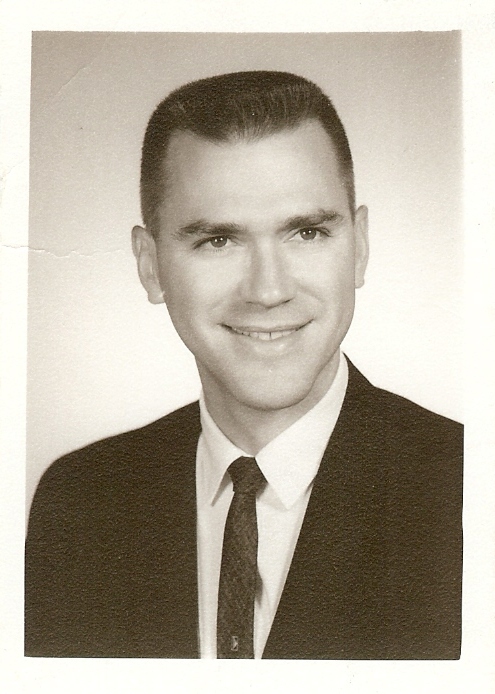 [5]
[5]My father characterized himself as a “conservative” on his Facebook page. He was especially outspoken in local Republican politics during the last few decades of his life. For instance, he was active with the St. Charles, Missouri Pachyderms.
My dad was also highly active with his church, Hope Lutheran Church. He wasn’t shy about singing loudly in the church choir nor about preaching to virtually everyone he met that they should accept Jesus Christ as their Lord and Savior. Prior to his death, my dad wrote his own long eulogy and copies were passed out at his funeral (here is a copy [6]). He wanted to make certain that the people attending his funeral knew the importance of accepting Jesus Christ.
As his only son, I can’t help comparing myself to my dad. He was a competitive extrovert, while I am an off-the-charts introvert [7]. He was extremely religious whereas I am not. He loved to surround himself with people, including members of his family, in order to have a good time. That’s one reason the church was packed at his funeral. People took notice of my dad whenever he stepped into a room. I, on the other hand, have spent my life honing my skills at sneaking out of rooms filled with lots of people in order to recharge by reading a book, by writing or by playing the guitar.
Those who are familiar with my writings at this website might suspect that my dad and I often didn’t see eye to eye. That would be a correct assumption. We didn’t disagree about everything, mind you. For instance, we both loved science; we shared an interest in knowing how the world works and an interest in helping others to appreciate science (it did not surprise me that he donated his body to a medical school). But there seemed to be far more points of friction than accord. It started at an early age (for instance, I mention my dad in this post [8]), and these disagreements continued to the end of my dad’s life. Most of these differences concerned politics and religion.
Looking back at how things went, it’s startling to see how often we were attracted to the same sorts of topics and activities, yet equally startling how often we ended up on opposite sides of issues. How did this come to be? I truly have no idea how we could have been so much the same and yet so different. That is probably the comment I most often hear from people who know us both: “You are so similar, you look so very much alike, you are interested in so many of the same things, you are both so opinionated, yet you are so different.” How much the same and yet different? Here’s a symbolic anecdote: My name used to be Richard Vincent Vieth, Jr. I changed it at the age of 18 because I wanted my own name. My dad was not pleased with that decision, but I’ve got to give him credit in that he directly told me that it was my decision and he “accepted it.”
Our differences mounted over the years to the point where I avoided spending time with my father for many years. I understand why I did this, but I’m not proud of it. Further, I’m certain that I hurt him with my extended absences. It was not my conscious intent to hurt him.
 [9]
[9]But we did not end up at such a bleak impasse. A couple of years ago, after being prodded by several of my good friends, I reached out to visit with my father again. We met for lunch. He was truly delighted to see me, even after all of those years away. Following that lunch, we traded some emails. About a year ago, we sat down, just the two of us. He looked straight at me and asked me what I thought about religion. I told him a few things and he listened, then responded thoughtfully. And then an amazing thing happened. We proceeded to have a great conversation about religion and politics. We listened to each other like we never had done before. Where we disagreed strongly, we agreed to disagree. We respectfully showed a mutual interest in trying to understand each others’ world views. We focused on what we had in common rather than on our differences. There was even a bit of humor in our disagreements.
We finally had broken through. That long conversation was better in every way than any conversation we had ever had before. Not that either of us converted the other. But maybe that isn’t the point of some conversations. As our long conversation ended that day, I looked forward to spending more my time with my dad, but I also knew that his time on earth was growing short.
My dad and I reconnected just in time and that was a fortunate thing. I hereby offer my story to others who might be struggling [10] to get along with people they perceive to be their diametric opposites. The lesson I offer is a simple one. Don’t give up.
Print this post [11]
 [12]
[12]