Andrew Sullivan keeps noticing the sterilized version of CRT that the woke-permeated legacy media is promoting. They often refer to CRT as “teaching history. They can’t see it accurately because they don’t want to see how CRT plays out in classrooms. [1]Sullivan’s article is titled “Don’t Ban CRT. Expose It: There’s a liberal way to fight illiberalism. And it’s beginning to work [2].” Here is an excerpt:
The stories in the mainstream media this past week about the broadening campaign to ban critical race theory in public schools have been fascinating — and particularly in how they describe what CRT is. Here’s the Atlantic’s benign summary of CRT: “recent reexaminations of the role that slavery and segregation have played in American history and the attempts to redress those historical offenses.” NBC News calls it the “academic study of racism’s pervasive impact.” NPR calls CRT: “teaching about the effects of racism.” The New York Times calls it, with a straight face, “classroom discussion of race, racism” and goes on to describe it as a “framework used to look at how racism is woven into seemingly neutral laws and institutions.”
How on earth could merely teaching students about the history of racism and its pervasiveness in the United States provoke such a fuss? No wonder Charles Blow is mystified. But don’t worry. The MSM have a ready explanation: the GOP needs an inflammatory issue to rile their racist base, and so this entire foofaraw is really just an astro-turfed, ginned-up partisan gambit about nothing. The MSM get particular pleasure in ridiculing parents who use the term “critical race theory” as shorthand for things that just, well, make them uncomfortable — when the parents obviously have no idea what CRT really is.
I highly recommend a full read of Sullivan’s article. He offers many useful links along the way.
[Added 6/23/2021 – 9 pm CT]
What is CRT? Daily Wire offers this description [3], which comports with my understanding:
Critical race theory, of course, is not America’s actual history. It is a perverse worldview, unsupportable by the evidence, in which all of America’s key institutions are inextricably rooted in white supremacy; it is an activist campaign demanding the destruction of those institutions. The founders of CRT have written as much. According to CRT founders Richard Delgado and Jean Stefancic, CRT is founded on two key premises: that “racism is ordinary, not aberrational — ‘normal science,’ the usual way society does business, the common, everyday experience of most people of color in this country”; second, that “our system of white-over-color ascendancy serves important purposes, both psychic and material.” This means, according to Delgado and Stefancic, that “racism is difficult to cure or address” and that a formal commitment to legal equality on the basis of color-blindness is merely a guise for further discrimination. Furthermore, CRT founders say that whites are unable to understand racism, and that “minority status … brings with it a presumed competence to speak about race and racism.”
CRT therefore holds that racism is embedded deeply in American life, unconsciously into white American psyches, and that it is impossible for white Americans to understand their own racism or that of the system, let alone to remove it. The only solution: tearing away the only systems that have ever provided widespread liberty and prosperity. As fellow CRT founder Derrick Bell wrote, “The whole liberal worldview of private rights and public sovereignty mediated by the rule of law needed to be exploded.”
Are many schools pummeling their students with Critical Race Theory? They are, which is causing many schools to come under increasing scrutiny. As of late, many woke institutions have started claiming that schools are merely teaching “race history,” and that those who are appalled by what is going on in many American schools don’t understand what Critical Race Theory is. To that, I offer the following: A) I invite readers to check out the leaked teaching materials and first-hand accounts from many schools [1]; and B) Consider that if it walks like a duck and quacks like a duck, it is a duck. I strongly oppose CRT for many reasons, especially these three: [4]
Question: Is Critical Race Theory racist?
Answer: Yes.
Critical Race Theory begins by asserting the importance of social significance of racial categories, rejecting colorblindness, equality, and neutrality, and advocating for discrimination meant to “level the playing field.” These things lead it to reproduce and enact racism in practice. It also explicitly says that all white people are either racist or complicit in the system of racism (so, racist) by virtue of benefiting from privileges that they cannot renounce.
. . .
Question: Does Critical Race Theory advance the vision and activism of the Civil Rights Movement?
Answer: No.
Critical Race Theory refers to that vision as “traditional approaches to civil rights” and calls it into question. The Civil Rights Movement called for living up to the foundational promises of the United States (and other free nations) and incrementally changing the system so that those original ideals were met. Critical Race Theory rejects incrementalism in favor of revolution. It rejects the existing system and demands replacing it with its own. It rejects the liberal order and all that goes with it as being part of the system which must be dismantled and replaced. It is therefore fundamentally different than the Civil Rights Movement (and is explicitly anti-liberal and anti-equality).
. . .
Question: Does Critical Race Theory say that all white people are racist?
Answer: Yes.
More specifically, Critical Race Theory says that all white people are either racist or that they are complicit in a “system of racism” (so, racist) that they wittingly or unwittingly uphold to their own benefit unless they are “actively antiracist” (and usually even then). Those benefits of “whiteness” are labeled “white privilege” in general and are said to be outside of the scope of things that white people can intentionally renounce. The most they can do is “strive to be less white” and to become aware of and condemn “whiteness” as a system.
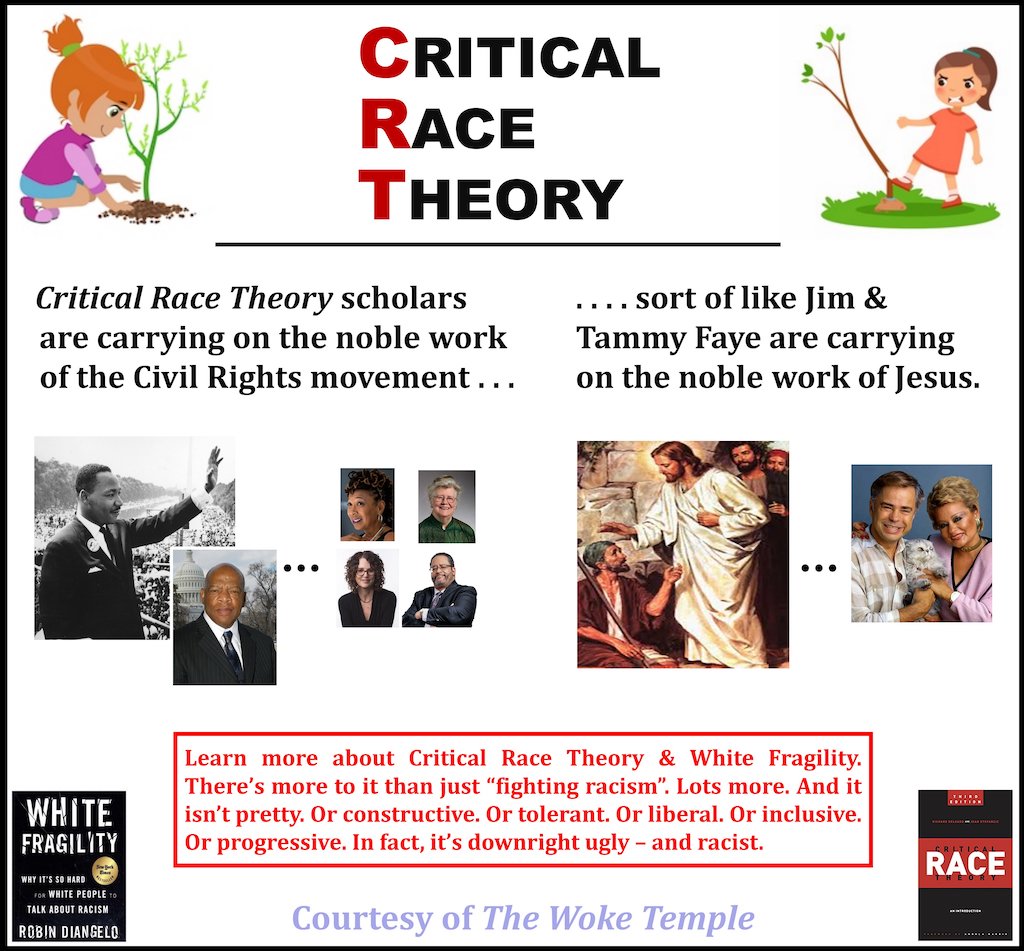
With regard to Reason #2, “The Woke Temple [5]” coarsely (but accurately) describes it:
John McWhorter [6] has also noted these evasive tactics by those who have been supporting “antiracist” programs in U.S. K-12 and colleges:
According to the “antiracist” apologists,] whenever a body of lawmakers (or anyone else) is against their kids being taught not how, but what, to think, and call this “Critical Race Theory” just as many of its teachers do, that body of lawmakers is a nest of racists.
Let’s break this down.
Elects commonly insist that critics of CRT would feel differently if they read actual foundational articles about it. But the issue is what is being done in CRT’s name, not what some articles contained decades ago.
The early writings by people like Regina Austin, Richard Delgado, Kimberlé Crenshaw are simply hard-leftist legal analysis, proposing a revised conception of justice that takes oppression into account, including a collective sense of subordinate group identity. These are hardly calls to turn schools into Maoist re-education camps fostering star chambers and struggle sessions.
However, this, indeed, is what is happening to educational institutions across the country. Moreover, it is no tort to call it “CRT” in shorthand when:
1) these developments are descended from its teachings and
2) their architects openly bill themselves as following the tenets of CRT.
In language, terms evolve, and quickly — witness, of late, how this has happened with cancel culture and even woke. To insist that “CRT” must properly refer only to the contents of obscure law review articles from decades ago is a debate team stunt, not serious engagement with a dynamic and distressing reality.
A useful document for parents in the new resistance just released by the Manhattan Institute may be useful for those who still bristle at the use of CRT to refer to … well, what it now means. One could be more precise:
“What we are interested in here might be termed “critical pedagogy.” “Critical pedagogy” names — without exhaustively defining — the host of concepts, terms, practices, and theories that have lately taken hold in many public and private schools. This term alludes to a connection to CRT — it might be thought of as critical race theory as applied to schooling — but also to “critical studies” and “critical theory,” a broader set of contemporary philosophical ideas that have been particularly influential in certain circles of the modern Left.”
Again, it’s not what the woke institutions are calling the things that they are preaching. What matters is what they are preaching, often to young children without the knowledge and consent of their parents. It is clear that schools from coast to coast [1] vigorously preaching to students (often doing far more than teaching) in accordance with CRT principles.
The following list from New Discourses [7] succinctly describes the principles being taught in many classrooms today. Again, those who defend these teachings no longer want to use the phrase “critical race theory” as a catchall for these principles, many because that phrase is becoming increasingly toxic as increasing numbers of parents learn what is being taught to their children [1].
Critical Race Theory…
-
- believes racism is present in every aspect of life, every relationship, and everyinteraction and therefore has its advocates look for it everywhere
- relies upon “interest convergence” (white people only give black people opportunities and freedoms when it is also in their own interests) and therefore doesn’t trust any attempt to make racism better
- is against free societies and wants to dismantle them and replace them with something its advocates control
- only treats race issues as “socially constructed groups,” so there are no individualsin Critical Race Theory
- believes science, reason, and evidence are a “white” way of knowing and that storytelling and lived experience are a “black” alternative, which hurts everyone, especially black people
- rejects all potential alternatives, like colorblindness, as forms of racism, making itself the only allowable game in town (which is totalitarian)
- acts like anyone who disagrees with it must do so for racist and white supremacist reasons, even if those people are black (which is also totalitarian)
- cannot be satisfied, so it becomes a kind of activist black hole that threatens to destroy everything it is introduced into
Here is another graphic, 8 unproven assumptions of CRT, apparently from the New Discourses [8] Website.

I will pause this conversation at this point. I felt it important to correct an increasingly misleading record being promulgated by many captured media outlets.
[Added June 24]
The Woke Temple offers this Summary of the general teachings of CRT and what is being taught in the names of “racial sensitivity,” Robin DiAngelo and Ibram X. Kendi.
 [9]
[9]
[Added July 3, 2021]
Is it proper to call the modern “anti-racist” curriculum “Critical Race Theory?”
The largest teacher union thinks so. So do many popular books on CRT.
 [10]
[10]
 [10]
[10]
About that nomenclature . . .
 [11]
[11]
[Added July 9, 2021]
From an excellent legal analysis [12] by Greg Lukianoff of FIRE [13]:
What these bills are trying to address doesn’t map directly to the academic definition of critical race theory, which is, in short, an academic school of thought pioneered by Derrick Bell, Kimberlé Crenshaw, Mari Matsuda, and Richard Delgado (among others) that holds that social problems, structures, and art should be examined for their racial elements and impact on race, even when they are race-neutral on their face.
As a result, a lot of arguments dismiss the bills by claiming “they don’t teach critical race theory in K-12!”, pointing to the fact that Bell’s work is on few, if any, K-12 syllabi. But that is a refutation of a point no one is actually making.
Like it or not, the acronym “CRT” as commonly used in 2021 doesn’t refer to the foundational texts and authors in the academic movement. It’s a shorthand for certain ideas that have filtered (in reductive forms or not) from CRT thinkers into the mainstream, including in bestselling books like “White Fragility” and “How to Be an Antiracist” — ideas like how relationships between individual white and nonwhite people are those of the oppressor and oppressed, that all white people are consciously or unconsciously racist, that ostensibly raceblind concepts like “meritocracy” are the result of white supremacy, among others.
This is a formula for reinforcing group difference, undermining the hope of future social cohesion, and returning to a kind of tribal politics.
Indeed, many if not most of the bills ban teaching of these concepts, rather than critical race theory itself. Arguing that the bills are bad purely based on the semantics that they are not referring to “true” CRT is little more than deflection. Arguing that the term “CRT” as applied to the bills is a misnomer may be correct, but it won’t persuade anyone that the bills, or the concerns underlying them, should be abandoned. (Additionally, if the bills were banning something that isn’t actually taught in K-12, why bother with any pushback?)What opponents of “CRT” are getting at is a philosophy that comes directly in conflict with small-L liberalism — and I am among the many Americans who believe the ideals of small-L liberalism are worth defending. What critics of CRT fear is the rise and widespread adoption of a philosophy that relies on genetic essentialism, overgeneralization, guilt by association, what we call in Coddling “The Great Untruth of Us versus Them,” shame and guilt tactics, and deindividuation. This is a formula for reinforcing group difference, undermining the hope of future social cohesion, and returning to the kind of tribal politics of the country in which my father grew up: Yugoslavia.
Print this post [14]
 [15]
[15]