Contrary to what so many of us want to believe, humans are not wired to act only as individuals; we are also wired to be intensely social. In his March 14, 2012 TED presentation, Jonathan Haidt characterized humans as half-bee. We aren’t completely socially integrated like bees–our social side clashes with our individualistic side. These two aspects of what it means to be human—our proud individualism and our craving to meld our selves with each other in large social groupings–often conflict with each other. As a result, human “hives” (the many types of human social groupings) don’t run as smoothly as the hives of true bees. Haidt argues that the scientific study of this inner-conflict offers us powerful insights into such things as religion, existential angst and warmongering.
Haidt began his 18-minute talk by asking for a show of hands. How many people in the audience consider themselves to be “religious?” Only a few raised their hands, yet a strong majority of the audience members declared themselves to be “spiritual.” Why is it that that so many people who don’t consider themselves to be religious do consider themselves to be spiritual?
Haidt argues that humans unrelentingly crave transcendence, and they try to accomplish this by melting into social groups. There are many types of social groups, of course, and they offer distinctive prices of admission. Many religions help their practitioners get up this “staircase” of self-transcendence through prayer, meditation, public commitment to doubtful church articles of faith, and even drugs. Unfortunately, war is yet another path to transcendence. “Nothing brings people together like war.” You can feel part of a bigger whole in numerous additional ways. You can root for your local sports team. You can join a protest movement. You can even join a group of skeptics. Regardless of the type of “staircase” we ascend into the world of the transcendental, what we achieve is that our sense of self thins out or melts away and we become one with other half-bee humans.
 [1]
[1]Emile Durkheim distinguished the profane (the ordinary or common) versus the sacred, indicating that humans have one foot in each side. He thus described humans to be homo-duplex organisms. Haidt points out that we experience a “phase change” when individuals “unite into a team, a movement or a nation that is far more than the sum of its parts”: E pluribis unum. Whenever this happens, we feel “nobler, better and uplifted.” He reminds us of the powerful feeling of unity the entire nation felt after 9/11.
As I’ve often mentioned at this website there has been an intense battle over whether the human tendency to come together and feel uplifted is A) an evolutionary feature or B) “a bug,” a defect, a maladaptation? http://dangerousintersection.org/?s=religion+adaptation Does religion happen when “wires cross in the brain”? Haidt disagrees with the New Atheists, who insist that religion is a “parasitic meme” that make us do all kind of crazy stuff. Instead, religion is but one type of manifestation of the human need to achieve transcendence.
Darwin sometimes explained morality in terms of “group selection.” (Min. 8:15). Following in the footsteps of David Sloan Wilson [2] (and here [3]), Lynn Margulis [4] and E.O. Wilson [5], Haidt points out that group selection has been much criticized by scientists because of concerns with the “free-rider problem,” but group selection is about to make “a strong comeback this year” as a result of E.O.Wilson’s new book, The Social Conquest of Earth (Also see this DI discussion [5]).
Haidt explains that we are subject to competition both within groups and among groups–we are part of a system of multi-level selection. These are “deep evolutionary truths,” which Haidt illustrates with a simple animation (Min. 10). He argues (contrary to mainstream biology [3]) that the “free-rider” problem has been “solved many times” by nature: The trick is to “put everyone in the same boat.” He points to the existence of mitochondria in eukaryotic bacteria–hundreds of millions of years ago, mitochondria were free-living bacteria, but they somehow came together with another type of bacterium in the same membrane [6] and work together to create a new super bacteria (see this short discussion of mitochondria [7] ). This event was a “major transition” in evolution. It also happened 140 million years ago when wasps came together in the same hive (min 13).
 [8]
[8]In the past 500 million years, human animals started coming together in tribes.
“They came together around a hearth or campfire. They divided labor, they painted their bodies, they spoke the same dialects and, eventually, they worshiped their own gods. Once they were in their own tribes, they could keep the benefits of cooperation locked inside, and they unlocked the most powerful force ever known on this planet, which is human cooperation, a force for construction and destruction.”
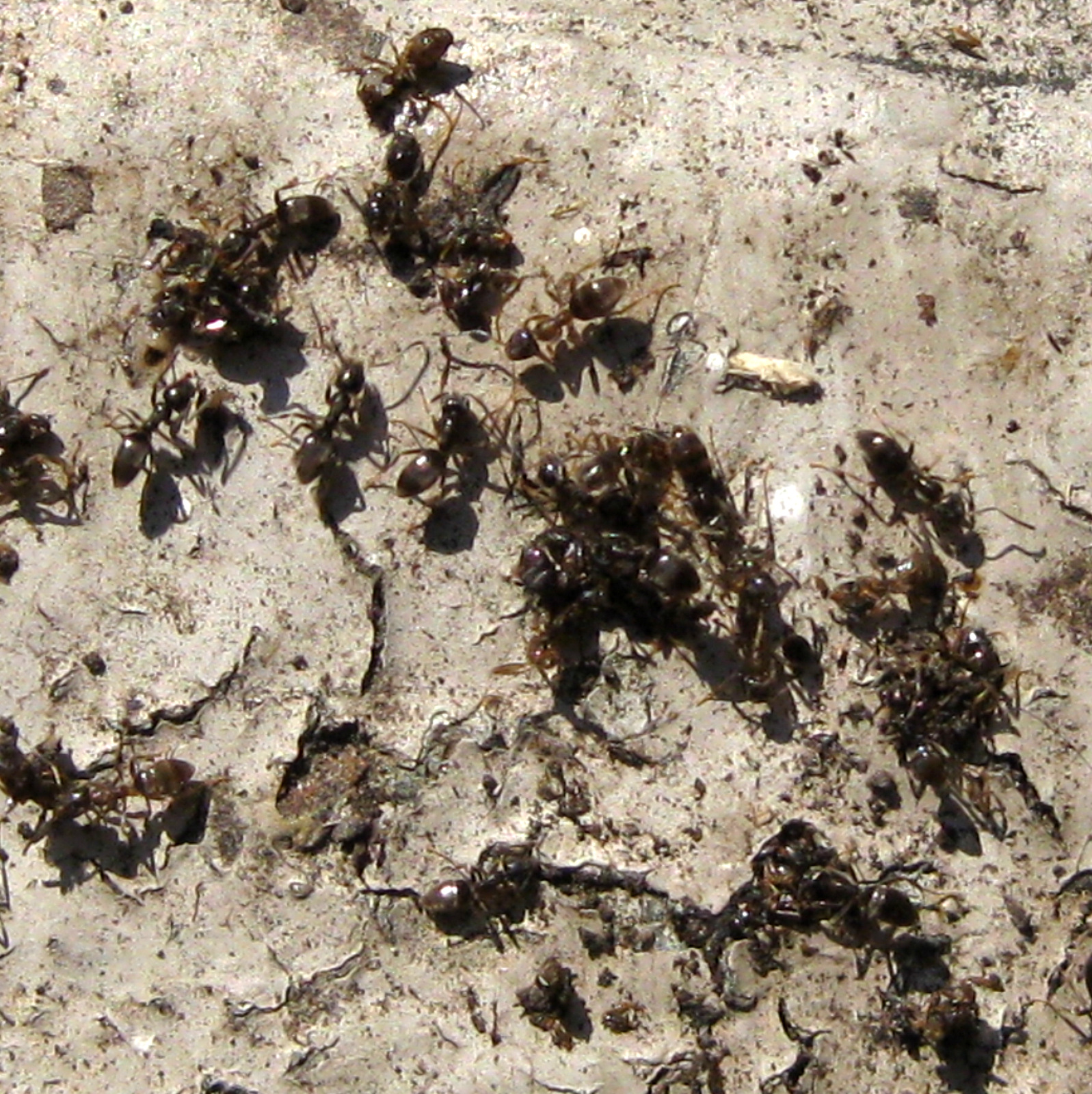
The problem is that we are only half-bee. We are not nearly as cohesive as bees. Though we often come together (in religious rituals, sports ceremonies), we often tend to break apart–we’re not “locked in” like mitochondria, or even like bees and ants. Nonetheless, when people do come together in such a way that individuals lose themselves and phase-shift to communal mode, they can “move mountains.”
Thus, Haidt’s claim that humans evolved to be “religious,” a phrasing that is guaranteed get lots of people riled up. By “religion,” though, Haidt includes much more than modern prominent religious organizations. Our religious roots existed far before these organizations and their particular versions of religious truth existed. Rather, we evolved long ago “to see sacredness all around us and to join into teams.” Organized religions comprise a small subset of the human attempt to satisfy an ancient craving.
Politics is tribal too, being partly profane (in that it’s about self-interest) but also about sacredness (because it’s about joining with others to pursue what is deemed moral). Politics is “about the eternal struggle between good and evil, and we all believe that we are on the good team.”
Haidt concludes his talk by noting the dissatisfaction so many of us feel with life. This is because we “fly around like individual bees,” wondering whether this is all there is while we sit in the comfort of our modern homes, plugged into our home entertainment centers. We feel something is missing. “What’s missing is that we are homo-duplex creatures, but modern secular society was built to satisfy only “our lower profane selves.”
 [9]
[9]The challenge of modern life is to find a “staircase” to allow us to do something good and noble as part of a larger social grouping. We should find hope in our dissatisfaction with our immersion in our modern profane lives—Haidt invokes the image of a person surrounded by an elaborate home entertainment system. That dissatisfaction is the first step to finding that which is truly sacred.
Haidt’s straightforward talk would seem to have explosive religious and political implications that touch on many of the topics about which I have written here at DI. Here are a few topics that come to my mind:
- Religion appears to be serving important biological functions, even though religious claims are often false and even oxymoronic (Mary was not a virgin).
- To claim that a person joins a religion because of [dogmatic claims of the religion] has it backwards; it is like claiming that the tail wags the dog. Haidt’s approach suggests that people join religions because of deep biological impulses to seek transcendence, justifying this impulse post hoc with a concocted reason.
- That wrinkled old man sitting alone on top of the mountain will never “figure out” the meaning of life.
- We need to guard against the possibility that biology has wired us for war.
- “Religious Wars” are not really caused by conflicting religious claims.
- We don’t need much of an excuse to congeal into groups and despise and fight other groups. We apparently don’t need any excuse.
- We need to pour energy into being self-critical, because biology encourages us to believe that our ingroup is always right.
- The function of human reason is to mold a coherent social group, though truth sometimes results. Much like newspapers are designed to sell ads, but truth sometimes spills out.
Aftermath:
Following the talk, I took a look at the YouTube ratings of Jonathan Haidt’s talk. I was surprised that after such an inspiring, thoughtful and scientifically rigorous talk, 30% of those voting disapproved. I then started reading the individual comments (I read them on April 4, 2012), and it was disheartening. Here are the basic categories of many of the comments on Haidt’s presentation:
- We need organized religion to fix the world & God loves us.
- This talk was bullshit or boring.
- [Something totally irrelevant, e.g., the butterfly effect or the Heisenberg Uncertainty principle, the Federal Reserve, law enforcement abuses, why someone else should be on TED, love is a delusion, everything is pre-determined, commenting on YouTube is meaningless, American warmongering].
- [Incoherent comments]
- Haidt is mocking believers.
- God condemns war, except for self-defense.
- Religion is pointless or misguided.
- Haidt is encouraging us to join religions.
- Tyrants fear smart people.
- Jesus is (or is not) holy.
- Suffering is necessary to make someone merciful.
- Haidt is trying “to promote his right-wing agenda.”
- Science is religion. Or science is overrated.
- [Someone saying, essentially, Look at me! Perhaps attempting to employ humor or sarcasm or put-downs] Haidt is saying that any worldview is a legitimate religion or system of morality, including getting stoned.
- I want to show that I am smart by changing the subject to something I would rather discuss.
- We need to work together.
After reading a couple hundred comments, I sat stunned for a few minutes. How can so many people misunderstand the basic points of Haidt’s talk? How can so many of them be so distractible? Why is it that so many people haul their own baggage into the comments instead of listening to the talk? Perhaps, the intensity of these comments are a natural consequence of the threats posed by Haidt’s talk. I clung to the fact others noticed this problem too:
So many idiots on this thread. Did you watch the video at all? He’s not promoting religion, he’s providing an evolutionary framework for understanding why we have a capacity for self-transcendent experiences. xRA1D32x
I suspect that many of the people whose comments misinterpreted the talk didn’t even watch the entire video. I suspect that some of them merely read the title, spotting the word religion, then weighed it with a comment. The mere use of the word “religion” seems to trigger ingroup defenses in many of us, eliminating the possibility that meaningful discussion can proceed.
Print this post [10]
 [11]
[11]