Names, names, names. According to the Bible, God gave Adam the power to name the animals, it that’s quite a power, to be able to name things. It’s a special privilege to have chosen one’s own name—I did this when I was 18; I changed my named from “Richard, Jr.” to “Erich.” As fun as it is to rename one’s self, it can be equally perplexing when other people rename you without your consent. Which leads to my story.
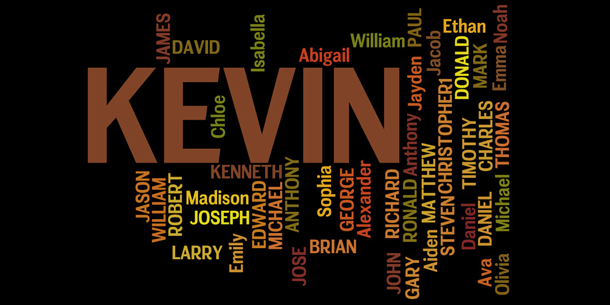
Over the years many people have called me by the wrong name. Nothing unusual about that, right? Why is it, though, that about half the time I’m called the wrong name, the wrong name they call me is “Kevin.” It happens at least four or five times per year. It happened last week, and it happened again this morning. In court today, an opposing lawyer, who knew me only by my signed pleadings, walked up, shook my hand and said, “Good to meet you, Kevin?” Do I look like a Kevin? What do Kevins look like? I’m not really annoyed by any of this. It just perplexes me that so many people call me by the same wrong name when there are so many other names they could incorrectly call me. This simply isn’t a random occurrence. Does it suggest mass hypnosis? A prior life? Astral projection?
This wildly skewed incorrect naming reminds me of Paul Churchland’s work on connectionism http://en.wikipedia.org/wiki/Paul_Churchland (see The Engine of Reason, The Seat of the Soul: A Philosophical Journey into the Brain, MIT Press, 1995) Perhaps the minds of Americans have distilled something from all of the Kevins of the world and embedded their collective essence into our brains’ middle layers. Regardless, I seem to be a lightning rod for Kevin-ness.
I’ve often wondered whether might be a physical prototype for many names. What does a person named “Robert” look like? It sounds like absurd question, but perhaps you might well have an image of Robert-ness that pops into your head when you think of the name “Robert.” What about Sophie (there seems to be 1000 young girls in Sophie these days). I actually do think I see an image of a “Sophie,” and not any particular Sophie, when I think of the word “Sophie.”
Kevin is not my only other name. For the past few months, I’ve been called “Babe” many times. I currently represent a group of construction workers in a lawsuit, and I’ve spent a lot of time with them. Apparently, it is common among many of the guys in this group of trade workers (painters, plasterers, electricians and roofers) to call each other “Babe.” It is used as a term of affection, e.g., “Catch you later, Babe.” I don’t mind it at all, even coming from some of these hard-working guys. It makes me feel like one of them, part of the group. Not all of them call me “Babe.” Actually none of them call me that nickname when we first meet or first start talking. It’s usually while we’re wrapping up a conversation. And I also hear different levels of formality. Some of my clients are comfortable with me and call me “Erich” (which I invite) while the other half insist on calling me “Mr. Vieth.”
And this is not the first time I’ve been called “Babe.” A female attorney at my office grew up in Kentucky, and has often worked this same term into her hellos and goodbyes: “How’s it going, Babe?” “I’ll catch you later, Babe.” Interestingly, my female coworker doles it out freely, but admits that she doesn’t receive this name well when it comes from a man. I suspect that’s because it’s just too darned close to the sexualized saying, “She’s a real babe.”
In my book, “Babe” is right up there with “Hon,” another term of endearment that regularly get from blue-collar middle-aged women working in retail establishments. “You have a nice day, Hon.” I get that from a lot of middle-aged and older female retail store clerks.
I have two kids in school. One of the schools is a private city school where the teachers, and all staff members, are called by their first names by the kids and parents. It puts everyone on the same level, even the janitor. I’ve seen several prospective parents squawk at this approach—they feel that it is disrespectful. At the other school, there is a strict rule that the kids must call their teachers more traditionally, e.g., Ms. Smith.”
Names have always been tricky for me. On my birth certificate, my name is Richard Vieth, Jr. I was born in the 50s, when some parents still call the kids “Dick.” When I was in the second grade, a couple of kids tell me what “dick” meant, and started laughing. It didn’t take me long after that to start calling myself “Richard.” In my teenage years, people couldn’t help themselves—they often generated new names for me. They changed Richard into “Rich,” “Rick,” and in Spanish class “Ricardo,” or when they were in a schadenfreudic mood, “Retardo Ricardo.” Other names came and went, including the name “Captain” (“Cap’n” for short), which I was often called in high school.
 [1]
[1]
I settled on “Rich” until I was about to attend law school at the age of 18. I saw that as a good window for permanently changing my name to something I liked. I assumed correctly that I was about to have many new acquaintances would know me only as my new name, making the switch-over easy . I decided on Erich, because it shares an etymological root in common with Richard (rex, meaning king — I would now be honorable king instead of strong king). Mostly, I liked the name Erich. I got mixed reviews at home when change my name. My father (recently deceased) stated “I don’t understand it, but I accept it [barely, and actually not really],” while my mother sent out birth announcements indicating that she had a new 170 pound baby boy named “Erich.” My choice turned out fairly well, in that I seem to be the only Erich Vieth in the United States (though there is one other of us in London-he’s a Facebook “friend” who sought me out because he thought that the two Erich Vieths should be friends).
I went through the name change court proceeding pro se, explaining to the judge that I simply wanted my own name (rather than being a “junior”), and I thought the name “Erich” fit better. Change of name petitions are often granted by the court as long as the petitioners not trying to evade creditors (I wasn’t). By the way . . . there are two ways to change you name in most states. Going to court is one way. The other is simply to start calling yourself by a new name, and that eventually becomes your legal name. Check with a lawyer in your state to make sure this applies to you, if you want to call yourself, e.g., “Kevin.” In fact, that is how newly-married women effect their name change to their new last name (those that choose to change their last names). No court proceeding necessary to change that last name. Same process, though, to change your first name—just start using a new first name.
I remember meeting my then-girlfriend the evening after I went to court. She was more than happy to call me “Erich,” which made me feel like a fraud at first. It was that same night as the court proceeding when I first met her parents and she simply introduce me as Erich, not explaining that my name had been different that morning. I remember shaking their hand and looking them in the eye and that was that. A few reminders to family and friends, and after they knew that I was serious about the name change, they were happy to call me by my new name.
This takes us all the way to present times where I am now known as Erich, but often as Kevin. If the Kevin thing keeps up, though, perhaps I should just give in and change my name to Kevin.
Print this post [2]
 [3]
[3]