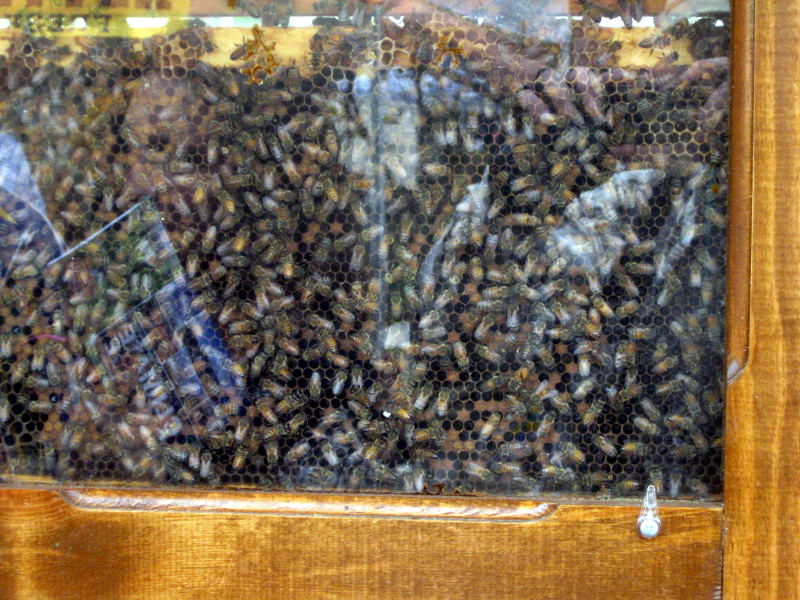
Bees look free. They seem to dance capriciously from flower to flower. No one seems to be telling each bee what to do. Anyone who has carefully studied bees, however, knows that they are not “free.” The health and welfare of bees and their hives are highly sensitive to a great many factors. Here are a few:
A) Excesses and deficits in rainfall and temperature;
B) The survival and location of plants from which bees gather nectar;
C) The prevalence of parasites and viruses;
D) The existence of rival hives and predators;
E) Human encroachment, including pesticides and destruction of habitat;
Whether bees thrive is subject to these and many other factors. If any of these factors is changed, the bees will be affected. “Free as a bee,” is an expression I have heard from time to time, but it turns out that bees are not actually very “free.” Hard-working bees and hives are often killed for factors beyond their control.
 [1]
[1]The “free market” is not free either, a point of which I was reminded while reading Mark Tiedemann’s recent article, “The Free-Market Problem [2].” Mark bluntly asserted that there is no such thing as a “free market.” I agree, and I will explore that point further in this article. I will borrow heavily from others in support of my arguments. The market is not “free” for many reasons that have been clearly articulated in two recent books:
A) 23 Things They Don’t Tell You about Capitalism, by Ha-Joon Chang [3] (2010). Chang is a member of the Faculty of Economics at the University of Cambridge.
B) The 15 Biggest Lies about the Economy (2010), by Joshua Holland [4]. Mr. Holland is a senior writer and editor at Alternet, where he has often covered the economy.
Chapter One of Chang’s book is titled “There Is No Such Thing as a Free Market.” At the beginning of this chapter, Change sets forth the claim so often asserted by modern-day conservatives: Markets need to be “free” and the government should not interfere with the “free market.”
We are told by conservative politicians and pundits that “interfering” with the “free market” stifles innovation and investment. They talk about the “free market” as though it were a wise and benevolent transcendent Being [5]. Thus, they say, we should not have a social safety net, such as single payer healthcare insurance, and we should not attempt to regulate Wall Street, because the “free market” will take care of these issues for us. The “free market” will take care of the need for health care and Wall Street corruption, and everything else we need. Chong responds:
The free market doesn’t exist. Every market has some rules and boundaries that restrict freedom of choice. A market looks free only because we so unconditionally accept its underlying restrictions that we fail to see them. How “free” a market is cannot be objectively defined. It is a political definition. The usual claim by free-market economists that they are trying to defend the market from politically motivated interference by the government is false. Government is always involved in those pre-marketers are as politically motivated as anyone. Overcoming the myth that there is such a thing as an objectively defined “free market” is the first step toward understanding capitalism.
(Page 1)
Chang points out that our society is filled with regulations we take for granted, such as environmental regulations restricting the pollution produced by cars or factories. Many people consider these sorts of regulations to be a “natural” part of a “free market,” while other people see these regulations as artificial restrictions imposed by the government. Hence, Chang argues,
 [6]
[6]There is really no objective way to define how free that market is. In other words, the free-market is an illusion. If some markets look free, it is only because we so totally accept the regulations that are propping them up that they become invisible.
(Page 3)
He points out that there or many other restrictions on the “free market.”
For instance, there are restrictions on the types of things that can be traded (electoral votes, government jobs, and street drugs).
There are restrictions on who can participate in the market. For instance, children cannot enter the labor market, and licenses are required for various professions, such as doctors and lawyers.
The conditions of trade are specified by numerous rules and regulations, many of them developed through common law rules that are enforced by courts.
There exist various kinds of price regulations, such as rent controls and minimum wages.
Wages are largely controlled by immigration policy, rather than by a “free”
market. Chang points out that if a labor market were truly “free,” as many as 80 to 90% of native workers would be replaced with cheaper (and often more productive) immigrants.
After the 2008 financial meltdown, interest rates became a lot lower in many countries due to specific political decisions to “boost demand by cutting interest rates.”
Many of our prices are influenced by tariff regulations. Further, the prices of many of the things that we buy from exporting countries such as China are dramatically influenced by political decisions in those countries affecting wages and worker conditions.
After the financial meltdown, our government poured hundreds of billions of dollars into various ad hoc funds to prop up American banks. Had this money gone to public schools, conservatives would have screamed that it was socialism, but the money was pouring into banks and, therefore, the U.S. Government and most news media outlets worked hard to spin this huge premeditated injection of money (and loan guarantees) as a “free market” maneuver. President George W. Bush argued that rather than being socialistic, the plan was simply a continuation of the American system of free enterprise, which “rests on the conviction that the federal government should interfere in the market place only when necessary.” Again, this gift to big banks wasn’t socialism because it was money being handed to banks:
[I]n his view, nationalizing a huge chunk of the financial sector was just one of those necessary things. Mr. Bush’s statement is, of course, and ultimate example of political doublespeak-one of the biggest state interventions in human history is dressed up as another workaday market process. . . . As the statement so clearly reveals, what is a necessary state intervention consistent with free-market capitalism is really a matter of opinion. There is no scientifically defined boundary for a free market.
Many other important matters lie “outside of the market today,” based upon political decisions rather than the workings of supply and demand. John Lewis some of these: Government jobs, electoral votes, legal decisions, university places were uncertified medicines. Many products are regulated or certified through the government, such as organic food, regulations related to product safety, pollution restrictions and product labeling.
Chang then argues that all of the above matters dictate that economics is not a science, such as physics or chemistry “but a political exercise.”
What should we think, then, will we hear that we should not interfere with the “free market?”
When free-market economists say that a certain regulation should not be introduced because it would restrict the “freedom” of a certain market, they are merely expressing a political opinion that they reject the rights that are to be defended by the proposed law. Their ideological cloak is to pretend that their politics is not really political, rather it is an objective economic truth, while other people’s politics is political. However, they are as politically motivated as her opponents. Breaking away from the illusion of market objectivity is the first step toward understanding capitalism.
I’m also reading a book by Joshua Holland titled The 15 Biggest Lies about the Economy (2010). Chapter 3 of that book is titled “There Is No Free
Market: Don’t Believe That Modern Markets Exist without Government.”
Holland starts labeling the “free market” as “perhaps the central and most enduring myth of conservative economics.” He argues that conservatives have thoroughly rigged the deck regarding the economy:
They’ve made sure that certain people come out ahead, that income flows upward, and that other people are put at a disadvantage-and these things are built into the rules of the system. And then what they want to do-in talking about “free markets” if they want to kick back and say “no, no, no, those are the rules, and we can’t talk about them.
Holland points out that conservatives often get away with claim that the American economy is based on a “free market” because there is a “kernel of truth” to their arguments: The opposite of the free-market, “the centrally planned economy” has indeed proved disastrous.
It’s pretty clear that economies in which entertainers have the ability to start new businesses, take risks on new ventures, and hopefully come up with a better mousetrap fair significantly better than those that lack the relative freedom of liberal capitalism.
(Page 50)
Although Holland agrees that greed is necessary to a vigorous market, “unchecked greed–unconstrained by regulations that protect the public interest-is a disastrous force.” He cites Robert Pollin: “It is time to recognize that unregulated financial markets always have, and always will, cause financial crises. There are no historical exceptions to this observation at all.”
Holland argues that it’s the rules of the game, rules created and enforced by the government, that determine how the market works, much more than any sort of “hidden hand.” Government rules “ultimately determine who wins and who loses.”
Although the market is very good at allocating various goods and services (it makes possible to always find a hotdog vendor on the streets of New York), the “free market” does not handle other products and services well. He raises the examples of firefighting and public roads, which have proven to be disasters when approached as matters of pure private enterprise, mostly because of negative externalities.
One important reason that a truly “free” market is not possible is that it is impossible to have perfect knowledge in modern consumer culture. Another reason the market is not “free” is that large corporations are spending enormous money ($3.3 billion in 2008) to make sure that the US economy is not a free-market model.
The government intervenes in the market all the time–we pay some farmers to grow crops, others not to; we promote specific industries’ products in international markets; the government sets up the rules under which corporations negotiate with their workers; government signed trade agreements that determine which workers will face competition from overseas firms, and which will not; they routinely dole out tax breaks and low-interest loans and waive environmental and other standards to promote regional growth; and on and on and on.
Holland also points out the fact that immigration policy directly impacts wages in the United States. Networks of laws protects professionals such as doctors, lawyers and economists from foreign competition. Further, trade deals are negotiated “with tons of input from corporate lobbyists and trade attorneys, but very little advice from people who represent US consumers and workers or the environment.”
(Page 55).
Holland spends a great deal of time discussing the economic meltdown and the machinations of Wall Street, working all too closely with the federal government to pour tax money into banks in an alleged attempt to prop up the banks.
The bailouts were the most visible evidence that the biggest players have a firm grip on the “free market” in the United States. They represent the height of crony capitalism – of socializing risk while privatizing profits, a perverse reverse socialism that protected the most comfortable among us. And the ultimate punch line is that this was a program designed by people who the Washington Post’s Peter Whoriskey called the most ardent disciples of free-market principles.
(Page 58).
Based on the common sense observations from these two books by Chang and Holland, the market is not at all “free.” It would be much more accurate to characterize the market as carefully regulated by many factors, including the federal government and banks, as well as by the numerous social factors set out above.
 [7]
[7]Is there a “free market?” Sure there is, in the sense that bees are free. Freedom is in the eye of the beholder, and to the extent that well-monied entities control our mass media, it is proclaimed without question that the market is “free.” Why would we want to change a market so utterly and perfectly “free” that the tax burden has been “naturally” falling increasingly on the shoulders of middle class Americans.
From now on, when someone claims that we shouldn’t enact any government policy to provide health care or job training to the poor because we need a “free market,” remind that person that the government is already heavily regulating the market, and that the discussion should be about the types of policies that should be enacted, and not a discussion about whether a particular policy “interferes” with the “free market.” It’s not a matter of whether the economy is “free,” but how we decide to run the economy.
I’ll end this post by presenting a link to a list of quotes illustrating that it has long been recognized that American banks have had great control over the way the American economy runs. [8] And I’ll end with a rhetorical question: Does any high-placed bank executive (think of Goldman Sachs) really think that the “free market” runs the U.S. economy? It’s time to stop allowing the “free marketers” get away with this deceitful rhetoric.
Print this post [9]
 [10]
[10]