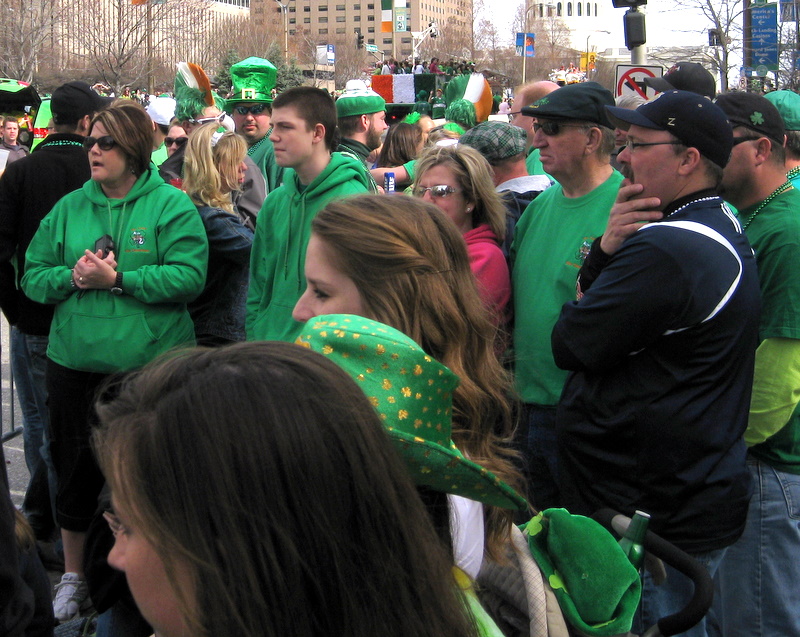
Yesterday, I was trying to get some work done in a tall office building in downtown Saint Louis. In the early afternoon, I was distracted by lots of crowd noise and drum beating outside. It was March 12, which somehow means that it was time for the downtown Saint Patrick’s Day parade (St. Louis also has an 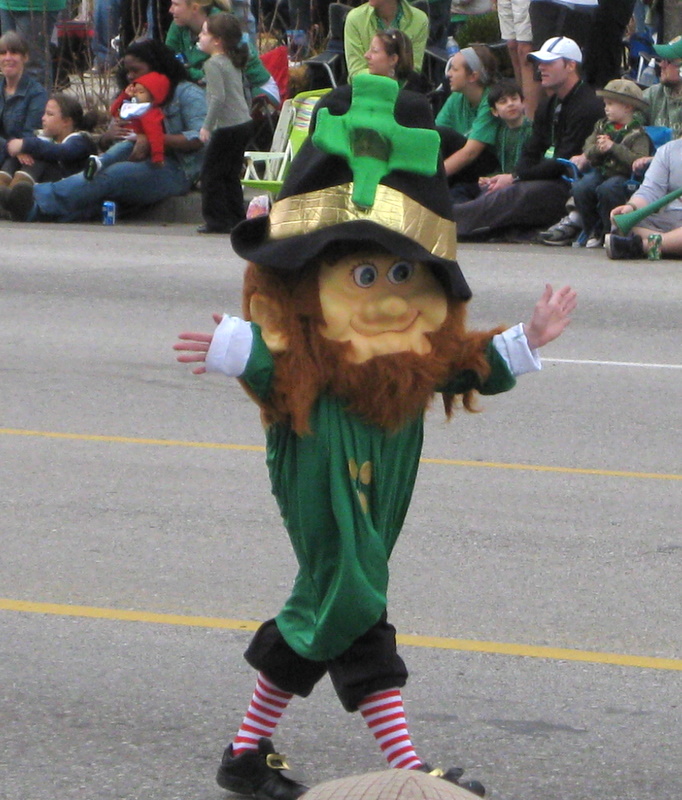 [1]annual Hibernian parade on March 17 [2]). I decided to grab my camera and go down to street level to see things up close. I’m posting a dozen photos with this article.
I’m somewhat of a introverted non-drinking semi-misanthrope, which gives me a special perspective whenever people gather for merriment. Whenever I notice great energy being funneled into big social gatherings, I am immune to being swept up myself. Some would consider the way I am to be a curse, but I disagree. On these occasions I put on my armchair-anthropologist hat and I enjoy the opportunity to get to work. I ponder why it is that human animals so 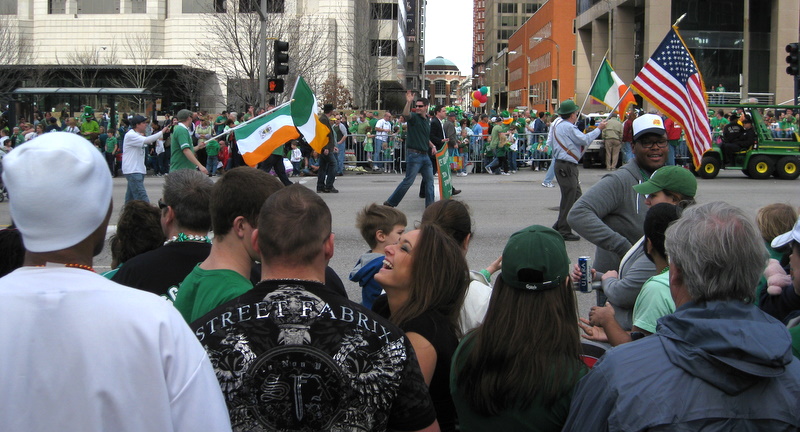 [3]often burn such energy for reasons that almost always escape me. For instance, at Christmas time, very little of the energy is spend pondering Jesus. On the forth of July, very few Americans seriously consider whether we are better off not being part of the British Empire. We are people of food, drink, presents, fireworks and being groupish. We are also prolific excuse-makers.
How would a first rate scientist or historian size up yesterday’s big parade? I believe that the answer is instructive regarding the issues raised here [4]and here [5]). 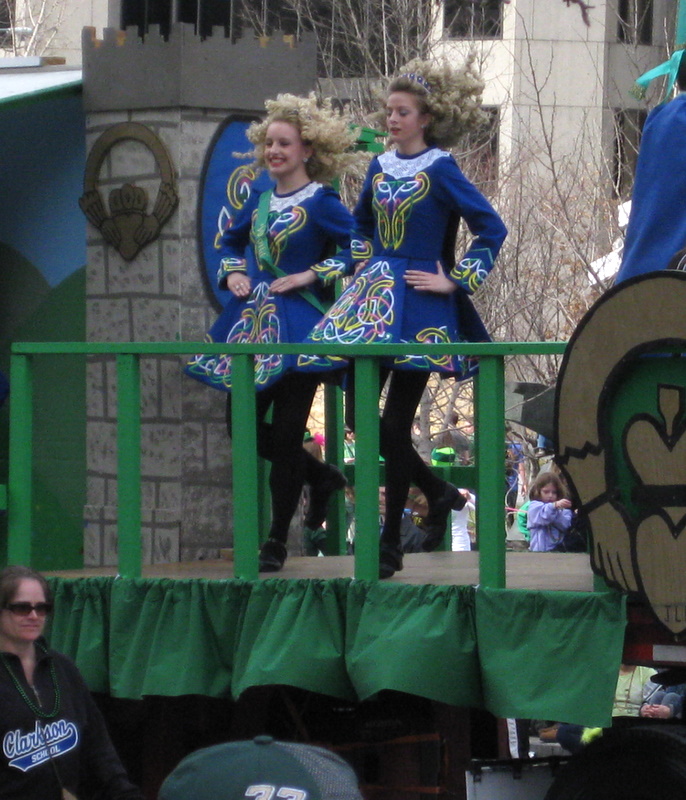 [6] To the extent that a few of the revelers are telling stories about “Saint Patrick [7],” a scientist would immediately suspect that these stories don’t survive scrutiny. For instance, did he really banish snakes from Ireland? Not at all. Scientific evidence shows that there were never snakes in Ireland. Did Saint Patrick really teach people about the Holy Trinity by reference to a shamrock? There is no historical evidence of this. Did his walking stick really take root? There’s no evidence of this either. Was he holy? Scientists would remind us that there is no evidence that supernatural beings or essences exist. Therefore, these stories about Saint Patrick are mere stories–tall tales. If you try to convince the folks that the stories aren’t true, they won’t care. The parade will go on regardless of the truth of the excuse.
Therefore, a scientist would use rigorous science, and an historian would use historical evidence (or lack thereof) to dismantle these legends.
 [8]But why are the people participating in the parade outside my building allegedly so excited about Saint Patrick? Many other countries who don’t care about Saint Patrick hold big celebrations and parades and they find their own excuses to drink excessively. Why does this group outside my office building claim that they are celebrating Saint Patrick? Perhaps it’s a matter of path dependence. [9] Some excuses catch on, and people don’t like to give up annual celebrations that offer an excuse to whoop it up. Perhaps an historian could trace it back and shed more light on this question.
But now imagine a biologist who happened upon the scene, who was annoyed by the parade He considers parades to be a waste of time. He personally considers it to be feeble-minded to believe in the legends of St. Patrick and feels the need to walk up and down the parade route telling people that they are misguided.  [10] But then his frustration leads him to go one step further. He starts arguing out loud that the people who engage in Saint Patrick Day parades are misguided, and that this entire enterprise is a waste of time. He claims that it is feeble-minded and pointless to engage in Saint Patrick’s Day parades. In fact, he proclaims that in his opinion as a first-rate evolutionary biologist participating in Saint Patrick’s Day parades is an evolutionary byproduct, and that it is maladaptive given that people are failing to question the legends regarding St. Patrick.
I would have some serious questions to ask such a scientist. Yes, if you ask  [11]individuals why they are celebrating, they will often cite unsubstantiated legends, and those excuses can be easily shot down using careful science and history. But back up and try to see the parade as one instance of many of people being groupish (note these photos). See the people as we view ants. If we saw ants marching in a miniature parade, dressing up in leaf fragments and showing each other little signs, we wouldn’t declare it to be a byproduct without engaging in some serious study. Something is going on that makes us so undiscriminatingly groupish. A reasonable scientist would do considerable experiments before shouting out “byproduct”!
 [12]
[12]
Consider also, that if the people in yesterday’s crowd weren’t celebrating Saint Patrick, they might well be annually coming together in huge numbers to celebrate some other embellished excuse. Maybe it would be the annual Ground Hog Day Parade or some feast that hasn’t yet been created. Isn’t it possible that the urge to come together and to assert some unsupportable embellished excuse as as the reason for the celebration might be deep in our bones as human animals? Isn’t it possible that this activity of being groupish combined with cognitive distortion (accepting unsupported legends as fact) is potentially adaptive in that it brings people together and facilitates the knitting of the social fabric?  [13]
[13]
Is a scientist really doing science to merely declare that the urge to celebrate unsubstantiated facts together is maladaptive? Isn’t there a huge difference between A) using science to shoot down factually unsupported claims such as the purported reason for the lack of snakes in Ireland, and B) Claiming, without any scientific evidence, that Saint Patrick’s Day Parades are maladaptive byproducts?
I think so.
Print this post [14]
 [15]
[15]