Indonesia invaded East Timor in 1975, after which followed decades of brutal repression and violence directed at the Timorese people. Hundreds of thousands of Timorese [1] have died as a result of the conflict, whether killed outright or as a result of disease and hunger. In one incident alone, known as the Dili Massacre [2], hundreds of people agitating for independence for East Timor were massacred as Indonesian soldiers opened fire. There was no intervention by the United States, and in fact, we continued to sell weapons and train the Indonesian military. There are no known oil reserves credited to East Timor, according to the Energy Information Administration [3] (EIA). Whatever resources do exist are mired in competing claims [4] with Australia.
 [5]
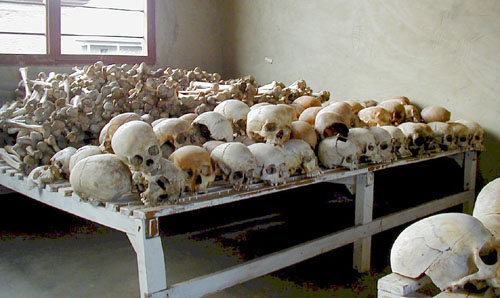
[5]In 1994, an estimated 800,000 people were massacred in Rwanda, or as much as 20% of the entire population (source [6]). A 2001 National Security Archive report [7] faulted the U.S. in five distinct ways for contributing to the crisis:
- The U.S. lobbied the U.N. for a total withdrawal of U.N. (UNAMIR) forces in Rwanda in April 1994;
- Secretary of State Warren Christopher did not authorize officials to use the term “genocide” until May 21, and even then, U.S. officials waited another three weeks before using the term in public;
- Bureaucratic infighting slowed the U.S. response to the genocide in general;
- The U.S. refused to jam extremist radio broadcasts inciting the killing, citing costs and concern with international law;
- U.S. officials knew exactly who was leading the genocide, and actually spoke with those leaders to urge an end to the violence but did not follow up with concrete action.
According to the EIA, Rwanda has no known oil resources [3].
A civil war has been raging for years in Sudan. Wikipedia notes [8] the horrific casualties:
There are various estimates on the number of human casualties, ranging from under twenty thousand to several hundred thousand dead, from either direct combat or starvation and disease inflicted by the conflict. There have also been mass displacements and coercive migrations, forcing millions into refugee camps or over the border and creating a large humanitarian crisis.
 [9]
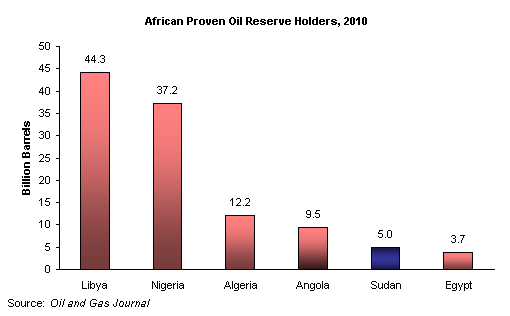
[9]The United States did not intervene in the Sudan, then or now, other than famously bombing a pharmaceutical factory in 1998. Before taking office, President Obama said [10]“I will make ending the genocide in Darfur a priority from day one. ” And yet, hundreds of Sudanese are dying to this day [11], and yet there is no sign of U.S. intervention. There are allegations that the U.S. has provided arms and training to some of the rebel groups [12] in a bid to destabilize the region and prevent China, one of the few world powers challenging U.S. hegemony, from increasing their engagement in the area. (See here [13] also). The Sudan contains between 3 and 5 billion barrels of oil [3], enough to supply the U.S. for between 150 and 250 days. Or it would be if China hadn’t already made arrangements for that oil [14].
But perhaps the clearest case where U.S. hypocrisy is evident is the near-unequivocal support for Israel offered by the U.S in the decade-old Israeli-Palestinian conflict. The 2008 escalation of the conflict included Israel’s version of “shock and awe” [15], in which Israel strategically wanted to appear to “go crazy” and cause large numbers of civilian deaths in order to influence the civilian population to abandon their support of Hamas. Subsequently, Israel enforced a blockade of Gaza, withholding much-needed food and medicine from the occupied territory. There have been multiple allegations of war crimes against Israel [16]. Their use of white phosphorus, an incendiary which sticks to the skin and causes horrific burns, was widely condemned . Two Israeli soldiers were convicted [17] last year of forcing a 9-year old Palestinian boy to serve as a human shield while searching for explosives and booby traps during the conflict. In 2010, an attempt to break the Israeli blockade of Gaza and deliver humanitarian aid was attacked by the Israeli special forces. Nine activists attempting to break the blockade were killed [18] and dozens more were wounded. Six of those were the victims of “summary executions” according to a report from the United Nations Human Rights Council.
In addition to being one of the U.S.’s most important allies in the Middle East, Israel has substantial quantities of oil [19] and gas [20]. Our unwavering support for Israel has not gone unnoticed in the Arab world. Suhail Khalilieh explains [21]:
What is happening in Libya today, and the way the world is reacting to it, brings to mind the US and the international community’s stance on Israel’s 2008-2009 war on Gaza.
The term war did not even apply to that offensive as there was no remote equality of power between Gaza and the Israeli army. The shameful attitude of the international community resulted in the massacre of more than 1,500 Palestinians in the Gaza Strip, more than 5,000 casualties and the destruction of thousands of homes.
On the other hand, US President Barack Obama was swift to sign sanctions on Libya over the unrest there. Meanwhile the EU slapped Libya with a package of economic sanctions, mindful that 85 percent of the country’s oil production goes to Europe.
The puzzling standpoint of the US — giving Gadhafi an “ultimatum” to surrender his power “without delay,” using words of intimidation in a session for the U.N. Human Rights Council in Switzerland — reveals a lot about the US foreign policy toward injustice in the world: a clear cut case of schizophrenia.
“Nothing is off the table as the Libyan government continues to kill Libyan civilians,” said Secretary of State Hillary Clinton.
The EU is no different, instantaneously imposing an arms embargo among other restrictions. Clinton and EU foreign policy chief Catherine Ashton were furious with Gadhafi’s crackdown on the protestors and did not hesitate to take tangible actions against it.
…
None of the atrocities committed by the Israeli army have been put under serious investigation since 2000 when Israeli F16 fighter jets were used to suppress Palestinians. The most infamous atrocities since then include the Jenin massacre, the incursions of Palestinian towns in 2002 known as Operation Defensive Shield, and the 2008-2009 Operation Cast Lead when Israel bombarded the Gaza Strip with the internationally-banned white phosphorus bombs.However, it seems that according to Clinton, only Gadhafi’s regime should be held accountable for human rights abuses, or maybe it will just pave the way for the US and the EU to command a bigger share of Libya’s oil market.
 [22]
[22]Speaking of the Libyan oil market, with 40-45 billion barrels Libya has the largest oil reserves [23] in Africa, and the ninth-largest in the world. The next time you hear about the U.S. about to intervene on “humanitarian” grounds, ask– what else is in it for us? Humanitarian grounds alone have rarely been enough to induce us to intervene.
Print this post [24]
 [25]
[25]