Tim Geithner, appointed to Secretary of the Treasury despite being unable to calculate his own taxes, has just proven he does not understand the role of oil prices in modern economies. Speaking at a breakfast today in Washington, Geithner claimed [1] that:
“The economy is in a much stronger position to handle” rising oil prices, Geithner said…. “Central banks have a lot of experience in managing these things.”
 [2]
[2]This is the opposite of truth. Central banks do not, in fact, have a lot of experience in dealing with rapidly rising oil prices in a worldwide recessionary environment where there is no clear deflation nor inflation. Hell, central banks do not even have a lot of experience in managing an out of control real-estate bubble, or dot-com bubble, or any of the economic crises that hit over the past decade or so. Nor is the American economy in a “much stronger” position than it was in 2008, which was the last time a major oil price spike played a role in devastating the world economy [3].
In fact, there is no shortage of people arguing the opposite of Geithner. Let’s start with Fatih Birol, the chief economist of the International Energy Agency (IEA). Just yesterday, he warned of the danger [4] of high oil price’s impact on the economy:
Fatih Birol, the IEA’s chief economist, said high prices could put pressure on central banks to raise interest rates, especially in more developed countries such as the UK. “Oil prices are a serious risk for the global economic recovery,” he said. “The global economic recovery is very fragile – especially in OECD countries.” He said oil prices had entered a “danger zone” for the recovery at over $90 a barrel.
Economic analysts for the major banking institions agree with Birol [5].
While few analysts see oil returning to its high of $147 hit in 2008 because of oil producers’ excess capacity, crude prices do represent a threat to the global economy and particularly to Europe at levels even well below that.
“Whenever the size of the energy sector in the global economy reached 9 percent, we went into a major crisis,” said Sabine Schels, a commodity analyst at Merrill Lynch.
“It was in the 1980s and it was the same in 2008. Right now we are at about 7.8 percent and if you go above $100 per barrel to $120 per barrel, you get to that 9 percent level.”
Other analysts have calculated exactly how much impact rising oil prices have on the economy [6]:
No one knows precisely at what point oil begins to substantially hinder consumer spending and slow commercial activity — but this much is known: every $1 per barrel rise in oil decreases U.S. GDP by $100 billion per year and every 1 cent increase in gasoline decreases U.S. consumer disposable income by about $600 million per year.
To be sure, the flexible and resilient U.S. economy is more-energy efficient today that it was in 2008, and will likely become even more efficient in the years ahead, but that doesn’t blot-out the fact that the United States remains an oil-dependent economy. Most cars still run on gasoline, trucks on diesel, and oil is also a major fuel for heat. Hence, sustained, high oil prices translate in to bag things for U.S. GDP, corporate earnings growth, and by extension, for most U.S. stocks.
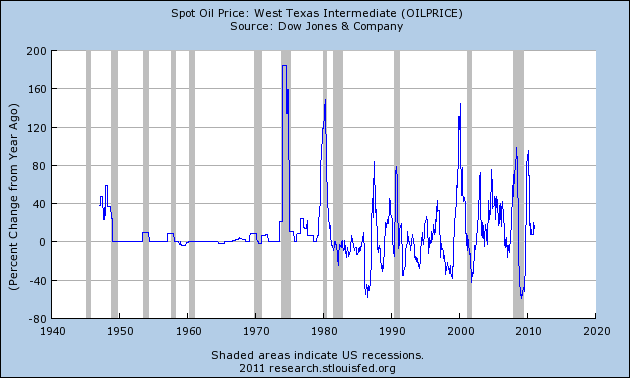
Even data from the Federal Reserve tends to support the conclusion that oil prices are intimately tied up with the economy. See this chart from the St. Louis Fed, showing that with only one exception, oil price rises of over 80% year-over-year have been followed by recession for the last 40 years. I don’t count the 2010 oil price spike as an exception as I fully expect a renewed recession as a result of these oil prices:
 [7]
[7]
In racking my brain trying to understand how Geithner could make such a boneheaded claim, it suddenly hit me. He meant that higher oil prices won’t have a material impact on the wealthy. Proportionally speaking, that’s true, but only at the first derivative. Gail at The Oil Drum explains [8]:
Energy expenditures are not a big share of income for high income people, but they are for the many people getting along on minimum wage, or close to minimum wage. If oil prices go up, these folks find the price of food and gasoline going up, and perhaps the price of home heating and electricity (because the prices of the various types of energy tend to move together). They find their budgets stretched, and they either
1. Cut back on discretionary spending, or
2. Default on loan repayments.
A similar situation happens to the many people who earn more than minimum wage, but live paycheck to paycheck, and pretty much spend all the money they earn. As the prices of energy-related goods rise, these people too find a need to cutback. Some will cut back on discretionary goods; others will default on loan repayments; some will do both.
Thus, when oil prices rise (or energy prices in general rise), we end up with two main effects:
1. Banks find themselves in worse condition because of many loan defaults.
2. The economy starts feeling recessionary impact, because so many people cut back on buying discretionary goods.
And bingo, the recessionary cycle starts again. Geithner’s worldview is so far gone from that of most people, though, that he doesn’t understand microeconomics. A rise of a dollar in the price of gas will not force hard personal choices on Geithner, nor I daresay many of his pals. But for the vast majority of Americans, we live on an actual budget. A rising gas price means that we can’t spend that money on other things. Simple, right? Too bad they guy in charge of the Treasury doesn’t understand it.
Print this post [9]
 [10]
[10]