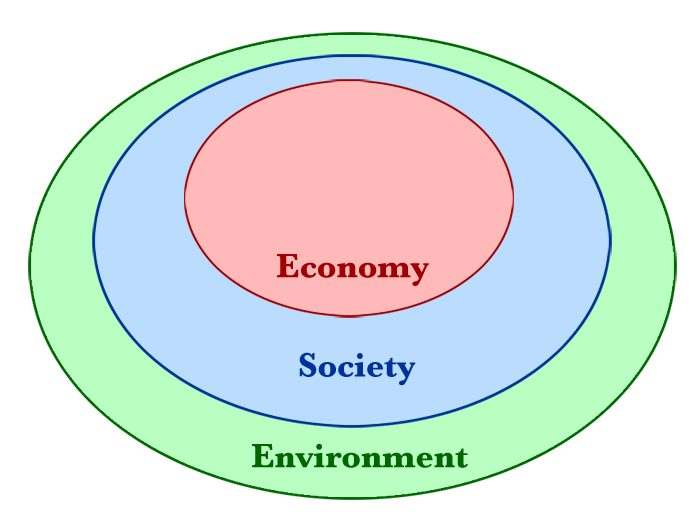
There is much talk of “sustainability” these days, but I don’t think very many people have considered what that truly means. “Sustainable” has become synonymous with “green”, which in our hyper-consumerist American society has transformed into “buy something [1]“. Understandable, perhaps, but it’s deadly wrong. The World English dictionary defines “sustainable” as “2. (of economic development, energy sources, etc) capable of being maintained at a steady level without exhausting natural resources or causing severe ecological damage”, which seems to me to be a pretty good definition of what the word really means, as opposed to what people think it means.
Environmentalist and author Derrick Jensen explains the problem of sustainability in his book Endgame Vol. I: The problem of civilization [2].
“Any social system based on the use of nonrenewable resources is by definition unsustainable…The hope of those who wish to perpetuate this culture is something called “resource substitution,” whereby as one resource is depleted another is substituted for it… Of course, on a finite planet this merely puts off the inevitable, ignores the damage caused in the meantime, and begs the question of what will be left of life when the last substitution has been made. Question: When oil runs out, what resource will be substituted in order to keep the industrial economy running? Unstated premises: a) equally effective substitutes exist; b) we want to keep the industrial economy running; and c) keeping it running is worth more to us (or rather to those who make the decisions) than the human and nonhuman lives destroyed by the extraction, processing, and utilization of this resource.
…
“Another way to put all of this is that any group of beings… who take more from their surroundings than they give back will, obviously, deplete their surroundings, after which they will either have to move, or the population will crash… This culture — Western Civilization– has been depleting its surroundings for six thousand years, beginning in the Middle East and expanding now to the entire planet. Why else do you think this culture has to continually expand? And why else, coincident with this, do you think it has developed a rhetoric– a series of stories that teach us how to live– making plain not only the necessity but desirability and even morality of continued expansion– causing us to boldly go where no man has gone before– as a premise so fundamental as to become invisible? Cities, the defining feature of civilization, have always relied on taking resources from the surrounding countryside, meaning, first, that no city has ever been or ever will be sustainable on its own, and second, that in order to continue their ceaseless expansion, cities must ceaselessly expand the areas they must ceaselessly hyperexploit. I’m sure you can see the problems this presents and the endpoint it must reach on a finite planet. If you cannot or will not see these problems, then I wish you the best of luck in your career in politics or business.” (p. 36-37)
 [3]
[3]Jensen argues that we are now in the endgame of human civilization, and that human survival is literally at stake. But right now you’re probably saying to yourself, “I’ve heard all of this before, and nothing bad has happened.” We could accuse Jensen of being another Malthusian nutcase, but more and more scientists and experts are warning of similar danger. Malthus warned that human population was expanding faster than it could increase production of food, but he failed to anticipate the advances that came as a part of the Industrial Revolution. Malthusian warnings now commonly mocked as wrong, but what if he were simply early? Andrew Leonard at Salon.com writes [4]:
“And yet his dystopian vision that humanity’s lot, our inescapable fate, will be grinding, desperate poverty, lives on. Down for more than 200 years, but not yet out, because there’s always a get-out-of-jail-free card for Malthus: Just wait.
Just wait until the technological wellsprings of innovation run dry, when even the most advanced genetic modification technologies can no longer boost food yields. Just wait until peak oil puts an end to the age of cheap energy, until the oceans are overfished and the atmosphere is choked with carbon dioxide. Just wait until Chinese and Indians and Brazilians consume with the same unsustainable abandon as Americans. Malthus isn’t wrong — he just isn’t right … yet.”
Similarly infamous was the wager between economist Julian Simon and ecologist Paul Ehrlich [5]. The wager was that the price of a basket of metals would be higher in ten years time than when they made the bet in 1980. Ehrlich lost that bet, and it entered into our cultural memory as proof that the free markets solve all of our problems and that environmentalists are the modern Chicken Little. Energy blogger Gregor MacDonald explains [6]why that understanding is mistaken:
“…once you start moving the 10 year bracket forward from 1980 then Ehrlich, who bet on scarcity and lost, starts to win. Indeed, the winner of the wager was the beneficiary of timing, not insight. But leave it to economists to convert ephemeral conditions into permanent ones. While it’s true that both the price signal and technology can bring forth more supply of resources, often at lower costs, this is only true up to a limit. Once those limits are reached, as we have seen in global Copper and also Oil for example, then better technology might be able to create more supply on a nominal basis, but not at a lower price, and not in real terms.”
In other words, although technology and the free market can allow us to find oil in places we couldn’t before (like say, under a mile of water in the Gulf of Mexico), or even to exploit a greater percentage of the oil that we find, they cannot make up for the fact that oil is ultimately a finite resource. The time-frame to generate new supplies is millions of years. Global oil discoveries peaked in the 1960’s and we have used more oil than we’ve discovered since the 1980’s [7], so our situation becomes more precarious by the day.
It would be a mistake to focus simply on oil, though. The truth is, we face an enormous and interconnected set of problems without any easy solutions. Rather than simply Peak Oil, we are really dealing with what Richard Heinberg calls “Peak Everything [8]“. We are living beyond our means, ecologically speaking, and one day that bill will come due. Unfortunately, we keep racking up the bills, faster than ever [9]:
Think tank the New Economics Foundation (NEF) look at how much food, fuel and other resources are consumed by humans every year. They then compare it to how much the world can provide without threatening the ability of important ecosystems like oceans and rainforests to recover.
This year the moment we start eating into nature’s capital or ‘Earth Overshoot Day’ will fall on 21st August, a full month earlier than last year, when resources were used up by 23rd September.
Climate change is affecting both humans and other species, threatening all of our collective survival. The U.N. is among the most strident in sounding the warning. Ahmed Djoghlaf, the secretary-general of the U.N. Convention on Biological Diversity, argues [10] “What we are seeing today is a total disaster… if current levels [of destruction] go on, we will reach a tipping point very soon. The future of the planet now depends on governments taking action in the next few years.” The Guardian continues [10]:
According to the UN Environment Programme, the Earth is in the midst of a mass extinction of life. Scientists estimate that 150-200 species of plant, insect, bird and mammal become extinct every 24 hours. This is nearly 1,000 times the “natural” or “background” rate and, say many biologists, is greater than anything the world has experienced since the vanishing of the dinosaurs nearly 65m years ago. Around 15% of mammal species and 11% of bird species are classified as threatened with extinction.
Almost 1,000 times the background rate of extinction, and accelerating. Far worse,these extinctions and declines are starting to affect species that form the foundation of the food chain. If these species go, there will be no turning back. The Independent reports [11]:
The microscopic plants that support all life in the oceans are dying off at a dramatic rate, according to a study that has documented for the first time a disturbing and unprecedented change at the base of the marine food web.
Scientists have discovered that the phytoplankton of the oceans has declined by about 40 per cent over the past century, with much of the loss occurring since the 1950s. They believe the change is linked with rising sea temperatures and global warming.
…
“Phytoplankton is the fuel on which marine ecosystems run. A decline of phytoplankton affects everything up the food chain, including humans,” Dr Boyce said.
A meta-analysis of the existing data on the health of the world’s oceans came to a very similar conclusion last year [12].
Comparing the oceans to human lungs, [study lead-author Ove] Hoegh-Guldberg said
“… the findings have enormous implications for mankind, particularly if the trend continues … Quite plainly, the Earth cannot do without its ocean. This study, however, shows worrying signs of ill health. It’s as if the Earth has been smoking two packs of cigarettes a day!”
…Hoegh-Guldberg does not keep anyone in suspense over the consequences of unchecked climate change.
“This is further evidence that we are well on the way to the next great extinction event.”
Not merely on the way, the extinction event has been happening for some time. 21% of all mammals are at risk for extinction [13], as are 30% of amphibians. Some scientists have called the modern age the “anthropocene [14]“, and are warning that the scale of extinctions could be similar to the five other acknowledged epochs in Earth’s history. Species are now vanishing faster than they have at any other time in the past 65 million years [15]:
Researchers now recognise five earlier cataclysmic events in the earth’s prehistory when most species on the planet died out, the last being the Cretaceous-Tertiary extinction event of 65 million years ago, which may have been caused by a giant meteorite striking the earth, and which saw the disappearance of the dinosaurs.
But the rate at which species are now disappearing makes many biologists consider we are living in a sixth major extinction comparable in scale to the others – except that this one has been caused by humans. In essence, we are driving plants and animals over the abyss faster than new species can evolve.
Consider some other recent headlines:
- One-fifth of the world’s vertebrate species at risk of extinction [16]
- Tigers could be extinct in 12 years [17]
- One in five plant species faces extinction [18]
- Census of marine life: large animals in danger of dying out [19]
- And if you like oysters, better eat them while you still can: Oysters disappearing worldwide, now “functionally extinct” [20]
 [21]
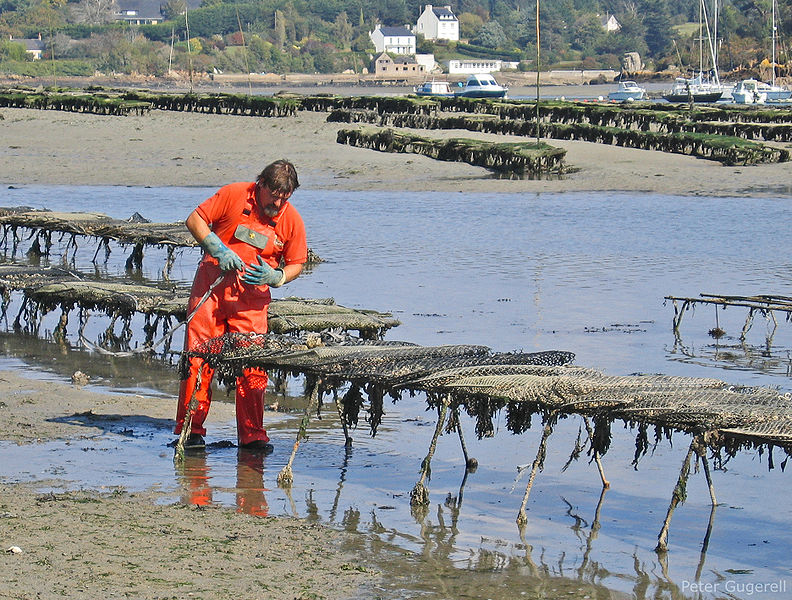
[21]Culturing oysters- one attempt to mitigate failing natural harvests. Image via Wikipedia (commons)
This is coming at a time when it’s already increasingly difficult to feed the people that we already have, not to mention the billions on the way. The impacts of climate change, global price speculation, increasing population, the shift to a Western diet, limited water supplies, etc… are already causing prices to spike and people to go hungry. From 2005-2008 world food prices were up 217% [22]. The challenge is ongoing, in another 20 years we will need to increase our food production by 50% [23] just to keep up. The diversion of cropland from agriculture to the production of biofuels as a result of the arrival of peak oil means that we are already deciding that it’s more important to power our extravagant lifestyles than it is to make sure that people are fed. Not only that, but the demand for biofuels is so strong, it’s accelerating deforestation and a host of other environmental problems [24]. Even wealthy and fully-developed countries like Britain [25] and Australia [26] are starting to ask how they are going to feed themselves. Corporations and governments around the world are grappling with the same question, and buying up key commodities like potash. The Telegraph [27] explains [27]:
However, this month has also seen news reports on escalating wheat and coffee prices due to bad weather and poor harvests. Then on August 19 came the headline “Australian mining giant launches hostile $40 billion takeover bid for world’s largest potash supplier”. It is not immediately apparent what we’re talking about here, but this is City champagne bar speak for “world runs out of food”. This really is news about food that consumers should be fearful of.
There is a finite quantity of naturally occurring potash, or potassium carbonate, in the Earth’s crust. You can manufacture it by burning down forests of broad leaf trees – let’s not go there. Digging it out of the ground is the agri-business-preferred option. Meanwhile, to produce the nitrogen for fertiliser you need to burn an awful lot of – er – crude oil. Yep, the world is going to look like a perforated airflow golf ball by the time we’ve finished with it.
Every government needs to pay attention to what is happening. It is the opportunity for a debate about what is the right way forward and it may well be that if, at this juncture, we choose the wrong food policy, there will be no going back.
See what I mean about peak-everything? But hey, who cares, right? That new I-pad sure looks spiffy.
Others are also warning of the interconnected and synergistic nature of the threats facing humanity [28]:
But in his chilling book The Coming Famine, journalist and science writer Julian Cribb warns we are headed towards global food shortages in the next 40 years because of scarcities of water, good land, energy, nutrients, technology, fish and, significantly, stable climates. You can add to that population growth, consumer demand and protectionist trade policies.
“The coming famine is also complex, because it is driven not by one or two, or even half a dozen factors but rather by the confluence of many large and profoundly intractable causes that tend to amplify one another,” Cribb writes. “This means that it cannot be easily remedied by ‘silver bullets’ in the form of technology, subsidies, or single-country policy changes, because of the synergetic character of the things that power it.”
The world is running out of farmland. Advanced farming depends entirely on fossil fuels likely to become scarce, supplies of nutrients for farming have peaked and fresh water resources are finite. With global warming, up to half the planet faces regular drought by the end of the century. Storms and the kinds of floods that have devastated Pakistan are tipped to become more frequent and intense.
The same basic factors are at play in each of these cases: the relentlessly increasing population, and the profligate use of resources. We assume that because technology has always saved us in the past, that it will inevitably do so in the future. Unfortunately, we’re starting to see the contours of some very unyielding limits. Not to mention that our so-called solutions have in some cases created other, unforeseen problems. Like the fertilizers that powered the Green Revolution which are now causing dead zones in the Gulf of Mexico the size of Massachusetts [29], compounding the problem of feeding ourselves.
 [30]
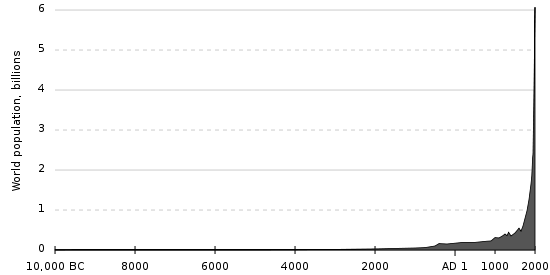
[30]Erich here at Dangerous Intersection has called for a more open debate on the population problem [31], and he’s hardly alone. The Independent wrote earlier this year [32]:
Misery, what misery? You can of course imagine the political class arguing that scientists have consistently got it wrong about overpopulation. But the next 40 years are going to be very different to the previous 40 years, and many scientists fear that there will indeed be extreme misery to come if the world does not take population more seriously.
The facts speak for themselves. The UN estimates that the global population will rise from 6.8 billion in 2009 to 8.3 billion by 2030, with much of the increase in the poorest countries, notably sub-Saharan Africa, which is set for a 51 per cent increase in the same period – four times that of the UK.
World food production will have to increase by 50 per cent to meet rising demand; water availability will have to increase by 30 per cent; and global energy demands by 50 per cent. Politicians may think that science and technology will provide what is needed, as it has done in the past at a cost to the environment, but many scientists are not so sure.
But, somehow, everything seems to be relatively normal as we look around. Ecosystems are collapsing around us, but by most objective measures, more people are doing well than at any time in the past. This is known as the “environmental paradox”, and researchers are struggling to understand why. In discussing a new study, Scientific American lays out the case [33]:
For decades, apocalyptic environmentalists (and others) have warned of humanity’s imminent doom, largely as a result of our unsustainable use of and impact upon the natural systems of the planet. After all, the most recent comprehensive assessment of so-called ecosystem services [34]—benefits provided for free by the natural world [35], such as clean water and air—found that 60 percent of them are declining.
Yet, at the exact same time, humanity has never been better. Our numbers continue to swell [36], life expectancy is on the rise, child mortality is declining, and the rising tide of economic growth is lifting most boats.
The study that Scientific American is talking about is available for a limited time here [37], after which it will be behind a paywall. The authors of the study examine 4 hypotheses to explain the divergence between the health of the planet and the health of it’s global population.
The four hypotheses are:
1. Critical dimensions of human well-being have not been captured adequately, and human well-being is actually declining. Measures of well-being that suggest it has increased are wrong or incomplete.2. Provisioning ecosystem services, such as food production, are most significant for human well-being; therefore, if food production per capita increases, human well-being will also increase, regardless of declines in other services.
3. Technology and social innovation have decoupled human well-being from the state of ecosystems to the extent that human well-being is now less dependent on ecosystem services.
4. There is a time lag after ecosystem service degradation before human well-being is negatively affected. Loss of human well-being caused by current declines in services has therefore not yet occurred to a measurable extent.
The authors dismiss the first hypothesis, as the data in this area is fairly clear and convincing. Society as a whole seems to have adopted the third hypothesis as unalloyed truth. One could make a pretty good case for the second hypothesis, but personally I think that the fourth is the most likely. None of these are mutually exclusive, so it would be more accurate to say that it’s probably some combination of the second and fourth hypotheses. In other words, because we’ve been able to generate an increasing amount of food per-capita, we’ve been blind to damage in other areas. That damage will catch up with us at some point in the future, but has not yet. For reasons explained in this post [38], sometimes “tipping points” are reached which we are unable to see coming, after which we are unable to regain equilibrium until we reach a new, stable state of ecology, usually at a much-impoverished level from the previous steady state. A similar dynamic can be observed in the economic arena, as experts are telling us that the millions of newly unemployed persons since the crisis began in late 2008 are symptomatic of structural changes to the economy [39], meaning that the high levels of unemployment are the “new normal” for the forseeable future [40]. (Note also that under the “new normal” link, the authors at the Brookings Institute attribute a major part of the economic crisis to excessive levels of consumption, which “depended increasingly on unsustainable increases in household debt and declines in personal savings”– a clear parallel to our ecological situation.)
As I mentioned at the beginning of this post, some very credible and brilliant scientists are sounding the alarm, some in surprising ways. Stephen Hawking is warning that we must find a way to abandon this planet if humanity is to survive [41]:
The man who helped eradicate smallpox, Professor-emeritus Frank Fenner, has a similar warning [42]:
We humans are about to be wiped out in a few decades. The grandchildren of many of us will not live to old age.
Hear it from Frank Fenner, emeritus professor of microbiology at the Australian National University and the man who helped eradicate smallpox.“Homo sapiens will become extinct, perhaps within 100 years,” he told The Australian this week.
“It’s an irreversible situation.” Blame global warming.
So, to round it back up to where we started, “sustainable” has become the latest buzzword, but stop and think about what it really means. Sustainability is like pregnancy– there is no partway. Either we have a sustainable civilization, or we don’t. It’s clear that we don’t, so what are the implications of that? Either we get sustainable, or we risk collapse and extinction. The only debate left is over the time-frame.
If one thing is clear, it’s that we cannot depend on government action to take the necessary steps. Politicians are generally incapable of seeing beyond the next election cycle, and sometimes not even that far. The U.S. National Intelligence Council (which, according to its website [43], seeks “to provide policymakers with the best, unvarnished, and unbiased information—regardless of whether analytic judgments conform to US policy”) released a report in late 2008 [44] which makes this crystal clear in its analysis of the converging threats facing us (emphasis mine):
A switch from use of arable land for food to fuel crops provides a limited solution and could exacerbate both the energy and food situations. Climatically, rainfall anomalies and constricted seasonal flows of snow and glacial melts are aggravating water scarcities, harming agriculture in many parts of the globe. Energy and climate dynamics also combine to amplify a number of other ills such as health problems, agricultural losses to pests, and storm damage. The greatest danger may arise from the convergence and interaction of many stresses simultaneously. Such a complex and unprecedented syndrome of problems could overload decisionmakers, making it difficult for them to take actions in time to enhance good outcomes or avoid bad ones. (p.41)
But don’t worry. Robert Laughlin, the co-recipient of the 1997 Nobel prize for Physics, explains that the earth will be just fine [45], even if we will not:
Humans can unquestionably do damage persisting for geologic time if you count their contribution to biodiversity loss. A considerable amount of evidence shows that humans are causing what biologists call the “sixth mass extinction,” an allusion to the five previous cases in the fossil record where huge numbers of species died out mysteriously in a flash of geologic time. A popular, and plausible, explanation for the last of these events, the one when the dinosaurs disappeared, is that an asteroid 10 kilometers in diameter, traveling 15 kilometers per second, struck the earth and exploded with the power of a million 100-megaton hydrogen warheads. The damage that human activity presently inflicts, many say, is comparable to this. Extinctions, unlike carbon dioxide excesses, are permanent. The earth didn’t replace the dinosaurs after they died, notwithstanding the improved weather conditions and 20,000 ages of Moses to make repairs. It just moved on and became something different than it had been before.
Print this post [46]
 [47]
[47]