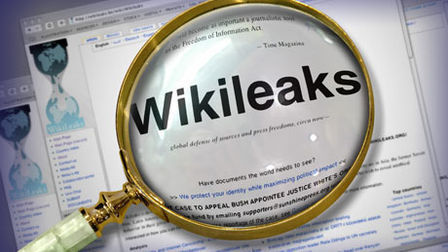
 [1]
[1]“Turn yourself in, Julian Assange.” (Headline in Slate [2], Dec. 6, 2010)
Wikileaks founder Julian Assange surrendered to British authorities December 7th, 2010.
“Turn yourselves in, Federal Employees.” (Headline in next week’s news?)
The Office of Management and Budget (OMB) issued a memo [3] to agency heads December 3rd, which may result in an order forbidding Federal employees from downloading or viewing Wikileaks documents.
How a government responds to the illegal release of its classified documents is predictable. How an individual struggles over whether to release classified documents is anything but predictable. Christopher Hitchens wrote the following [2] about his own experiences in relation to Britain’s Official Secrets Act.
A democratically elected British Parliament had enacted an Official Secrets Act, which I could be held to have broken. Would I bravely submit to prosecution for my principles? (I was later threatened with imprisonment for another breach of this repressive law, and it was one of the reasons I decided to emigrate to a country that had a First Amendment.)
The 1980s BBC sitcom Yes Minister [4] laid bare the inner workings of the British government through the twin prisms of English humor and focused insight. “Jobs for the Boys,” an episode that mentioned the Official Secrets Act [5], began by revealing Sir Humphrey Appleby’s need to cover-up a scandal surrounding some of his past financial misdealing. Sir Humphrey was the supremely self-serving, Permanent Secretary to the Department of Administrative Affairs (DAA).
In the following “Jobs for the Boys” dialog Sir Humphrey shares his understanding of the real purpose of the Official Secrets Act with Bernard Woolley, private secretary to the Minister for the DAA.
Bernard: Sir Humphrey, this is a bit of cover-up, isn’t it?
Sir Humphrey: We’ll use the Official Secrets Act.
Bernard: But how can it possibly be a secret. It’s so huge.
Sir Humphrey: It’s a big secret Bernard.
Bernard: But surely you can’t use the official secrets act. Not with something that everybody knows about.
Sir Humphrey: Bernard, The Official Secrets Act is not to protect secrets. It’s to protect officials! (Emphasis added!)
High-level government officials use secrecy at times as a means for reaching political and administrative solutions in the conduct of international diplomacy and domestic affairs. Sovereign nation-states have the power to shield the acts of government officials from public view.
This year Wikileaks released hundreds of thousands of classified documents reflecting the secret exercise of nation-state power, which in some cases deprived individuals of rights, liberties and freedoms. Wikileaks raised questions about how best to prevent government officials acting in secret from harming individual citizens of their own and foreign nations.
What comes next? What have we yet to learn as Wikileaks releases additional documents in opposition to the secret exercise of nation-state power? What differences, if any, will Wikileaks make in the conduct of domestic politics, in the conduct of international diplomacy?
Print this post [6]
 [7]
[7]