I claim to be a traveler. But I don’t travel for business. I work from home, so there is not even a daily commute. I have been on only two commercial jets trips in the last decade. So how can I claim to be a traveler?
My wife and I take road trips. During our most recent one, we distinctly experienced the disconnect between “travel” and “vacation.” Recall National Lampoon’s Vacation [1], but a longer trip, no kids, and most of our destination sites were (barely) still open. Had we left a few days later, and we would have missed much more.
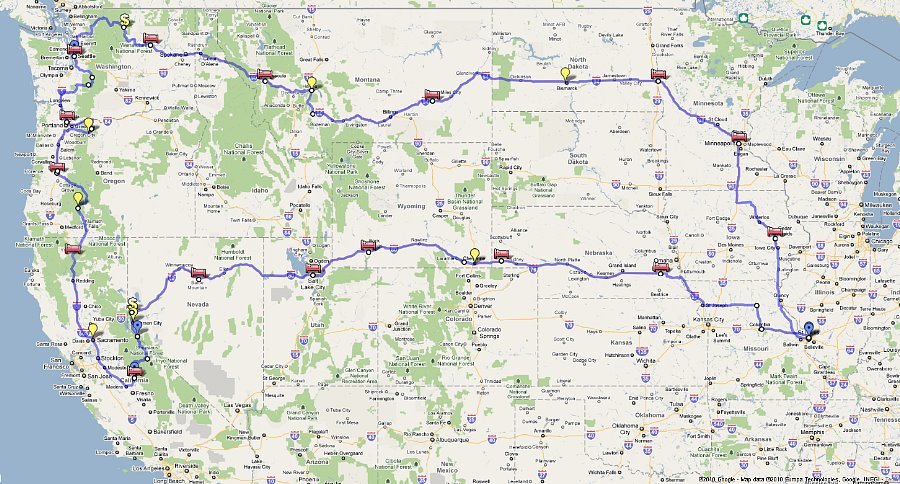 [2]This latest trip (click on the map for more details) was an effort: We drove 6,000 miles in 22 days, across thirteen states, in a sedan that I’d bought new for $12k in 1998. It now has over 185,000 miles on it, but still averaged better than 36 mpg for the journey. We took some stretches of older roads to better see America.
My narcissistic self photo-blogged as we went. At least on days when there was enough time left for writing and digital darkroom work. About half of the trip got posted only after we got back. But my subscribers could keep track of where we were because I’d skip days and back fill rather than writing from beginning to end. I didn’t report certain points in my travelogue, in the interest of time.
 [3]A tour guide under Seattle asked the group how far we’d traveled. The farthest was from Japan. I mildly resented the question, because the farthest of these “travelers” simply walked into an aluminum tube and were delivered to this city a few hours later. Practically teleportation. But our trip was a journey of several days longer than that of any of these other folks. We worked harder to get here, and know the route.
Travel, to me, is a process in the spirit of the Odyssey. Popping to a new town by jetliner isn’t really travel because there is no transition. A flight to New Orleans is exactly like a flight to San Francisco. But if you drive, one route traverses woods, bayous and moss forests, and the other covers mountains, deserts, and ferny rain forests. When driving, you know that you are in a different world, and get a feel for why the endpoint is how it is.
We do hit the road with a destination in mind, but remain open to seeing what we can see. As in “The bear went over the mountain” song, the target is the mountain. But the goal is yet to be determined. Yes, this song was stuck in my head a few times on the trip. But some of the best stops were unplanned detours.
In my youth I was a poor candidate for a road tripper; I got car sick. Any ride more than a half hour, however smooth, had me heaving. I survived family trips to Florida and Michigan, and an annual week at Bull Shoals Lake (about 8 hours away back before I-44 was opened). By the end of each trip my car sickness would subside. We even drove all over Europe when I was 11, so I decorated roadsides in many countries. Travel was not a good word to me.
But I had enjoyed reading Henry Reed’s Journey [4] so much when I was 8, that I re-read it annually till I was as old as — and even a few years older than — the protagonist. I’ve also read several other classic road trip books. And there was the TV Series “Route 66 [5]“. I even have a cousin featured in a chapter of The Electric Kool-Aid Acid Test [6]. So my early nauseated travel disposition was largely trained and enticed out of me.
Sadly, the tradition of a road trip grew until 1960’s, and then withered up. I think that three major factors did it in:
- Dropping air fares made flight cheaper than road travel except for the largest families and shortest trips. Figure in gas and motels versus car rental, and a trip longer than a couple of hundred miles became cheaper to fly.
- The Eisenhower Interstate system created level and straighter and restricted access routes, often replacing or bypassing the WPA Roosevelt Federal Highways. This turned travel from adventure to boredom. How can you stop for the cutie in the produce stall when they are forbidden to be within 100′ of the road on which you are forbidden to park? At 75mph, a tourist attraction needs to be advertised miles in advance on huge and expensive billboards, and is expected to provide every amenity.
- And television brought the world into your living room in living color. The producers want you to feel as though you’ve been there. But until you actually go to these places, you don’t know how much you are missing. Now the internet lets you view almost any place you want to, real time and on demand. Why go anywhere? Here’s the Colorado River in Canyonlands [7]. But you cannot feel the breeze, hear the subsonic rumble of the water, or smell the piñon pines. Even IMax is a poor substitute for actually being in the Grand Canyon.
One now can cross the country on the ground without ever seeing a town smaller than a big city. The older roads were slightly slower, but much more interesting to drive. One had to slow down for towns and see things by the road. Even in between towns, you were only feet away from the cows and trees, not 1/4 mile away.
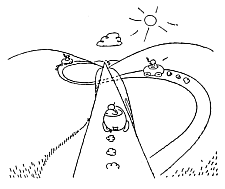
As Piet Hein [8] put it in his 1960’s Grook
 [9]
[9]Road Sense
another winding road,
will take another load
They’re busy making bigger roads,
and better roads and more,
even faster than before
that everything is everywhere alike.
I disagree that everywhere is alike. Sure, the near-instant transportation that the end of the 20th century took for granted is homogenizing culture. So too is the media endorsement of multiculturalism making all products available in all cities. But there is still regional pride. But you may have to get off the interstate to find it.
 [10]Also, some of the improved divided Federal Highways are not quite as bland as interstates. Yet. These sections of road have one direction on modern, flat, straight pavement, and the other way is still the old, scenic roller coaster road. US-36 in Missouri is still like that. If you are going east, it is almost like taking the old roads.
Alas, our country is now full of ghost towns. Not just the old wild-west and mining boom towns that were tourist stops half a century ago. A few still are. But now most of the highway tourist boom towns of the 30’s through 70’s are largely boarded up. Some states worked to preserve the old highway life. As did Oklahoma with its turnpike paralleling US-66. But the old classic motels and diners of the heyday of mid 20th century travel are dead or dying where the old road drifts too far from free interstates.
Road travel is a somewhat poignant experience, as I feel nostalgia for the era I missed. But there is still a living culture of travel. TV shows like Rare Visions Road Trip [11]and websites like RoadsideAmerica.com [12] try to keep it alive. But relatively few people actually go to these locations. Too many are satisfied to see them on their HDTV, not knowing what they miss.
And the only way to find out is to travel. Knowledge may be what you read or are told. But wisdom is what you find out the hard way; what you work to learn. The serendipitous adventure of a road trip, however well planned, brings wisdom and understanding of our country, its culture, and its destiny.
Print this post [13]
 [14]
[14]