On May 18, 2010 the Center for Inquiry [1], the Council for Secular Humanism [2] and the Committee for Skeptical Inquiry [3] jointly announced that they had accepted the resignation of Paul Kurtz [4] from each of these boards. Kurtz, who had founded each of these three organizations [5], had been serving on each of the boards, and as well as serving as Chair Emeritus of CSH and as Editor in Chief of CSH’s flagship publication, Free Inquiry. In the joint announcement, the boards recognized Dr. Kurtz for his “decades of service to the Council for Secular Humanism, the Center for Inquiry (CFI), and its other affiliates.” This same announcement also contained the following statement:
At Paul Kurtz’s behest, CFI and its affiliates began years ago to organize a leadership transition. Moreover, in recent years the board had concerns about Dr. Kurtz’s day-to-day management of the organization.
As a long-time subscriber to Free Inquiry and Skeptical Inquirer, I was familiar with many of the writings of Paul Kurtz, but I had never before spoken with him or corresponded with him. As a result of reading his articles at Free Inquiry, I was also aware that there was internal tension at those organizations (e.g., see here [6] , here [7], and here [8]).
After reading about his resignation, I emailed a short note to Mr. Kurtz to wish him well in light of the announcement of his resignation. I also asked him whether he would allow me to interview him with regard to the announcement. He agreed:
[Note: CFI’s CEO Ron Lindsay responded to the following interview of Paul Kurtz here [9].]
EV: To what extent was your resignation from the Center for Inquiry voluntary?
PK: It was done voluntarily, but under great duress.
 [10]
[10]—
EV: What were your titles and job duties prior to your resignation.
PK: I founded the modern skeptics movement and sustained it for over three and a half decades. I had been the Chairman of the Center for Inquiry, the Council for Secular Humanism and the Committee for Skeptical Inquiry. In June, 2008, I was made “Emeritus” and stripped of any authority. Since 1980, I was Editor-in-Chief for Free Inquiry, but starting in June 2008, I no longer had any authority. I never received any compensation working for these organizations. I worked as a volunteer, living off savings I accrued while working as a philosophy professor. In fact, my wife and I donated more than $2 million dollars over the years to CFI, CSH and CSI. We were the second largest donors to these organizations. Over the years, I helped to raise over $40 million for the Center for Inquiry.
—
EV: I saw the announcement of your resignation in the August/September, 2010 issue of Free Inquiry. Why didn’t you publish any explanation regarding your resignation in Free Inquiry?
PK: Tom Flynn and the CFI Board refused to run my letter of resignation in Free Inquiry or any of the Websites of CFI. It was censorship, clear and simple. I was censored four times, beginning in June 2008.
—
EV: Isn’t the refusal to publish your position at odds with an organization that calls itself “Center for Inquiry” or an organization that publishes “Free Inquiry“?
PK: It is similar to thought police. Alas! They refused to publish three of my editorials, and they refused to publish my statement regarding my resignation. What a contradiction. Even though I am the founder of the organizations, their position essentially was that I had no right to publicly express my concerns about the direction of the organization or the new management practices adopted under the current leadership — both of which I have grave reservations about. I consider this as similar to a Board of Bishops seeking to control its Founder.
 [11]
[11]—
EV: Given that you are the founder of the Center for Inquiry and you were the Editor in Chief of Free Inquiry, how did it make you feel when you were forced to resign?
PK: I have been censored and members of the staff have been instructed not to reveal any information about CFI to me. Barry Karr said that since I resigned, I have no right to be made aware of internal matters within the organization. I asked, “What about my moral authority? I said, “This is similar to what happened to Galileo when placed under house arrest.”
 [12]
[12]EV: In its announcement that you were resigning, the Center for Inquiry stated that the board “had concerns about Dr. Kurtz’s day-to-day management of the organization.” Had you been in charge of the day-to-day operations of the Center prior to your resignation?
PK: No. Actually, I delegated most decisions to the staff on a day-to-day basis. I was primarily concerned with the overall direction.
—
EV: Do you still have a physical office at the Center for Inquiry?
PK: Yes. At one time current President and Chief Executive Officer Ron Lindsay asked me to turn in my keys. I said that I designed, raised the money for and built the headquarters, and I refused to move out. They backed off.
[Note: A few days after this interview was conducted, Mr. Kurtz advised me that he has now been denied free access to CFI. See below]
—
EV: Please discuss your position regarding “Blasphemy Day” and certain FI cartoons. [13]
PK: While I am of course a strong defender of the right to blaspheme, as this is essential to a free society, I was opposed in principle to CFI’s sponsorship of Blasphemy Day and the cartoons contest [14], for they ridiculed religion and did not appeal to rational arguments. Moreover, I never intended for the organization to mock religion. Humanism has always stood for — among other things — the thoughtful and critical examination of doctrinaire religion. This has especially been true since day one of the founding of Free Inquiry and the Council for Secular Humanism when we stated unequivocally that our aim was to present a “sophisticated analysis of religious inconsistencies and their social consequences.”
 [15]
[15]
Neither Blasphemy Day nor the Cartoon contest lived up to this standard of intellectual probity. I thought that they betrayed humanism and betrayed the civil principle of reasoned discourse. This is especially disconcerting when one considers the fact that the current leadership of CFI chose to abandon both The Jesus Project, along with the Committee for the Scientific Examination of Religion (CSER) and the publication of its journal CAESAR and The Secular Islam and Origins of the Quran research project, which were to be headed up, respectively, by R. Joseph Hoffmann [16] and Ibn Warraq. [17]
EV: Are you suggesting that it is improper for anyone to ridicule religion?
PK: No, others in society can and should do so, but not Free Inquiry and CFI. As I just pointed out, I have always considered these organizations to be important philosophic and scientific forums requiring appropriate decorum. In an academic-oriented organization such as CFI, among philosophers, sociologists and historians, ridicule for ridicule’s sake is in bad taste. One of the things that disturbs me most about the current leadership is that they have exhibited a great deal of antipathy towards the idea that CFI represents a think tank. Surely the organization engages in advocacy as well (legal and otherwise) but the key mandate, in my view, has been for CFI to contribute something of enduring substance to the marketplace of ideas, and this we had done for over thirty years.
—
EV: To what extent is it OK for someone to criticize or ridicule religions and believers?
PK: I believe that in an open, free and democratic society, people should be permitted to express their views, but to the extent that CFI does, I believe it should be a product of intellectual probity and decorum.
—
EV: How does your broader vision for the Center differ from the vision of those currently in charge?
PK: My vision is that high level, respectful, sophisticated, academic critique of religion is central to our mission. But far more important, my vision for CFI was always connected to extending the naturalistic and scientific worldview to all areas of human interest, most especially the realm of meaning and value. Indeed, I spelled out my vision for CFI in great detail around 2002 in a position paper I wrote called “What Is the Center for Inquiry?” But my views have also been expressed repeatedly in my editorials for Free Inquiry through the years.
—
EV: Will Americans ever be supportive of an organization that ridicules religion?
PK: I doubt it. We are a pluralistic society and believe in fairness and tolerance.
—
EV: Why do atheists need to focus on positive moral values, and not simply “atheism” and separation of church and state?
PK: This agenda is too limited. It marginalizes other issues of great importance. Atheists need to be committed to a moral compass, given the fact that totalitarian atheists (and secularists) have sometimes used terror to achieve their ends; it’s important that the means be ethical. In short, it is vital that we move beyond atheism. We need to develop, articulate, and defend ethical and moral alternatives, drawing upon science and humanistic wisdom, that speak specifically to human questions and concerns. We need to appeal to both the head and the heart. My basic point has remained the same: We need to defend and explicate a positive agenda of humanism — relevant to all. It needs to be constructive, prescriptive, and ethical. I have enunciated this view in virtually all of my writings. We cannot merely offer to the world negative critiques of religion. We have to be FOR something as well. We have to speak directly to the human condition.
—
EV: How extensive is the current outreach of CFI and the Committee for Skeptical Inquiry?
PK: The Center for Inquiry movement is now declining. Why? Because programs have been cut to the bone. I’ll list only some of them: The Jesus Project, Office of Public Policy, Committee for the Scientific Examination of Religion and its journal. The Koranic Criticism Program is also defunct. Leading scholars associated with CFI for years have left. The summer school has been cut way back. I believe that it was about 25 days a few years ago, 15 days last year, only two weekends this year. The exchange programs with our Chinese and Russian friends are being cut back. Our international friends are dismayed at what has happened. Centers are being closed: Tampa, Washington, New York City.
And those in command have been unable to attract sufficient funding. Numerous people have either been fired or quit. Most troubling is the fact that this is especially the case with employees who had been openly supportive of me and/or agreed with my concerns with the current situation. Twenty-five people have left since June 2008, when the new CEO [Ronald Lindsay] took over. That is approximately half of the employees. I have managed hundreds of employees over the years, largely in the publishing industry. The average turnover is generally very low. We are supposed to inspire employees for the cause, not cajole them.
CFI was founded to be an academic organization, especially for the leadership of editors, authors and spokespersons. Now, however, CFI is primarily a “business corporation.” Employees must follow “directives” and they are submitted to what is known in the corporate world as progressive discipline if they do not. People have been terminated, or threatened with termination, for being disloyal to the organization because they have expressed their views. This has even been the case for views expressed in private e-mail communications or during private conversation.
—
EV: In the foreseeable future, to what extent will non-believers be seen as respectable by mainstream American society?
PK: I hope that atheism and unbelief will become accepted in society as another form of belief-in this case unbelief. In other words, it needs to become humanistic. It will never do so if it becomes fixated on mean spirited ridicule and criticism, or if it fails to move on to the broader questions of meaning, value, and morality in a natural universe.
EV: What is your connection to Prometheus Books? To what extent has that endeavor been a success?
PK: I founded Prometheus Books in 1969, and I never received any salary there either. Prometheus Books, fortunately, is an independent company. It is doing very well and it is the largest humanist and skeptics publisher in the world.
—
EV: Describe your “Neo-Humanist Statement of Secular Principles and Values.”
PK: The Neo-Humanist Statement [18] includes my current sentiments.
—
EV: What are your plans for promulgating the principles stated in the Neo-Humanist Statement?
PK: In June 2008, after I was disempowered by CFI and after my articles started being censored, I founded The Institute for Science and Human Values. [19] I founded this new organization to deal with the following question: “How can science help us to revise our values so that they are relevant to the problems facing humankind?” That is the urgent issue that needs to be dealt with not only by secularists and humanists but all sectors of the Planetary civilization that is emerging.
Epilogue:
The above interview was finalized earlier this week. More recently, Mr. Kurtz advised me that CFI
 [20]
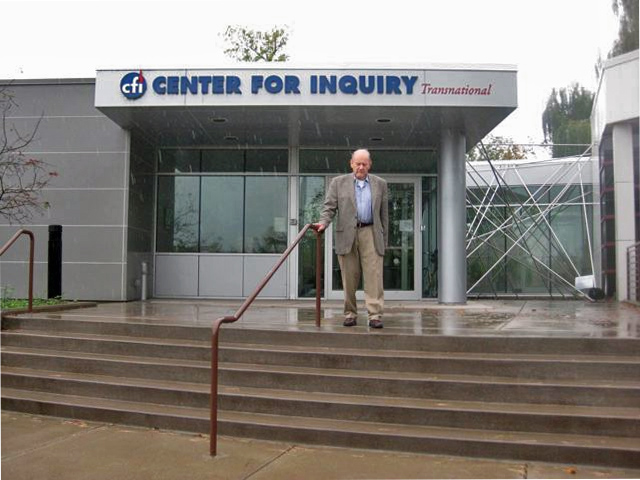
[20]management had changed the locks to the exterior doors of its Amherst, New York headquarters and refused to give Mr. Kurtz a copy of the new key. Kurtz indicated that he returned to CFI with a photographer to document the problem. He commented further:
I could not believe that the present management of the Center for Inquiry would be so mean-spirited as to change the locks of all the outside doors of its world-wide headquarters in Amherst, New York so that that my keys would no longer admit me. I had to ring the bell and request admittance.
Print this post [21]
 [22]
[22]