In a speech given earlier this year, the Chief Economist for BP made his case [1]that fears about peak oil were overblown.
“One factor is resources. They are limited, and a barrel can only be produced once. But ideas of peak oil supply are not true. Doomsayers have exaggerated the issue. The bell-shaped curve of production over time does not apply to the world’s oil resources,” he told the seminar in Alkhobar city.
“Those who believe in peak oil tend to believe that technology and economics don’t matter, and I think this is false.The application of technology, the innovation of new technology and economic forces especially mean that recoverable oil resources can increase. If there is a peak in oil, it will come from the demand side. There are always fears, but these remain overstated and exaggerated.”
A barrel can only be produced once, this is true. And technology has allowed us to tap into oil reservoirs that were unthinkable a few decades ago. Yet as the catastrophic ongoing oil geyser in the Gulf of Mexico shows us, technology is not the savior the oil majors would have us believe. Advanced technology may allow us to drill for oil a mile under water, but it obviously does not offer any easy solutions when things go horribly awry as they have on the Deepwater Horizon rig, which has been spewing hundreds of thousands of barrels of oil into the Gulf of Mexico for over a month.
The bigger point, made by Richard Heinberg [2] (and others [3]) is that recent events prove that peak oil is here:
This is what the end of the oil age looks like. The cheap, easy petroleum is gone; from now on, we will pay steadily more and more for what we put in our gas tanks—more not just in dollars, but in lives and health, in a failed foreign policy that spawns foreign wars and military occupations, and in the lost integrity of the biological systems that sustain life on this planet. The only solution is to do proactively, and sooner, what we will end up doing anyway as a result of resource depletion and economic, environmental, and military ruin: end our dependence on the stuff. Everybody knows we must do this. Even a recent American president (an oil man, it should be noted) admitted that “America is addicted to oil.” Will we let this addiction destroy us, or will we overcome it?
Indeed, the Wall Street Journal practically made the same point in an article earlier this year [4] (linked through Yahoo):
Big Oil never wanted to be here, in 4,300 feet of water far out in the Gulf of Mexico, drilling through nearly five miles of rock.
It is an expensive way to look for oil. Chevron Corp. is paying nearly $500,000 a day to the owner of the Clear Leader, one of the world’s newest and most powerful drilling rigs. The new well off the coast of Louisiana will connect to a huge platform floating nearby, which cost Chevron $650 million to build. The first phase of this oil-exploration project took more than 10 years and cost $2.7 billion — with no guarantee it would pay off.
Chevron came here, an hour-long helicopter ride south of New Orleans, because so many of the places it would rather be — big, easily tapped oil fields close to shore — have become off-limits. Western oil companies have been kicked out of much of the Middle East in recent decades, had assets seized in Venezuela and seen much of the U.S. roped off because of environmental regulations. Their access in Iran is limited by sanctions, in Russia by curbs on foreign investment, in Iraq by violence.
So, Chevron and other major oil companies are moving ever farther from shore in search of oil. That quest is paying off as these companies discover unexpectedly large quantities of oil — oil that only they have the technology and financial muscle to find and produce.
In May, the first wells from Chevron’s latest Gulf of Mexico project came online. The wells are now pumping 125,000 barrels of oil a day, making the project one of the gulf’s biggest producers. In September, BP PLC announced what could be the biggest discovery in the gulf in years: a field that could hold three billion barrels.
…
The discoveries come as many of the giant oil fields of the past century are beginning to dry up, and as some experts are warning that global oil production could soon reach a peak and begin to decline. The new deepwater fields represent a huge and largely untapped source of oil, which could help ease fears that the world won’t be able to meet demand for energy, which is expected to grow rapidly in coming years… “A lot of people can get the very easy oil,” says George Kirkland, Chevron’s vice chairman. “There’s just not a lot of it left.”
The low-hanging fruit is gone. We are at the top of the tree, in the perilously thin branches stretching our arms as far as they can reach to grab the remaining fruit. Sometimes, inevitably, we slip and fall. The consequences are tragic, but foreseeable.
The rest of the story is compelling, if only because of the brazenness of the characters involved. Of course, there’s all the usual campaign finance shenanigans [5] and the special perks that come with that. But Americans are numb to that story, having heard it so many times. I’m sure the Wall Street Journal thought this was shocking news [6]:
Employees of a federal agency that regulates offshore drilling—including some whose duties included inspecting offshore oil rigs—accepted sporting-event tickets, meals, and other gifts from oil and natural-gas companies and used government computers to view pornography, according to a new report by the Interior Department’s inspector general.
The report—published Tuesday on the inspector general’s website—describes a culture in which inspectors assigned to the Lake Charles, La., office of the Minerals Management Service have moved with “ease” between jobs in industry and government, drawing on relationships that formed “well before they took their jobs” with the agency.
*Yawn*, try something original! The SEC guys already got caught watching porn [7] when they were supposed to be supervising Wall Street and all the little Madoffs [8] who work there. Bribery? Heard it before! Same with their tired old revolving-door story– everyone who has been paying attention knows big business bought the government long ago.
A Google search for “BP oil spill” [9] yields a number of predictable results about the spill in the Gulf of Mexico, but just one front-page result about another spill [10]:
The Trans-Alaska Pipeline, partly owned by BP, shut down on Tuesday after spilling several thousand barrels of crude oil into backup containers, drastically cutting supply down the main artery between refineries and Alaska’s oilfields. The accident comes at a difficult time for BP — the largest single owner of the pipeline operator, holding 47 percent — as it struggles to plug a gushing Gulf of Mexico oil well.
Well, that’s bad news, but it gets worse. Surely, BP is aware now that their business-as-usual way of cutting safety corners is a bad idea, right? Not so fast! It turns out that BP is currently lobbying the Canadian government [11] to relax their safety restrictions on deep-water rigs:
In an incredible display of corporate arrogance, BP is claiming that a current safety requirement that undersea wells drilled during the newly ice-free summer must also include a side relief well, so as to have a preventive measure in place that could shut down a blown well, is “too expensive” and should be eliminated.
Yet clearly, if the US had had such a provision in place, the Deepwater Horizon blowout could have been shut down right almost immediately after it blew out, just by turning of a valve or two, and then sealing off the blown wellhead…
Such is the calculus of corruption. BP has paid $1.8 billion for drilling rights in Canada’s sector of the Beaufort Sea, about 150 miles north of the Northwest Territories coastline, an area which global warming has freed of ice in summer months. and it wants to drill there as cheaply as possible. The problem is that a blowout like the one that struck the Deepwater Horizon, if it occurred near the middle or end of summer, would mean it would be impossible for the oil company to drill a relief well until the following summer, because the return of ice floes would make drilling impossible all winter. That would mean an undersea wild well would be left to spew its contents out under the ice for perhaps eight or nine months, where its ecological havoc would be incalculable.
See what I mean? Brazen, right? If I may offer a little unsolicited advice to the Canadian government: do the opposite of whatever BP wants you to do. The safety restrictions are a good idea. Whatever you do, Canada, don’t subsidize these highly profitable ventures in their risky search for new oil, like the US has done [12]:
Since the government began aggressively issuing offshore drilling permits under President Reagan, the industry has received tens of billions of dollars in tax breaks and subsidies, including exemptions from royalty payments — the fees due when a company extracts resources from U.S. government property.
The royalty waiver program was established by Congress in 1995, when oil was selling for about $18 a barrel and drilling in deep water was seen as unprofitable without a subsidy. Today, oil sells for about $70 a barrel, but the subsidy continues.
The Government Accountability Office estimates that the deep-water waiver program could cost the Treasury $55 billion or more in lost revenue over the life of the leases, depending on the price of oil and gas and the performances of the wells.
Wow, I bet the Treasury wished they had that $55 billion now, what with the economy in shambles and all. Anyway, it would be one thing to oppose safety regulations if the company had a stellar safety record to begin with, but such is not the case with BP (although they did argue that US laws [13] were too expensive and their “voluntary” safety program was effective). Now that corporations are the same as real people [14], I think they should be subject to similar punishments. California has a three-strikes law, but nothing comparable exists for the corporations who commit repeated offenses with impunity. Here’s a quick glance at BP’s rap sheet [15]:
In March 2005, a massive explosion ripped through a tower at BP’s refinery in Texas City, Texas, killing 15 workers and injuring 170 others. Investigators later determined that the company had ignored its own protocols on operating the tower, which was filled with gasoline, and that a warning system had been disabled.The company pleaded guilty to federal felony charges and was fined more than $50 million by the U.S. Environmental Protection Agency.
Almost a year after the refinery explosion, technicians discovered that some 4,800 barrels of oil had spread into the Alaskan snow through a tiny hole in the company’s pipeline in Prudhoe Bay. BP had been warned to check the pipeline in 2002, but hadn’t, according to a report in Fortune. When it did inspect it, four years later, it found that a six-mile length of pipeline was corroded. The company temporarily shut down its operations in Prudhoe Bay, causing one of the largest disruptions in U.S. oil supply in recent history.
BP faced $12 million in fines for a misdemeanor violation of the federal Water Pollution Control Act. A congressional committee determined that BP had ignored opportunities to prevent the spill and that “draconian” cost-saving measures had led to shortcuts in its operation.
Other problems followed. There were more spills in Alaska. And BP was charged with manipulating the market price of propane. In that case, it settled with the U.S. Department of Justice and agreed to pay more than $300 million in fines.
See here for Bloomberg News [16]‘ current count of the potential criminal implications for the current spill. But fines in the millions of dollars are just the cost of doing business to a company that reported gross profit of $54.6 billion [17] dollars ($54,600,000,000.00) last year–and that’s profit, not revenue! As the Huffington Post reports (slideshow item #6) [18]:
BP has proven time and time again that they’d rather pay off their mistakes rather than take steps to prevent them. They have paid $485 million in fines [19] in the U.S. alone in the past five years. BP paid $87.43 million [20] to the Occupational Safety and Health Administration in October 2009 — the largest fine in OSHA’s history — for the Texas refinery explosion. They paid an additional $50 million to the Department of Justice for the same explosion. Last month, BP paid $3 million [20] to OSHA for 42 safety violations at an Ohio refinery. The company was also fined $20 million [19] by the Department of Justice for the Alaska Prudhoe Bay spill (pictured), which violated the Clean Water Act.
Mother Jones’ Kate Sheppard notes that all this is pocket change compared to the company’s $5.65 billion in profits [19] in just the first quarter of this year, up 135 percent from last year
And now, the Deepwater Horizon explosion has killed another 11 people. Angry yet? How about if I told you that BP is hiring newly unemployed (unemployed due to BP’s massive oil spill) fishermen to spread dispersants? What if I told you that those dispersants were highly toxic, and that they are being used anyway? What if we knew that these fishermen were getting sick from all the work they are doing to cleanup BP’s mess, and nobody is doing anything about it? FOX News (sic) reports [21]:
“These are the exact symptoms that you could expect from overexposure to crude oil and to the chemicals that are being used out on the cleanup,” said Riki Ott, a marine toxicologist and activist who worked on the cleanup in Alaska after the 1989 Exxon Valdez oil spill.
Ott said she had been in contact with several Louisiana fishermen suffering a range of ailments —”sore throats, burning headaches, burning eyes, skin rashes, nausea, dizziness” — that track with those suffered in the aftermath of the Valdez spill. The dispersants, she says, compound the health risks created by exposure to crude oil.
“This is like throwing kerosene on a fire,” she said.
BP has sprayed more than 800,000 gallons of dispersant into the Gulf since an explosion on the Deepwater Horizon oil rig on April 20. At the same time, the oil giant has been enlisting the paid help of Gulf fishermen, whose fleet of hundreds of boats provides them broad access to areas affected by the spill.
BP’s “Vessels of Opportunity” program employs commercial fishermen to hem in surface oil and help clean oil clumping along the coast, creating work for the industry likely to suffer most in the fallout from the oil spill.
But critics say the rudimentary safety training given to the fishermen isn’t enough. While BP’s “key requirements” include a four-hour training session and a dockside examination by the Coast Guard, the company does not appear to be providing special Hazmat equipment for the ad hoc cleanup crews.
“We are not seeing correct personal protection equipment,” said Clint Guidry, secretary of the Louisiana Shrimp Association, who touted his own experience with toxins from working on oil rigs before he became a fisherman.
Guidry’s colleague, Acy Cooper, gave a blunt assessment of the situation faced by fishermen patrolling the Gulf’s oily waters.
“They’re putting themselves at risk … [with] nothing to protect themselves,” he said Thursday. “Their eyes are burning, their noses are burning, but all of them need to go — they need the money.”
On May 20, the EPA ordered BP to stop using the dispersant [22] and switch to a “less-toxic and more effective” dispersant, but BP did not do so. On May 24, the EPA told them to cut back [23] how much of the dispersant they were using. No word yet on whether BP has complied with this order. BP wishes to keep using this particular dispersant, Corexit, mainly because the company who manufactures it shares close ties with BP (not to mention vampire-squid [24] Goldman-Sachs [25]). The New York Times reports [26]:
So far, BP has told federal agencies that it has applied more than 400,000 gallons of a dispersant sold under the trade name Corexit and manufactured by Nalco Co., whose current leadership includes executives from BP and Exxon. And another 805,000 gallons of Corexit are on order, the company said, with the possibility that hundreds of thousands of more gallons may be needed if the well continues spewing oil for weeks or months.
But according to EPA data, Corexit ranks far above dispersants made by competitors in toxicity and far below them in effectiveness in handling southern Louisiana crude.
…
Critics say Nalco, which formed a joint venture company with Exxon Chemical in 1994, boasts oil-industry insiders on its board of directors and among its executives, including an 11-year board member at BP and a top Exxon executive who spent 43 years with the oil giant.
“It’s a chemical that the oil industry makes to sell to itself, basically,” said Richard Charter, a senior policy adviser for Defenders of Wildlife.
The older of the two Corexit products that BP has used in the Gulf spill, Corexit 9527, was also sprayed in 1989 on the 11-million-gallon slick created by the Exxon Valdez grounding in Alaska’s Prince William Sound.
Cleanup workers suffered health problems afterward, including blood in their urine and assorted kidney and liver disorders. Some health problems were blamed on the chemical 2-butoxyethanol, an ingredient discontinued in the latest version of Corexit, Corexit 9500, whose production Nalco officials say has been ramped up in response to the Gulf of Mexico disaster.
Among Corexit’s competitors, a product called Dispersit far outpaced Corexit 9500, EPA test results show, rating nearly twice as effective and between half and a third as toxic, based on two tests performed on fish and shrimp.
Angry now? Check out these amazing pictures [27]as the oil begins to reach the Louisiana’s shoreline, then let me know.
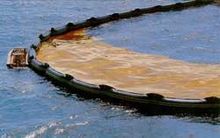
This is a boom:
 [28]
[28]A boom is supposed to contain the oil to a certain area. This oil-industry insider [29] claims that they are just there for P.R. reasons, and are not deployed correctly if the intent is to actually stop the oil.
Anyway, I’m absolutely sickened and extremely angry about this whole situation. If you think this will spell the end of offshore drilling, you’re wrong [30]:
It won’t happen. Drilling bans will not come. The predicted slowdown in the offshore industry’s growth will not happen. The reason is simple: Offshore is where the oil is.
And as long as we are utterly dependent upon oil to power every aspect of our lives, we will continue to follow the oil, no matter the cost.
Print this post [31]
 [32]
[32]