What happens when one of the finest classical musicians in the world decides to perform incognito in a Washington D.C. subway station for 45 minutes? In January, 2007 violinist Joshua Bell played a string of exquisite musical pieces on his Stradivarius in D.C.’s L’Enfant Metro Station, yet no crowd gathered and only $32 was thrown into his violin case. This is a man who was filling $100 seats at evening concerts at this time, yet barely anyone stopped to listen, and the exceptions to this rule were barely exceptions. Bell was repeatedly disoriented when he heard the total lack of applause at the conclusion of each of his riveting pieces. No one walked up to him and asked for his autograph.
Three minutes went by before something happened. Sixty-three people had already passed when, finally, there was a breakthrough of sorts. A middle-age man altered his gait for a split second, turning his head to notice that there seemed to be some guy playing music. Yes, the man kept walking, but it was something.
A half-minute later, Bell got his first donation. A woman threw in a buck and scooted off. It was not until six minutes into the performance that someone actually stood against a wall, and listened.
Things never got much better.
The Washington Post described this fascinating experiment in great detail, and provided video as well. [1] The outcome invites conducting another experiment where a sophisticated symphony audience would listen to two symphonies playing behind curtains and were then asked to guess which one consisted of the career musicians and which one consisted of skilled high school students like these. [2] It’s an experiment that would never be run, I assume, because it risks inflicting massive damage and embarrassment on the symphony and its audience.
But there’s another take-away from this experiment. At a gut level, when there is no gathered crowd, it’s not an important event. A world-class musician playing world-class music should seemingly be of the same importance, existentially speaking, wherever it occurs, whether that be in a packed symphony hall or in Mr. Bell’s living room. But that’s not how the world works. And even when a crowd gathers, it apparently needs to be the right kind of crowd. That is why the final game of the spring training baseball season is not significant, whereas the first game of the official season is of great significance, even though both of them are well attended.
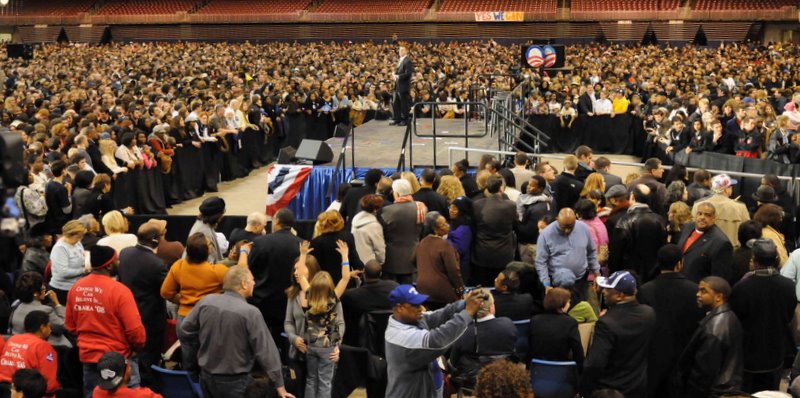 [3]
[3]Politicians are well aware of the power they have when they speak in front of large sympathetic crowds. That is why George W. Bush was notorious for filtering out those people who would dissent at his public events. And even when a crowd is of a decent size, it needs to look even bigger. Politicians are keenly interested in making certain that the rooms in which they speak are not bigger than the expected crowd–they can’t stand the thought of visuals that include empty seats. If the crowd won’t fill a baseball stadium completely, they look for a smaller venue such as a basketball arena. I previously worked for a media-savvy Attorney General, who freely admitted this strategy.
Many commentators have noted that we humans are herd animals. We tend to do what others do (and this is arguably the psychological basis for the legal principle of stare decisis [4]). We tend to think what others think. [5] When we see a crowed gathering at a stadium, a political rally, a street corner or a church, we assume that something important is occurring. When there’s no crowd, our default is that nothing important is happening. Had Martin Luther King given his “I Had a Dream” speech to only a handful of people it wouldn’t have been such an “important” speech, even it it had later gone viral. King has given many fascinating interviews, but those interviews (including this one [6] and this one [7]) are barely mentioned in comparison to “I have a Dream,” even though his points were riveting and profound.
I’ve previously written [8] on the way that crowds make events important, and this issue continues to intrigue me. There appears to be a connection to the availability heuristic [9]; we are emotionally tuned to whatever the crowd does –whatever the crowd is doing becomes readily available to us. Consider also this Monty Python skit, “Thomas Hardy’s Novel Writing Contest [10],” which constitutes a humorous comment on the “importance” of crowds
The existence (or non-existence) of crowds strongly sets our inner default as to what is important, even though we intellectually know that the existence of a crowd does not necessarily have anything to do with whether an event is important. Perhaps the most important thing we can do about our apparently biologically wired tendency to respond to the existence of crowds is to be aware of it and to (at least occasionally) fight this inner compulsion to go with the crowd.
Print this post [11]
 [12]
[12]