Payday loans are high-interest short-term unsecured small loans that borrowers promise to repay out of their next paycheck, typically two weeks later. Interest rates are typically 300% to 500% per annum, many multiples higher than the exorbitant rates charged by banks on their credit cards. A typical payday borrower takes out payday loans to pay utility bills, to buy a child’s birthday present or to pay for a car repair. Even though payday loans are dangerous financial products [1], they are nonetheless tempting to people who are financially stressed. The growth of payday lenders in the last decade has been mind-boggling. In many states there are more payday lenders than there are McDonald’s restaurants. [2] In Missouri Payday lenders are even allowed to set up shops in nursing homes. [3]
Missouri’s payday lenders are ferociously fighting a proposed new law that would put some sanity into a system that is often financially ruinous for the poor and working poor. Payday lenders claim that the caps of the proposed new law would put them out of business. Their argument is laughable and their legislative strategy is reprehensible.
Exhibit A is the strategy I witnessed Thursday night, February 18, 2010. On that night, Missouri State Senator Joe Keaveny and State Representative Mary Still jointly held a public hearing at the Carpenter Branch Library in the City of St. Louis City to discuss two identical bills (SB 811 [4] and HB 1508 [5]) that would temper the excesses of the payday loan industry in Missouri. Instead of respecting free and open debate and discussion regarding these bills, payday lenders worked hard to shut down meaningful debate by intentionally packing the legislative hearing room with their employees, thereby guaranteeing that A) the presenters and media saw an audience that seemed to favor payday lenders and B) many concerned citizens were excluded from the meeting. As discussed further down in this post, payday lenders are also responsible for flooding the State Capitol with lobbyists and corrupting amounts of money. [6]
[6]
When I arrived at 7:00 pm, the scheduled starting time, I was refused entry to the meeting room. Instead, I was directed to join about 15 other concerned citizens who had been barred from the meeting room. There simply wasn’t room for us. But then who were those 100 people who had been allowed to attend the meeting? I eventually learned that almost all of them were employees of payday lenders; their employers had arranged for them to pack the room by arriving en masse at 6 pm.
Many of the people excluded from the meeting were eventually allowed to trickle into the meeting, but only as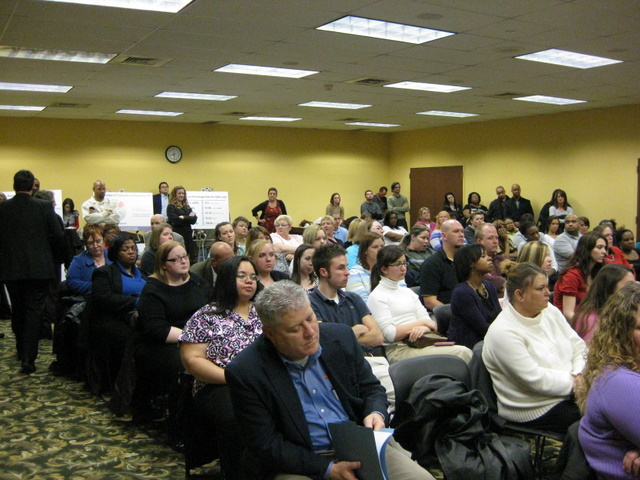 [7] other people trickled out. I was finally allowed into the meeting at 8 pm, which allowed me to catch the final 30 minutes. In the photo below, almost all of the people plopped into the chairs were payday lender employees (the people standing in the back were concerned citizens). This shameful tactic of filling up the meeting room with biased employees has certainly been used before. [8] [BTW, I suspect either that these employees were being paid to attend or I was witnessing a roomful of FLSA violations].
The irony of using these tactics is that the proposed new bills are arguably industry-friendly; they (I’ll sometimes refer to the bills in the singular since they are identical bills, one for each Legislative House) don’t outright ban payday lenders, despite the danger of these loans. Rather, the bills gives payday lenders the ability to charge high interest rates (up to 36%) and “loan setup fees” (up to an additional 5% on a 90 day loan) on their loans. This additional “setup” fee is the equivalent of 20% more interest per annum (for loans paid off in 90 days) and the equivalent of 130% per annum (for those customers who pay off their payday loan in 2 weeks). The new law thus gives payday lenders the ability to earn 56% (36% interest + 20%) on loans that are paid off within 90 days and 166% (36% interest + 130%) on loans that are paid off within 2 weeks. Keep in mind that 20% would be a high rate of interest on a credit card. Consider also that paying 460% interest on a payday loan of $500 is the equivalent of paying 5.8% interest on a loan of $40,000. 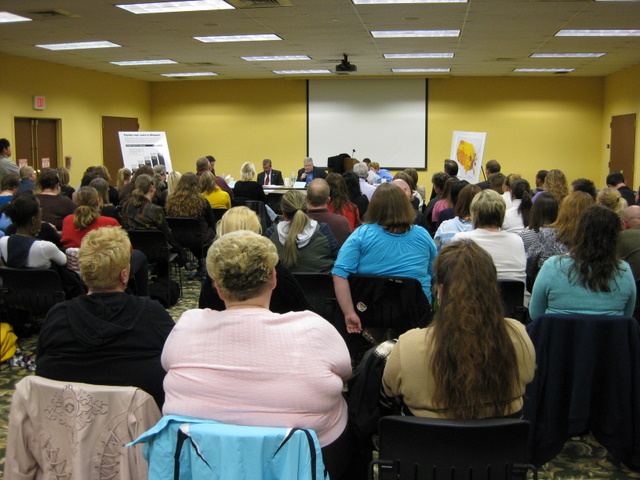 [9]
[9]
Bottom line – the proposed new law would allow payday lenders to charge between 56% and 166% on the money they lend out. But that’s not good enough for the payday lenders, because they want to continue charging obscene amount of interest, 400% or more. Keep in mind that payday lenders weren’t the first to rake the working poor with high interest loans where the payment was due on the customer’s payday. That tactic was commonly used more than 100 years ago, and we used to call those lenders “loan sharks. [10] We outlawed those types of loans back then, because the financial services industry wasn’t as powerful as it is today.
The proposed new law also would make a second change that the payday lenders probably hate even more than the 36% interest rate cap. The new law would prohibit payday lenders from making any new loan to a borrower until one week has passed after that borrower fully paid off an existing payday loan. This provision was designed to prevent payday lenders from creating a continuous series of fake “new” loans to stretch out the original loan as far as possible. The tactic is simple: when a borrower comes into the payday loan store to attempt to pay off a loan, the lender suggests folding the amount still owed on the original loan into a “new loan.” Consequently, the borrower pays the interest accruing over the past pay period (a typical example would be $70 of pure interest every two weeks on a 469% loan of $400), and the lender repeats this as often as possible. This is how “short term” payday loans get converted into dangerous long term loans that strip borrowers of their freedom and dignity. You can see why payday lenders would fight so hard against this bill. Who wouldn’t like to charge $70 every two weeks on principle of $400? That’s $1,820 of interest every year—it’s like printing money. Paying $70 twice a month is enough to buy a $7,500 car (based on a 6% loan over 60 months).
Payday lenders are motivated to make these fake new loans because the current law allows only six “renewals” (extensions of the original loan for an additional pay period). They also like these fake new loans because current law also limits total interest and fees to 75% of any particular loan; it is much more profitable to make many “new” loans because the 75% cap is quickly exhausted over the course of any one loan since payday lenders charge such high interest rates. You can just imagine the sorts of conversations that occur in many Missouri payday loan shops: “Ms. Jones, why renew your 469% interest payday loan? Instead, let’s tear up your original loan and finance that $500 you owe us with series of “new” loans for your convenience? All you need to do is visit us every two weeks to pay the interest . . .”
But wait! Aren’t these problems all caused by the payday loan customers? Why do these people keep taking out loans that they can’t afford to pay off? To address this issue, let’s start with the assumption that most consumers are bad at math. This is a proven fact. For instance, 60% of Americans can’t add two simple numbers and calculate 10% of the total. [11] Based on this undeniable fact, we immediately come to a fork in the road. Given that our state has millions of people afflicted with innumeracy, what shall we do about it? Should we allow these math illiterate people to keep getting victimized by products that they shouldn’t be buying? Should we essentially throw up and rationalize that the consumers are incompetent and they’ve therefore got what’s coming to them? Should we really buy into this social darwinist claptrap [12]? Or should we, instead, rein in sophisticated lenders who are profiting from the aggregate misery they are inviting? The answer is clearly the latter, given that society at large needs to deal with the mess created by the irresponsible actions of payday lenders.
Consider further, this this compelling hypothetical [13] offered by Elizabeth Warren with regard to defective toasters (her example was a comment on the danger of predatory home mortgages, but the logic can easily be extended to payday loans):
It is impossible to buy a toaster that has a one-in-five chance of bursting into flames and burning down your house. But it is possible to refinance your home with a mortgage that has the same one-in-five chance of putting your family out on the street—and the mortgage won’t even carry a disclosure of that fact. Similarly, it’s impossible for the seller to change the price on a toaster once you have purchased it. But long after the credit-card slip has been signed, your credit-card company can triple the price of the credit you used to finance your purchase, even if you meet all the credit terms. Why are consumers safe when they purchase tangible products with cash, but left at the mercy of their creditors when they sign up for routine financial products like mortgages and credit cards? . . . Consumers entering the market to buy financial products should enjoy the same protection as those buying household appliances.
Speaking of the sophisticated lenders, bear in mind that current Missouri law prohibits a payday lender from making a loan to any customer unless the lender has “considered” the financial ability of that borrower to reasonably repay the loan. The problem is that most payday lenders flagrantly violate this requirement. In the real world, most payday lenders put on blinders. They merely look for the existence of a checking account and a pulse. In my consumer law practice, I have never yet seen any indication that any payday lender has actually considered the income stream and current indebtedness of any borrower before making a loan. Lenders don’t care if prospective borrowers have massive indebtedness. They don’t care if borrowers can barely able to make their house payments, car payments, child support payments and utilities payments? In fact, such people would be perfect customers. They are the kind of folks likely to beg for an unending series of fake new loans running juice at 400% or more. The reality is that payday lenders prefer customers who can’t quite pay off those high interest loans. They want semi-desperate customers who will come back to the shop with a handful of interest-only cash, again and again.
What is the damage done by payday loans? Consider the financial damage done to a borrower who has taken out a payday loan of $500 at 400% interest, where the loan is stretched out for a year (by converting the original loan to a series of fake new loans). After paying almost $2,000 in interest over a year, such a borrower would still owe the payday lender $500 principle. That original loan of $500 looked so very tempting, but it was the financial equivalent of crack cocaine. It’s pretty amazing, that payday lenders can squeeze that kind of money out of so many desperate people. Those unending interest payments create a huge sucking sound, as scarce money that should be going to pay electric bills, medicine and school supplies feed the profits of big companies that are smart enough to have tricked the Missouri Legislature into believing that they were offering “short-term” loans. And, of course, the damage isn’t only financial. There is also human tragedy [14]. Harassing phone calls, lawsuits, damaged credit ratings, and parents working second jobs at $7/hour and thus unable to spend time with their children. All of this is being caused by payday shops handing out dangerous loans to consumers who don’t have the resources to dig themselves out. Research has suggested that payday loans often lead to terrible problems such as foreclosures and bankruptcy [15]. Truly, why should we allow such loans at all [16]? Yes, these customers were financially stressed before they took out the payday loans, but that financial desperation is multiplied by many months whenever they step into a payday store. Virtually every person who ever takes out a payday loan would be better off without that loan. The nicest thing a payday store could possibly do for its customers would be to refuse to give them those long-term 400% loans.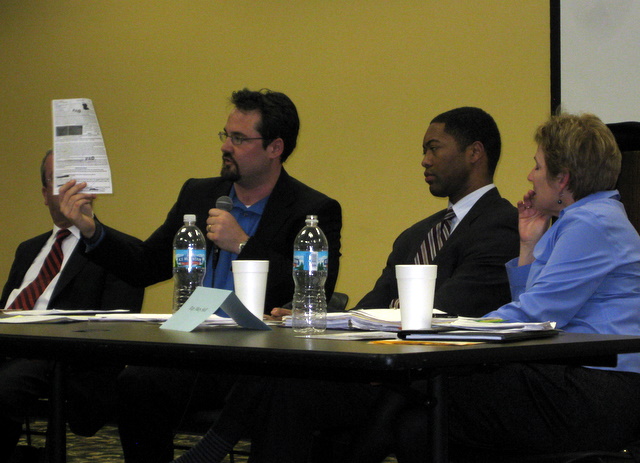 [17]
[17]
Near the end of Thursday night’s meeting, long after the television cameras had packed up and headed back to the stations with footage of the slick presentation by representatives of the payday industry, attorney John Campbell was allowed to comment on some of these issues from the consumer’s perspective. John also addressed some of the many false claims still being made by payday lenders as part of their efforts to trash the proposed new Missouri law:
John and I work together at the Simon Law Firm [18] in St. Louis. We are currently litigating several complex class actions against some of the biggest payday lenders in Missouri. It’s the same problem over and over: payday lenders systematically violate the weak payday lending laws that currently exist in Missouri.
In addition to systematically violating the laws of Missouri, most payday lenders compound the problem through legal trickery. They make customers sign contract provisions prohibiting class actions and class arbitrations (e.g., see this extremely difficult-to-read arbitration agreement [19] presented to the customers of Quik Cash). In our pending suits, John and I have successfully argued that payday lenders (and other merchants [20]) have tricked their customers into to signing mandatory arbitration clauses that (on their face) prevent customers from bringing any class proceedings. Missouri appellate courts have recently agreed with us that these “class waivers” (the clauses prohibiting customers from bringing class actions or class arbitrations) are unconscionable and thus unenforceable (here is the opinion [21] of the Missouri Court of Appeals in Woods v. QC Financial, where the Court struck the class waiver of Quik Cash, Missouri’s biggest payday lender). For deep insight into the problems with these arbitration clauses, consider viewing this video by consumer attorney Bernard Brown, [22]who eloquently explains why class waivers are so unfair to consumers. In another recent case, we convinced the Court of Appeals to ban class waivers in “title loans,” [23] an even more reprehensible financial product (where the customer is required to hand over the keys to the family car and the title as part of the loan application). Therefore, Missouri consumers can now bring class actions on behalf of large classes of customers of high interest lenders for the systematic violations of Missouri payday lending laws.
In our class claims against payday lenders, we have alleged [24] that Missouri’s largest payday lenders:
A) failed to consider the financial ability of the borrower to reasonably repay the loan in the time and manner specified in the loan contract; or
B) charged a total amount of accumulated interest and fees exceeding seventy-five percent of the initial loan amount of that loan for the entire term of that loan and all renewals of that loan, or
C) did not reduce the principal amount of the loan by at least five percent of the original amount of the loan as part of any renewal; or
D) renewed the loans more than six times.
[I will update this post with the results of our pending class arbitration actions against three large payday lenders.]
Representatives of St. Louis Community Credit Union [25] also appeared at the hearing. They indicated that they are making money by issuing 25% APR 90-day loans. Further, there is a forced savings component built into the program. Consumers taking out these loans will be actually putting 10% of the money borrowed into their own accounts in the process of paying back the 90-day loan. In other words, a credit union are issuing the kinds of low interest loans that payday lenders claim will put them out of business. In fact, quite a few Missouri credit unions are issuing these loans [26], and making money doing so.
You might be surprised that I haven’t discussed usury laws anywhere in this post. If you were under the impression that there were usury laws, you’re in for a surprise. There used to be usury laws, but they have now been loosened up for financial institutions to the point where they are essentially non-existent. It’s like the Wild West out there [27] now (and see here [28]) (and see this excellent article [10] by Chris Peterson regarding payday lenders and usury laws) . You’ll find further commentary on this issue of usury here [29].
Interestingly, the proposed Missouri law is similar to a federal law passed to protect members [30] of the military from these same predatory loans. Apparently, legislators figure it’s OK to rip off consumers as long as they aren’t in the military.
Here’s one more troubling note to end this troubling post. While I waited for my chance to get into the meeting on Thursday night, I had a detailed conversation with a long-time savvy political consultant. He indicated that the proposed new payday loan law would have essentially no chance to be heard in either the Missouri Senate or the Missouri Houses. Why not? Because
A) the legislative committees that have the power to hear such bills are headed by Republicans,
B) the Republican committee heads are given total discretion as to the bills that will be considered (and not considered), and
C) the Republicans have made it clear that they will not step on the toes of the payday industry.
Disheartened, I again asked the consultant why these highly worthwhile payday loan bills couldn’t get a hearing, and he starting talking about political power, political relationships and political money. He mentioned that it costs $250,000-$500,000 to run a competitive race for State Senator, for instance, and that this means that an aspiring Senator would need to raise $2,000 per week for four years in order to be competitive. Hence the need for money, combined with the fact that the financial services industry is flush with money and lobbyists.
What a terrible note to end on. If a state government can’t correct flagrant payday lender abuses, what can it do. Reforming payday loans should be a slam-dunk. If this consultant is correct, though, the consideration of this proposed new payday lender bill will have nothing to do with the merits of the bill. Which inexorably leads to the topic of campaign finance reform—another topic for another day.
Print this post [31]
 [32]
[32]