You’ve probably heard the stories in the news. A superpower has been shamed, a totalitarian state has been outed. A tyrannical government has been spying on the private communications of its citizens, including that of activists and journalists. What they plan to do with the fruits of their techno-espionage is not well understood, but given their history they can hardly be up to any good. What is clear is that this government is fanatical about crushing any challenge to their perceived supremacy, whether those challenges are internal or external. They even demand that private companies aid them in censoring unfavorable news (with a stunning degree of success), and these private companies (mostly based in the United States) may even have helped them spy on their citizenry.
You could be forgiven for thinking that this was just another blog posting about Google and China. It’s actually a post about hypocrisy.
First, if you haven’t heard, Google is re-evaluating their decision to do business in China [1], ostensibly as a result of some cyber-attacks directed at the Gmail accounts of some human-rights activists [2]. The U.S. State Department is planning to lodge a formal protest [3] on the alleged attacks. Plenty of others have already analyzed this story. As usual, the real story is behind the headlines.
The San Francisco Chronicle reported [4] last week:
The Google-China flap has already reignited the debate over global censorship, reinvigorating human rights groups drawing attention to abuses in the country and prompting U.S. politicians to take a hard look at trade relations. The Obama administration issued statements of support for Google, and members of Congress are pushing to revive a bill banning U.S. tech companies from working with governments that digitally spy on their citizens.
To prevent United States businesses from cooperating with repressive governments in transforming the Internet into a tool of censorship and surveillance, to fulfill the responsibility of the United States Government to promote freedom of expression on the Internet, to restore public confidence in the integrity of United States businesses…
So far, so good. Restoring public confidence in the integrity of U.S. businesses might be a tall order for any bill, but whatever. The rest are all noble goals: preventing repressive governments from using the internet as a tool of censorship and surveillance, promoting freedom of expression, and so on. Just one problem: none of these provisions apply to the U.S. Government.
You see, the U.S. Government is the tyrannical superpower from the first paragraph of this blog post. You might have asked yourself why it is that the Chinese people put up with having their private communications read by their government. The real question is this: Why do you put up with it? Consider the following:
New York Times (4/15/09): [6]The National Security Agency intercepted private e-mail messages and phone calls of Americans in recent months on a scale that went beyond the broad legal limits established by Congress last year…
New York Times (6/16/09): [7] The National Security Agency is facing renewed scrutiny over the extent of its domestic surveillance program, with critics in Congress saying its recent intercepts of the private telephone calls and e-mail messages of Americans are broader than previously acknowledged, current and former officials said…
Since April, when it was disclosed that the intercepts of some private communications of Americans went beyond legal limits in late 2008 and early 2009, several Congressional committees have been investigating. Those inquiries have led to concerns in Congress about the agency’s ability to collect and read domestic e-mail messages of Americans on a widespread basis, officials said. Supporting that conclusion is the account of a former N.S.A. analyst who, in a series of interviews, described being trained in 2005 for a program in which the agency routinely examined large volumes of Americans’ e-mail messages without court warrants. Two intelligence officials confirmed that the program was still in operation.
Washington Post (today, 1/19/10): [8] The FBI illegally collected more than 2,000 U.S. telephone call records between 2002 and 2006 by invoking terrorism emergencies that did not exist or simply persuading phone companies to provide records, according to internal bureau memos and interviews. FBI officials issued approvals after the fact to justify their actions.
E-mails obtained by The Washington Post detail how counterterrorism officials inside FBI headquarters did not follow their own procedures that were put in place to protect civil liberties. The stream of urgent requests for phone records also overwhelmed the FBI communications analysis unit with work that ultimately was not connected to imminent threats.
And private companies are involved heavily here, as they are in China.
- Sprint received 8 million law-enforcement requests [9] for GPS location data, just last year.
- An appeals court has ruled that FBI [10] may not activate the On-star system or similar in-car systems to eavesdrop on occupants. Not because it’s a violation of their privacy rights, but because the system may not work properly in the event of an accident.
- Yahoo and Verizon recently argued [11] that releasing information about the amount they charge law enforcement or spy agencies to funnel customer data to them would “shock” and “confuse” their customers. Yahoo also correctly noted that releasing that data would “lead to impairment of its reputation for protection of user privacy and security”. Verizon did note that they receive “tens of thousands” of these requests each year.
- The Electronic Frontier Foundation (EFF) has filed suit [12]against the CIA, Department of Defense, Department of Justice, as well as several other govenment agencies, seeking information as to how these agencies are using social media for surveillance or investigations. The suit was filed after all of the agencies ignored Freedom of Information Act requests seeking the data.
- In-Q-Tel, the investment arm of the CIA [13], has invested in Visible Technologies, a company that monitors social media. The goal is to be able to monitor all of a person’s online information: think Facebook, Amazon book reviews, blog posts, tweets, etc…
- If you thought all this was in the name of stopping terrorism, think again. Of 763 “sneak and peek” warrants [14] issued under the Patriot Act in 2008, only 3 were in relation to terrorism investigations. In other words, less than one-half of 1% were related to terrorism investigations. “Of 21 criminal offense categories for which warrants were issued or extended, terrorism ranked 19th, exceeding only conspiracy and bribery.”
- Despite our homage paid to the ideal of a free and independent press, the reality sometimes falls short. Mark Klein [15], the whistleblower of warrantless wiretapping by the NSA, had a great deal of trouble in getting his story heard. Can anyone really argue that it wasn’t a newsworthy story?
Perhaps unsurprisingly, Representative Smith– staunch defender of internet privacy– also voted to amend [16] the FISA law to comply with what the US government was already doing, as well as to provide retroactive immunity to any telecom company that broke the law when they were assisting the government in illegally spying on your communications.
The truth is, while China’s media is explicitly censored, ours self-censors. Noam Chomsky and Edward Herman explained the mechanism rather well in their book, Manufacturing Consent [17]. They also provide several examples of what they call the “propaganda model” in action. This model theorizes that the media will align themselves with the interests of the administration to a remarkable degree, based on a number of “filters” which act to select for media or journalists who have interests similar to the interests of those in power. The model goes further though, and predicts that “the victims of enemy states will be found ‘worthy’ and will be subject to more intense and indignant coverage than those victimized by the United States or its clients, who are implicitly ‘unworthy’.” (p. xix) So, in the current example, we have a diabolical Chinese regime, which will spy on its own dissident citizens (worthy victims) and filter out content which it finds objectionable or inconvenient. We have much the same in the US, but we rely on our media to do the filtering in place of the government. Since we use the free market to oppress our citizens (unworthy victims), we are superior to the godless Communists.
If you think I’m exaggerating, consider the Op-Ed content of the New York Times. There are two Op-Eds on the subject of Google and China; one is by Roger Cohen [18], and one is the unsigned editorial opinion of the paper [19]. Cohen’s editorial congratulates China for adopting so much of the ideology of Western globalization, for “hoisting of a great mass from backwardness” with their hearty embrace of rampant consumerism. He opines that “the Communist Party has bought into the seduction of branding. It has grasped that Nokia and Uniqlo are the bread and circuses of the modern age.” Yes, consumerism is a great distraction [20] for the unwashed hordes, and if the Communists have “bought into the seduction of branding”, it can only be the United States that sold it to them. Of course, Cohen neglects to point out that bread and circuses work equally well in the USA as they do in China. In any case, this Chinese consumerist utopia may be at risk if they continue to alienate Google. “Like the man who taps phones for a living and comes to believe phone tappers are everywhere, it has elevated suspicion to an obsession…,” Cohen writes in the concluding paragraphs of his article. But what of the phone-tappers in the US? I suppose their suspicion has not yet been “elevated to an obsession”, whatever that implies.
Similarly, the opinion of the paper on this issue is clear [19]: Google has taken a “bold stand” against the “troubling” policies of China. They do point out the contradictions in Google’s own record of “protecting user’s privacy”, but avoided entirely the issue of the US government’s intrusion on user’s privacy rights.
So how are analogous actions by the US government viewed by the Op-Ed page? On the issue of warrantless wiretapping, the program was “crucial”, “lawful, effective, and necessary” and “reflexive judgments to the contrary seem hasty at best”. We can be reassured that lawyers employed by the agencies doing the spying “remained comfortable throughout with the lawfulness of all aspects of the surveillance effort.” Alright, I’ll grant you that those words may be biased, coming as they do from Michael Hayden [21], former CIA director. Perhaps some other Op-eds on the subject will be more even-handed?
Well, perhaps not… the next Op-ed [22] is from a couple of other administration mouthpieces: David Rivkin and Lee Casey, who served as lawyers in the Reagan and Bush Administrations. For lawyers, they show a remarkable disdain for the law. They assure us that “even the administration’s sternest critics do not deny the compelling need to collect intelligence” and that “the only thing outrageous about this policy is the outrage itself.” They acknowledge that the Bush administration could have sought warrants to conduct their wiretapping, but that would involve “a number of bureaucratic steps” and that the FISA court was not “a rubber stamp and may well decline to issue warrants”. If the court was not a rubber stamp, it came exceedingly close– as of the end of 2004 the FISA court had approved [23] 18,761 warrants and only rejected five (some sources indicate only four were rejected). The authors spend the remainder of the editorial expressing the opinion that the whole debate is irrelevant, since any attempt to limit what the president does during wartime would be unconstitutional anyway.
The unsigned editorials from the New York Times on the subject, although opposed to the surveillance, maintain their opposition based solely on the illegality of the program and the impropriety in legalizing it after-the-fact. There is no condemnation of the program as wrong or troubling, per se. See here [24], her [25]e [25], here [26], here [27], and here [28] for examples. The Times also failed to point out that they sat on the story for over a year [29]. They may still be sitting on it today, but for the fact they were about to be scooped by a book from one of their own reporters. Oh, but we have a completely free and uncensored press, I forgot.
If the Chinese government were doing these actions, they would be anti-democratic and dictatorial on their face– when these actions are performed by the US government, they are criticized on the basis that they are ineffective, inefficient, or merely violations of outdated laws– laws which conveniently required updating anyway to align themselves with the new realities involved in fighting a perpetual “War on Terror”. No such concern about complying with or changing the relevant Chinese laws is evident. Google is fighting for truth, justice, and the American way; China wants to maintain its evil empire through all manner of nefarious means, no matter if the details are enshrined in Chinese law.
A nearly identical dynamic is at work when it comes to the Iranian government, with whom the US has an adversarial relationship. During last year’s protests in Iran following the outcome of a disputed election, the US government and news media jointly argued that Twitter and other social media were key to the fledgling democrats, and any interference with protester’s use of the internet was unjustifiable. The US State Department even asked Twitter [30] to delay scheduled maintenance on their servers to allow Iranian protesters to continue to use the service. Time [31] magazine opined that “Tyranny… is a monologue. But as long as Twitter is up and running, there’s no such thing.” However, Time did not report on the case of Elliot Madison. Mr. Madison was arrested by the FBI for Twittering the location and movement of police forces during last fall’s protests of the G20 meeting in Pittsburgh. He got his information from the public airwaves and re-broadcast it on Twitter, and for that he was charged with hindering apprehension or prosecution, criminal use of a communication facility and possession of instruments of crime. The blatant double-standard was not lost on Madison, who noted it in an interview he gave to Democracy Now [32] (Note: Sharif Abdel Kouddous is one of the hosts of the program, Martin Stolar is Mr. Madison’s attorney).
SHARIF ABDEL KOUDDOUS: And they may be the first to be charged criminally with sending information electronically to protesters about the police. What’s the significance of this in terms of First Amendment rights?
MARTIN STOLAR: It—
ELLIOT MADISON: Can I just clarify it?
MARTIN STOLAR: Sure.
ELLIOT MADISON: We’re not—we’re not the first. We’re the first in this country. During the Twitter revolution going on in Iran, in Moldova, in Guatemala, in the earlier newscast about Honduras, in all those cases, repressive governments have arrested folks for using Twitter. The only difference is, in all those cases the State Department, the US State Department, has condemned the arrest of these Twitter activists and had gone so far in the Iranian situation, the State Department, according to an article, asked Twitter to postpone its regular maintenance so as not to interfere with Iranian protesters to be able to send out their tweets. So the only difference is we’re the first arrested here. But this is a—over the past two years, repressive governments have been arresting people. The only difference is, the State Department has supported—I’m expecting the State Department will come out and support us also.
MARTIN STOLAR: Oh, you think so, do you?
Other media also make clear Madison’s status as an “unworthy victim”. The New York Times reported [33] that items of Mr. Madison’s seized during the search of his property included “black masks and clothes” (a well-known anarchist color!), gas masks, and even a picture of Lenin (gasp!). Other media jumped on the bandwagon, variously pointing out other items seized: goggles, test tubes and beakers, anarchist books, pictures of Marx (!) [34], walkie-talkies, a slingshot, and a Curious George doll. [35] Seriously. I’m not clear on how a picture of Lenin or Marx, not to mention Curious George himself, aided Madison in his twittering, but I’m sure they somehow figured prominently into his criminal exploits. They do, however, help paint him as a communist sympathizer, and therefore deserving of arrest and prosecution, despite being engaged in constitutionally protected free speech and protest activity.
The Washington Times reported [36] on the Iranian Twitter revolution as well, describing it in glowing terms. Protesters’ use of social media helped to ignite the “spirit of liberty” against the “authoritarian leaders” of Iran. They likewise failed to report on the case of Elliot Madison. The final paragraph of the Washington Times‘ editorial could apply equally well to the G-20 protests with the change of a few words:
What we are seeing is the flickering flame of freedom. People are willing to risk their lives to protest a system that oppresses them and denies them fundamental human dignity. Those who say none of this matters – that it is a feud between factions of the ruling class, that it has no chance of bringing about real change – are missing the point. The people of Iran are exercising their sovereign right as a people to stand before their rulers and say “No more.” They are commanding the attention of a world that seeks to make deals with their oppressors. Iranians are telling us that they yearn to be free.
 [37]
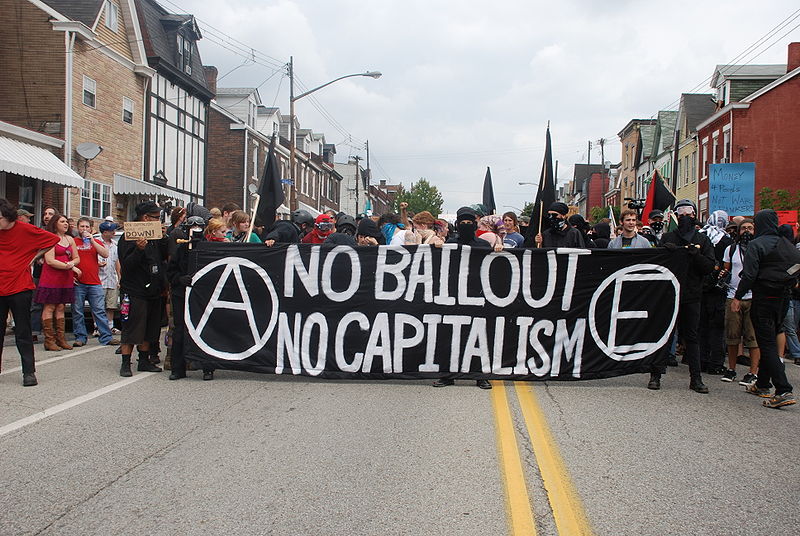
[37]However, to the Washington Times, the G-20 protests [38] were only about a few anarchists who were disgruntled with capitalism. After deploying tear gas and smoke grenades, police in full riot-gear were able to subdue the protesters (armed only with rocks, drums and protest chants), who were marching without a permit and therefore, unlawfully. No word on whether Iranian demonstrators had their required permits in order. Nevermind also the anarchist perspective that globalized capitalism is, in fact, “a system that oppresses them and denies them fundamental human dignity”, or that G-2o protesters were simply “exercising their fundamental right as a people to stand before their rulers and say ‘No more’.” Elections in the US might also be described as a “feud between factions of the ruling class” that have “no chance of bringing about real change”, but I guess that’s beside the point as well.
What makes this example all the more striking, is that the G-20 protests in Pittsburgh were the first time the LRAD (Long-Range Acoustic Device) was used domestically.

The LRAD is an acoustic weapon [39], “originally used by the military to repel battlefield insurgents and Somali pirates with piercing noise capable of damaging hearing”. Turns out that it works equally well on civilian protests in the homeland, which is why the Department of Homeland Security has been providing grants to local police departments who which to purchase one of these devices. Can you imagine the response if Iran had deployed cutting-edge battlefield technology in their efforts at repression?
Sadly, there is no shortage of hypocrisy in the political class and the media who serve them. Our actions are overwhelmingly virtuous, or at least well-intentioned. The actions of adversaries are inevitably evil, dictatorial, and tyrannical. My thanks to Glenn Greenwald, who provides an ongoing chronicle of self-serving hypocrisy by the media and politicians, and whose post a few days ago [40] inspired this article.
Print this post [41]
 [42]
[42]