A couple days ago, I saw this video of Sen. Lindsey Graham, a conservative senator from South Carolina, being pummeled by members of the “tea party.” The problem is that he is apparently not conservative enough.
You can hear the first questioner recommending that we basically dismantle the entire federal government to allow the “free market” to solve all our problems. It’s amazing to hear how prevalent this viewpoint is. I often hear it from conservative acquaintances, that government is in the way that the free market will take care of us much like God will take care of us, if only we would stop trying to help ourselves and just let good things happen. There is much evidence that this “free market fundamentalism” is pie in the sky, and it is also a dangerous way to think [1]. And see this analysis [2] and here [3].
The idea of free market fundamentalists [4], that good things will simply happen in a systematic way is based upon a huge mistaken assumption that all people are selfish and rational and that this selfish rationality will drive the system in a coherent way. This guiding principle of widespread rational selfishness is often referred to as homo economicus [5]. Also consider that regulation, formal or otherwise, is prevalent throughout nature [6].
This week, I had two experiences which served as powerful evidence to me that people are not necessarily rational or selfish. Both of these situations involve houses, which are typically the single largest investment made by most people. Therefore, there is a lot at stake in these situations, and we should expect that if people are selfish and rational that they would act especially selfishly and rationally when it comes to something as expensive as a house.
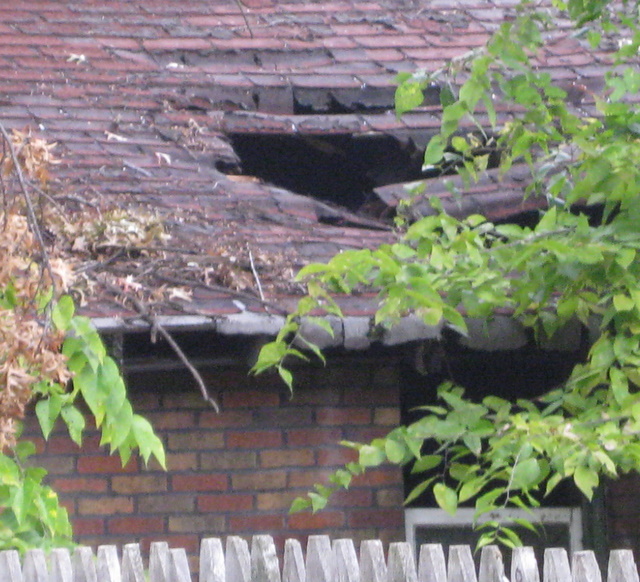
The first experience concerns a married couple who bought a house two doors west of my own house in the City of St. Louis. They bought that house three years ago when it already needed considerable repair, but they did not move into the house after buying it, they have done no repairs on it, and it remains vacant today. Today, there are big holes in the roofs of the house itself and the garage. Shingles are falling from the roof. One of the exterior walls is badly
 [7]
[7]deteriorated and starting to bulge. They purchased the house for $240,000 (they overpaid considerably), but because they have done nothing to patch the roof, water has been pouring into the structure, causing mold to flourish on the inside. They have left at least one window open, allowing more water to pour in, and allowing animals to live in the structure. At bottom, the structure is starting to collapse. Some of the neighbors and I have worked hard to get these owners before the city housing court, in order to force them to fix up the property to preserve it. To make things worse, my neighborhood is an historical district which involves a strict preservation code.
In front of the housing judge on Tuesday, the owners showed up and were angry that the neighbors were making them try to fix up their property to comply with the housing code. The judge explained to them that their property has deteriorated severely and that they were essentially watching the collateral to their mortgage be destroyed by doing nothing. The judge urged them to sell the property “as is” to someone who would be willing to rehab it, if that is even possible at this point.
The bottom line is that this house, which was purchased for $240,000 three years ago, is now worth about $100,000. The owners are upside down in their house (they owe much more on their mortgage than the house is worth), and they allowed this situation to become what it now is through their own lack of involvement. They asked the judge to basically to leave them alone to allow them to do nothing at all, such that the house would completely collapse and be worth less then zero. I would contend that this behavior is not rational.
 [8]
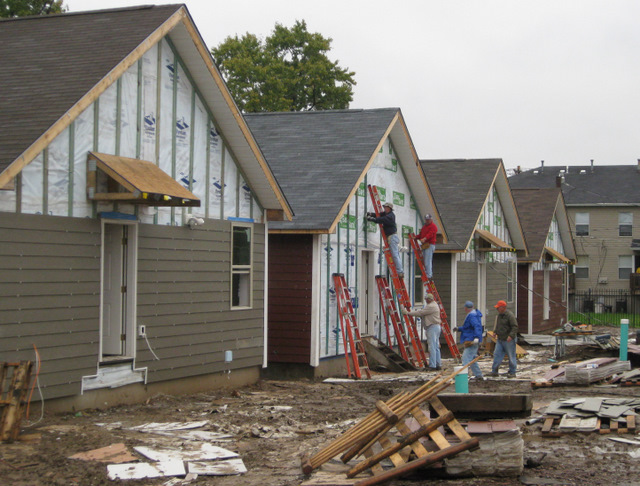
[8]Here’s the second recent incident–this one reminding me that an economic system that depends on people being selfish is woefully incomplete. Yesterday, I worked for Habitat for Humanity [9], as part of a group effort arranged by my law firm (I was working for the day with a team of about 12 employees of my law firm). This particular build site is in north St. Louis, where Habitat for Humanity built 24 new modest houses last year and it is building about 20 more this year.
The people who will live in these houses are required to purchase them, but they are allowed to buy them for merely the cost that it takes to build them. In other words, there is no financial profit tacked onto the sales price of the houses. Further, much of the work building these houses is done by volunteers. I volunteered for one day, and it was a wonderful and fulfilling experience, but my work was nothing compared to the work of many of the volunteers. For instance, I met one man who has volunteered every Wednesday for the past 12 years. He has been part of the building of hundreds of homes that have served the needs of many needy families.
Habitat for Humanity, an ecumenical Christian organization, not only sells these low-cost houses to the folks that need them, but provides them with no-interest loans, and trains the new owners on how to maintain their houses and manage their budgets. It is a wildly successful program that depends upon hundreds of volunteers and contributors not being selfish.
Print this post [10]
 [11]
[11]