Back when I was in high school and college, I played the guitar and sang backup for my band. We called ourselves “Ego,” and described ourselves as a “jazz-rock” band. There were eight of us, including a brass section–this splits the take rather painfully–but it was intensely satisfying for 18 and 19-year-olds to earn paychecks playing tunes by Chicago and Blood Sweat and Tears. I only sang a couple songs lead—I hid behind two incredibly talented singers who did most of the vocal work. The attached photo is Ego performing back in 1974. 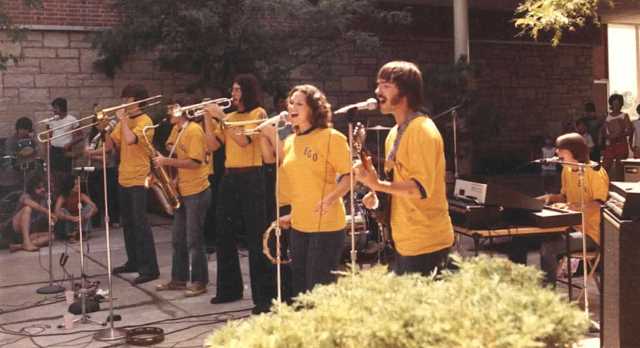 [1] Since then, we’ve all gone on to pursue careers as such things as an engineer, teacher, letter carrier and lawyer (though our percussionist/lead singer, Charles Glenn, continues to make a living as a singer in the St. Louis area).
Fast forward to 2009. I would love to play music with other musicians again, but I have a day job and a family (and a blog). It would be extremely difficult to arrange for rehearsals that didn’t interfere with my many other obligations. I’ve recently started picking up my guitar to play and sing. It’s not sounding all that bad, and I’m starting to consider performing for others again. [BTW–I had a scary episode where my left hand became numb cause by a pinched nerve in my neck. After surgery [2], the feeling in my hand is returning nicely, which probably explains my renewed interest in playing music again.]
I’ve never thought of myself as a singer, but I thought that I would have a much better chance of getting a solo gig if I learned to sing rather than just playing the guitar. Therefore, I recently took a singing lesson from Leslie Sanazaro [3], from whom I learned that my breathing was all wrong, a condition that can reportedly be remedied by doing exercises that would look and sound rather silly to anyone other than a singing teacher.
Leslie advised me that my pitch is okay but that I need to get out there and get some confidence. She said that the best way to get confidence is to go out and sing in public, over and over. That’s easy to say, of course. If you are not enamored with your voice, though, it is a daunting task. It brings back memories when, in the second grade, every student was required to stand up in front of the class and sing a song (my voice trembled and my knees knocked as I sang “Ooey Gooey Was a Worm [4]“). And even when I am able to sing a couple short songs that sound half-decent, I’ve noticed that in extended sessions, my voice grates on me. The fears that I’m experiencing are common, according to Leslie. She sent me this caveat by email: “Don’t get too burned out on your own voice, it’s the only one there is!”
My quest is thus to go out with a guitar and sing songs. It’s something that I intend to do within the next month or two at an open mic session at a local bar or coffee shop. Not a big deal, perhaps. But my voice and my guitar make for such a tiny band, nothing like that eight-piece jazz rock ensemble that I surrounded myself with when I was a young musician. Are there other ways to spruce up my little band without collaborating with other musicians? Yes, indeed, there are many reasonably-priced options, but these options raise issues about the authenticity of one’s “live” performance.
For purists, there is no substitute for an acoustic guitar and an un-amplified voice. That’s how I often practice at home. Over the years, however, various devices have been offered to musicians which make performances less pure, acoustically speaking. We are all now familiar with electronic amplifiers for voices and guitars. Those of us who like the acoustic sound can amplify it by sticking high-tech pickups into our acoustic guitars. I use a Fishman brand “Blend” pickup [5] in my guitar, which combines a piezo microphone with a tiny acoustic microphone, giving you impressive control over the sound. Even when it is amplified substantially, the guitar still sounds “acoustic.”
So what else can you do to enhance the sound of a guitarist/singer? The next obvious addition would be to process the sound through the use of a digital sound processor, allowing a wide range of effects including reverbs, delays, chorus, flange and other specialized effects. I have several methods of processing both my guitar playing and my voice and they really do a great job of enhancing the sound. These modestly-priced effects boxes are commonly used almost anywhere you hear musicians performing, but using them is nonetheless another noticeable step from the purist form of performing (I use a box made by Lexicon).
What if you want to increase the number of musicians in your “band” without hiring additional musicians? For instance, maybe you want to have a drum machine cranking out a rhythm behind your guitar playing. If you’re not careful, drum machines sound robotic, they lock down your rhythm and keep your music from sounding free and expressive. On the other hand, if you take the time to carefully program a drum machine, you can somewhat “humanize” the rhythms and enhance your (solo) performance. But is that still “live” music, to play along with a computerized rhythm module? Whatever your opinion, many small groups currently use drum machines in live performances, and many of them use these rhythm machines impressively.
But what if you crave the sound of a full band? Twenty years ago, musicians with day jobs could pony up $1000 to buy a four-track cassette tape recorder in order to create four separate tracks of music. This was a huge step up from the two-track reel to reel recorder that I had when I was 15. Having any kind of recording equipment allowed me to create a rhythm track and then to improvise on top of it. Much of my practicing consisted of improvising to my own rhythm tracks, because it was convenient. When you’re a teenager, it is sometimes difficult to gather together with other teenagers to jam. This was especially true because the best time for jamming was late at night and all of us still lived with our parents, who did not appreciate late-night jam sessions.
Musical recording technology has exploded over the past 30 years. In my own case, that revolution has given me access to a small digital recorder made by Boss, the BR-600 [6].
 [7]
[7]You can buy it for less than $350, and it comes with the ability to create eight separate tracks that you can mix down into your own musical CDs. It also comes with a built in drum machine, along with hundreds of options for processing your sound, including programs that will make your guitar sound like an old tube amp, or you can generate a heavy metal sound. There are even programs that will turn a six-string acoustic guitar into something that sounds a lot like a bass guitar. But there’s more. The unit comes with built-in stereo microphones, which are usable, though prefer to record through my instrument pickups and standard voice mics. The BR-600 weighs about a pound and can run on battery power for extended periods. All of your music is recorded onto a small compact flash memory chip. Consider the possibilities: you can take your guitar, your headphones and this little battery-powered unit (it’s no bigger than a book) out to a park and create a tune consisting of a “drummer,” a “bass player” a rhythm guitar, a lead guitar and three-part harmony. And it’s all CD-quality sound. I also have a digital keyboard, which allows me (when I’m back at home) to create my own jazz quartet (or quintet. . .) at home. If you are willing to spend the necessary time to bounce your tracks around on the unit, you could create an entire orchestra. Truly amazing technology.
So here’s the question: what if you want to enhance your guitar/voice performance with a drum track and a couple of instrument tracks using a digital recorder like the BR-600? Is that still a “live” performance? After all, you’re still playing an instrument and singing? I asked some experienced musicians about this, and I was told that it is not uncommon to hear “live” musicians backing themselves up with digital recordings. It’s not like you are simply playing along with a prerecorded CD by another music group. All of the music would be by you. You’ve merely time-shifted yourself. Nonetheless, the proportion of the “live” that is live is shrinking as you bring in more of the gadgets.
 [8]
[8]Here’s an additional way to push the “live music” envelope. It’s Digitech’s Vocalist Live 2 [9], a specialized sound processor that costs less than $300. You plug your rhythm instrument (typically your guitar) into a jack and that signal goes right through the unit. The guitar’s sound is unaffected, but the unit analyzes what chords you are playing. It instantly knows whether you’re playing G-minor or Bb7. Impressive. You also plug your voice microphone into a second jack, and the unit adds various harmonies to your voice and these vocal doppelgangers are really impressive . There are many options for layering your lead vocals with upper and lower thirds and fifths. I just purchased this unit at couple days ago and I am amazed at how good it sounds. If you are strumming a D major chord, Vocalist Live 2 detects that it is a D chord and that it is a major chord. If you have programmed it (ahead of time) to provide thirds, it knows to add an F-sharp as the third. By simply changing your chord to D minor, Vocalist Live 2 “hears” this change and immediately shifts the F-sharp to F-natural (the minor third of the D scale). I’ve even played complex jazz chords while singing along, and the unit quite often comes up with something serviceable, if not impressive.
Using the Vocalist Live 2 is addictive because it makes your voice sound like a roomful of people (there are more expensive versions of this product to provide four harmonies — my cheaper version provides two harmonies). The unit sounds so good that I’m often tempted to just leave it on while I play and sing, although I am absolutely certain that it would get annoying if I did that during a performance. Therefore, I’m planning on using Vocalist Live 2 on choruses, singing “solo” on verses. And I’m not planning to use it on every song I sing. Listeners will need to have regular breaks from these heavenly harmonies.
But once again, is it fair to characterize the use of digitally-produced harmonies as “live” music when so much of it is processed or not produced in real time? Imagine using all of the above gadgets together. In other words, your equipment consists of your voice, your guitar, your sound processors, your digital recorder, your amplifier and your voice processor. You know damned well that if you’re a crappy musician, none of this gadgetry is going to make you sound interesting to anyone. I think that I have highly discriminating ears, though, and I prefer the gadget-enhanced music by far.
On the other hand, using the gadgets is a long way from the purest version of an un-amplified guitar/voice. To the audience, it sounds like an entire rhythm section (a drummer, bass player, keyboard and or rhythm guitar) backing you up. Is it as good as a full live band of accomplished musicians? Of course not. But used sparingly and carefully, there is no doubt that using these gadgets can enhance and vary the sound of a solo musician who is playing solo for an extended period of time.
I recently discussed this issue with Jimmy Gravity, who runs J Gravity Strings [10], a musical instrument sales and repair shop near downtown St. Louis. Jimmy has constant contact with many musicians, including the high-profile musicians who tour through St. Louis. He told me that it is common for performing musicians to extensively enhance their “live” performances, and that audiences generally do not think anything of it these days. His advice was to go out and have fun playing your music however you want, because modern audiences expect that you’ll be using electronics to enhance your sound.
I guess I’ll find out what the audience thinks when I get the courage to actually get out there, with more or less equipment, and actually start playing and singing music. It’s been a long layoff for me. With sporadic exceptions (involving a coffeehouses and weddings here and there), I haven’t performed played live guitar for about 30 years. And I’ve never before presented myself as a singer. My electronic gadgets and I are looking forward to this opportunity.
Print this post [11]
 [12]
[12]