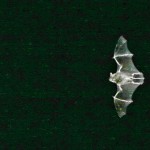
In the April 16, 2009 edition of Nature (available online only to subscribers), Johan J. Bolhuis and Clive L. Wynne asked “Can Evolution Explain How Minds Work? Their answer is that we need to be careful. Traits don’t always smoothly work their way up from ancestors to contemporary species. Sometimes, traits appear as a result of “convergence,” namely, these traits arise in species that are not closely related because these species were independently subjected to similar selection pressures. A good example of convergence would be the wings of birds and bats, which are not closely related species. Both species, however, were subjected to similar selection pressures, accounting for the existence of their wings.
 [1]
[1]The authors argue that many studies suggesting that humanlike traits existed in lower primates lacked sufficient controls. Maybe those capuchin monkeys were not reacting on the basis of assessing “fairness” when they shared or rejected slices of cucumbers. Maybe they were rejecting an inferior reward simply because better rewards were potentially available.
The authors suggest that their reanalysis of these experiments suggests that it is a mistake to assume the continuous development of mind up through the lower primates, culminating in human beings. In fact, many traits that once seemed at one point to be distinctly human can be found more compellingly in birds than in other primates. For instance, rooks rub their bills with one another after confrontations. Magpies seem to recognize themselves when they are put in front of mirrors after a mark has been placed on their bodies. Crows excel at the use of tools. Consider, also, that the “language” employed by bonobos isn’t a true language, because bonobos don’t show the ability to imitate sounds. Compare this substandard primate language to parrots and many other songbirds, who are excellent mimics.
The appearance of similar abilities in distantly related species, but not necessarily in closely related ones, illustrates that cognitive traits cannot be neatly arranged on an evolutionary scale of relatedness.
The authors suggest another major problem: it is impossible to “identify the factors that originally drove the emergence of contemporary animal and human traits.” They find that culture is one of these selection pressures that is not well accounted for. The authors take evolutionary psychologists to task, in particular. Some traits exist in a species but don’t exist at all in a closely related species. For instance, the marsh tit stores its seeds and is able to retrieve them several days later. Its close relative, the great tit, however, don’t store food at all.
The authors are not criticizing the application of natural selection, but reminding us that we need to be careful in its application. Sometimes, an aspect of cognition can be historically shown to exist in ancestors such that one can probably conclude that it was passed on through descent. In other cases, including many aspects of human cognition, we might be jumping to false conclusions to the extent that we announce that particular cognitive traits arose as a result of descent.
When reconstructing the evolutionary history of cognitive traits, there is no a priori reason to assume that convergence will be more important than common descent or vice versa. In addition, evolutionary theory may suggest hypotheses about the mechanisms of cognition, but it cannot be used to actually study these mechanisms as long as researchers focus on identifying human-like behavior in other animals, the job of classifying the cognition of different species will be forever tied up in thickets of arbitrary nomenclature that will not advance our understanding of the mechanisms of cognition.
Print this post [2]
 [3]
[3]