I’ve been reading more of Jonathan Haidt’s The Happiness Hypothesis [1], including Chapter 9, titled “Divinity With or Without God.”
Haidt’s travels through India led him to conclude that divinity and disgust were located on the same axis. As evidence of this, consider that throughout the world, cultures hold that divinity and disgust must be kept separate at all times. The relevant practices include “food, body products, animal’s, sex, death, body envelope violations and hygiene.” Haidt found that people recruit disgust “to support so many of the norms, rituals and beliefs that cultures use to define themselves.” (Page 186).
To know that which is sacred, identify that which elicits disgust and travel the opposite direction:
If the human body is a temple that sometimes gets dirty, it makes sense that “cleanliness is next to godliness.” If you don’t perceive this third dimension, then it is not clear why God would care about the amount of dirt on your skin or in your home. But if you do live in a three-dimensional world, then disgust is like Jacob’s Ladder: it is rooted in the earth, and our biological necessities, but it leads or guides people toward heaven–or, at least, toward something felt to be, somehow “up.”
Haidt, an atheist Jew, is not suggesting a particular path to that which is Divine. He is certainly not concluding, for instance, that religion is the only path to that which is divine. Rather, he is emphasizing that we all have a sense of what is sacred to us, what is “divine,” and we justify it in various ways. He cites Mircea Eliade’s The Sacred and the Profane [2], agreeing with Eliade that “sacredness is so irrepressible that it intrudes repeatedly into the modern profane world in the form of “crypto-religious” behavior.” He specifically cites Eliade’s conclusion that even a person who is committed to a “profane existence” has
privileged places, qualitatively different from all others–a man’s birthplace, or the scenes of his first love, or certain places in the first foreign city he visited in his youth. Even for the most frankly nonreligious man, all these places still retain an exceptional, a unique quality; they are the “holy places” of his private universe, as if it were in such spots that he had received the revelation of a reality other than that in which he participates through his ordinary daily life.
(Page 193). For Haidt, this passage perfectly characterized his own sense of “feeble spirituality,” one which was limited to “places, books, people and events that have given me moments of uplift and enlightenment. Even atheists have intimations of sacredness, particularly when in love or in nature. We just don’t infer that God caused those feelings.” 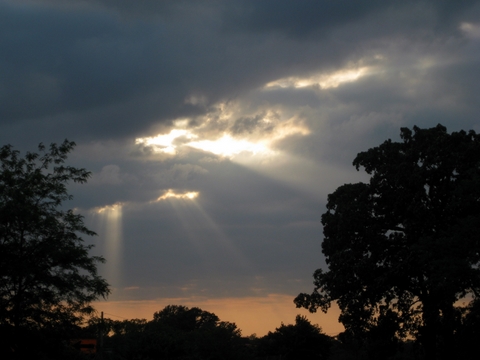 [3]
[3]
Haidt’s writing caused me to consciously realize that I too hold various things to be sacred, even though I hadn’t before consciously labeled them with the word “sacred.” Here are some of the things I would put in this category:
- Holding the hand of either of my daughters while we walk.
- Having an honest and intense conversation in a quiet place.
- Being alone in a quiet and beautiful place [4], including places of natural beauty. Consider further that even atheists can enjoy churches [5].
- Beating back the temptation of the confirmation bias through self-critical thinking, thus recognizing that one was previously wrong about something important.
- Being part of a sustained group endeavor to lessen real world human suffering.
- Being in the presence of another person who is cheerfully working hard for the benefit of others.
- Viewing certain photographs representing transitions in my life.
- Reveling in the Milky Way stretching all the way across the sky.
- Catching up with a good friend after many years apart.
- Noticing the kind eyes of a good friend while we visit.
- Rediscovering the intense beauty of something I had been taking for granted.
- Creating high-quality art or music, or enjoying high-quality art created by others.
- Resisting the temptation to edify one’s self above others.
- Being consciously aware of places that were important to me, such as the house where grew up, or the location of my high school (even though it is now a shopping center).
- Experiencing the natural healing powers of one’s own body after an illness or injury.
- Holding my wife at the end of a day or the beginning of a new day.
I agree with Haidt that these sorts of experiences have a certain character to them that seems to “transcend” ordinary daily activities. It seems equally true that damaging any of these things, ridiculing them or preventing them would trigger a deep mourning, and even a sense of disgust, and that this emotion would go well beyond any sense of pragmatic loss.
Perhaps, then, the existence of the sense of the Sacred is something on which believers and nonbelievers can agree. Really, we should add experience of the sacred to that long list of things that believers and non-believers have in common [6]. Perhaps we can learn to humbly allow each other to celebrate these moments in his or her own way. If only we could allow each other the freedom to experience such things without casting arrogant judgment, without acting like know-it-all experts of the ineffable. Without succumbing to the temptation to use others’ experiences of such elevated emotional experiences as the springboard to start arguments.
[Photo by Erich Vieth]
Print this post [7]
 [8]
[8]