I’m not claiming that non-believers and believers always get along, but I do know that they can get along. I know this for many reasons. Here’s my newest evidence: Last night I spoke about my lack of religious beliefs from the front of a packed church, during the religious service.
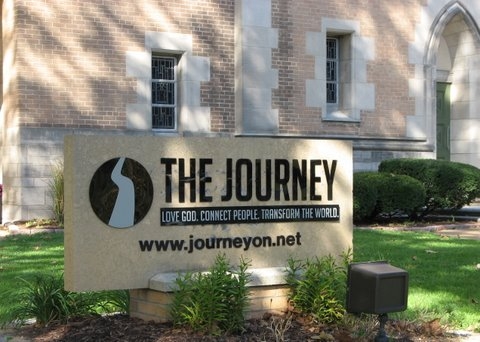
How this could possibly be true? Here’s a bit of background. I previously wrote [1] about a church in my neighborhood called The Journey. (here’s the website of The Journey [2]).
 [3]
[3]
After I wrote that post, Darrin Patrick, Pastor of The Journey, posted a comment at DI inviting me join him for lunch. We’ve had two lunches now, and we’ve traded quite a few e-mails and phone calls. I now considered Darrin to be a friend. We have many interests in common. He’s also an intelligent, curious, sensitive church leader who is an exquisite reader of people and who has an undying commitment to funnel the energy of his congregation toward improving his community. Like most friends, Darrin and I have differences of opinion on topics we consider to be important. Like all friends of mine, however, we both realize that we have far more in common than those things on which we disagree.
About two months ago, Darrin asked whether he could interview me on videotape and then play portions of my interview for his congregation. I agreed and I sat for an interview of almost an hour, talking about Dangerous Intersection, my family, my concerns about my community, my beliefs and my opinions regarding religion. Darren has already played portions of my interview (and the interviews of other skeptics) during church services to illustrate various types of skepticism and to promote a willingness to interact with skeptics. The Journey has also sponsored several Tuesday night discussion groups [4] at which members of the church further consider the role of skepticism in the lives of members of the church.
A few days ago, Darrin called to ask whether I would appear live at one of the church services. I readily agreed. Last night, after 15 minutes of music, we walked together to the front of the church, where we sat down on stools and talk about my thoughts on religious belief. Again, this extended discussion was included as part of a church service. I would estimate that there were several hundred people in attendance.
I started off by speaking of my admiration for Darrin. I noted how extraordinary it was that a church leader would invite one who does not believe in God to sit at the front of the church to talk to the congregation about his lack of belief in something they hold dear. I didn’t pull any punches. I told the congregation that, in my opinion, the God of Christianity was no more likely to exist than Zeus. It was an awkward thing to hear in a church, I’m sure, even though all people have had doubts along the way (yes, you too!).
As part of my introduction, I mentioned that I sometimes go to empty churches to meditate and write. I covered that topic here, in a post called “How to love going to church: a guide for atheists. [5] Sometimes I go to live church services, to see what they are like. That is how I learned of The Journey.
Much of my talk focused on the many things all of us have in common.
I spoke of the continuum of belief that ties us all together. In my view, all believers have doubts that they can’t resolve and all skeptics have beliefs that they cannot ultimately justify (at least they can’t justify them through rigorous scientific forms of proof). I periodically write about of these unproven beliefs of nonbelievers. For example, one of the annual questions of edge.org, asked participants to discuss things they believe what they cannot prove to be true. [6] My favorite example of this sort of believe is free will, to which many die-hard non-believers cling despite the total lack of evidence supporting it (despite that “feeling” that we are “free.” [7]). Though I didn’t have time to mention it in church, I would have liked to mention recent research regarding such feelings of certainty. This research strongly backs up our common sense that being “certain” [8] doesn’t necessarily have anything to do with being right.
All of us grapple with meaning. Even though we intellectually articulate this grappling differently, all honest people experience awe, humility, and an inability to fully come to grips with our own existence on planet Earth.
I urged the people in the congregation that they not lump together all nonbelievers. There are many types of nonbelievers. We are not all as harsh toward religious moderates as Richard Dawkins and Sam Harris. It is equally important that non-believers don’t lump together all believers. Not all believers are right-wing fundamentalists. Most believers and non-believers have many things in common, and relatively few things that divide us. We live in communities full of serious challenges and we desperately need to work together. Furthermore, we can work together, as long as fundamentalists aren’t running around vilifying nonbelievers–telling them that they’re all going to hell; and as long as shrill nonbelievers aren’t running around making sport of calling kind, decent and sincere religious people “stupid.”
I wish I had enough time to tell the congregation about a highly literate atheist who posted a DI comment indicating that he wouldn’t have been willing to march with MLK in the 60’s because King believed in God and based his mission on his religious beliefs while the atheist didn’t share those beliefs. It truly made me sad to read this comment.
 [9]
[9]
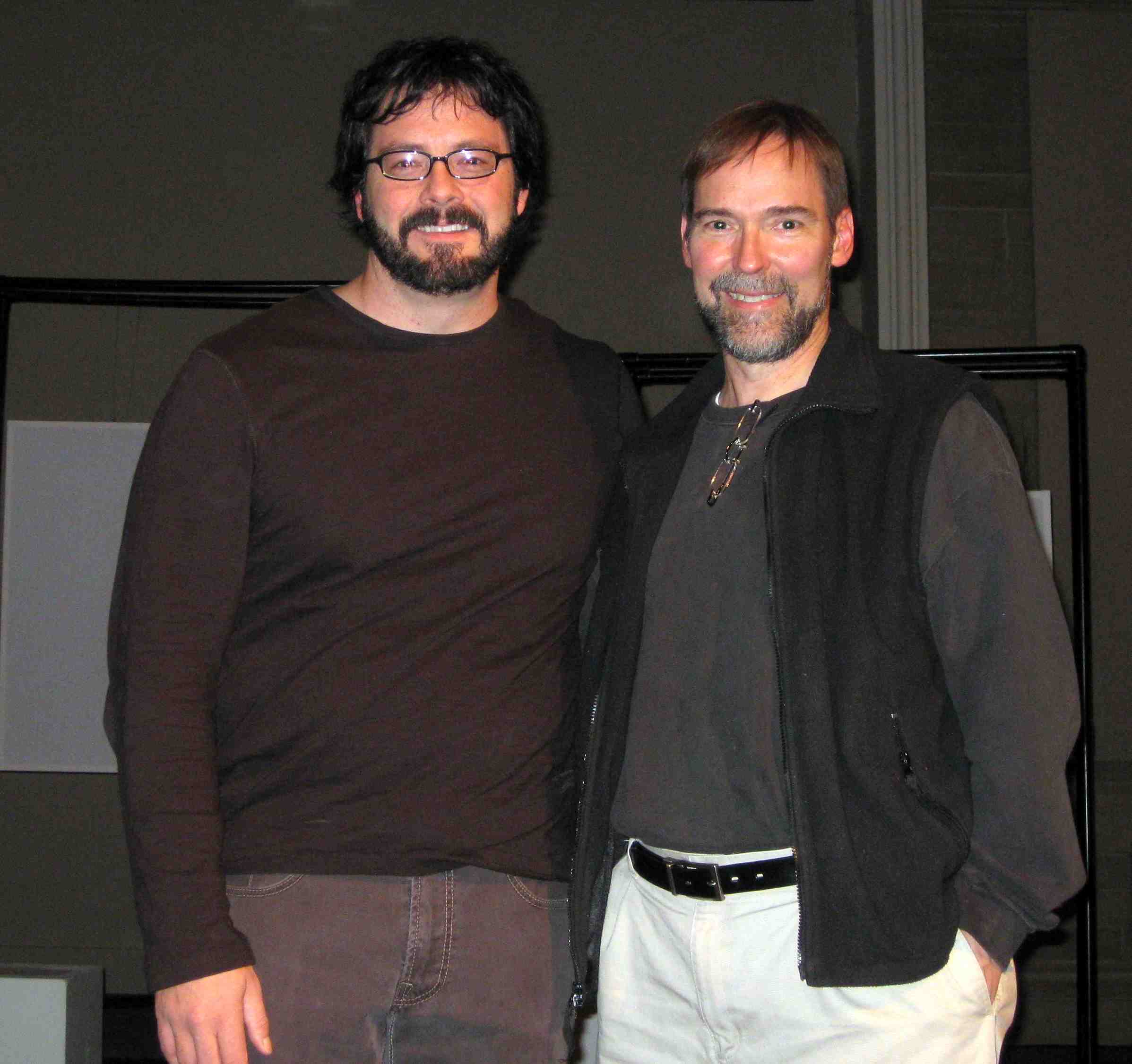
Darrin Patrick, Pastor of The Journey, with Erich Vieth
Believers and non-believers have so many things in common! The list goes on and on, as described in this post on the extraordinary sameness of humans. [10] Here’s a tiny sampling: We can drink beer together. We can contribute to flood victims together. We can throw muggers in jail together. We can celebrate the beauty of parks together. We can make sure our children learn to appreciate Shakespeare, mathematics and history together at school. As I’ve already said, the list goes on and on. [11]
In the quiet of their bedrooms, all skeptics wonder about life’s meaning and their proper role in the world. In the quiet of their bedrooms at night, all believers do the same. We differ in that believers make use of traditional religious stories to illustrate and attempt to comprehend life’s mysteries. Recalcitrant skeptics (I am one of them) are more cautious about claiming knowledge in the lack of scientific knowledge. As a result, many skeptics are proficient at uttering a phrase that is most unsatisfying to many believers: “I don’t know.” [12]
We can revel both in the beauty and elegance of great scientific findings (as long as we non-believers don’t stretch them beyond the evidence [13]). Thoughtful believers and non-believers both know that science doesn’t have all the answers [14].
Many of the problems arising between believers and non-believer arises from the sloppy use of labels. That topic came to the fore when Darrin asked me how I would describe myself. I told him that I’m not a theist, except in the sense that Einstein was a theist. [15] I don’t call myself an agnostic in public because most people don’t know what it means or they assume that it means that I simply need to sit down and think a little harder to make up my mind, as though the problem were that I haven’t been giving serious thought to the issue. I don’t call myself an “ignostic,” although I am sometimes tempted to do so. I don’t call myself an “atheist” because this word has been so thoroughly co-opted [16] that to use it is essentially to call one’s self an amoral self centered egotistical person who’s proud of these qualities. Calling myself an “atheist” gets too many people in such a mental froth that they are unable to continue the discussion. They erect a huge wall and they lose all trust in you. It doesn’t happen with all believers, but it happens with most of them, in my experience (the father of a woman I once dated (a philosophy professor nonetheless) cast me out of the family house, telling his Catholic daughter: “Never again allow that God-damned atheist step foot in our house.”) I know that many atheists disagree with me and insist that atheists should use the term “atheist” and take back that word. I don’t disagree with that approach as a long-term strategy. Here’s my short-term approach, though. Why end what might turn out to be a fruitful discussion when words other than “atheist” are easily available. Lately, I’ve referred to myself a “skeptic” and a “non-believer,” terms that clearly convey the necessary ideas, yet tend to keep the blood pressure of believers relatively low. In my view, we need to be extremely careful about the labels we use when we describe our religious beliefs (or the nonreligious beliefs) of others.
There is a similar problem in the context of “race.” Not long ago, many people incorrectly believed that racial essentialism was justified. They thought that color of skin served well as a token for various characteristics relating to a person’s intellect, character and culture. Now that Barack Obama has helped shatter many of those stereotypes in an extraordinarily public way, it is clear that a person’s “race” has almost nothing to do with the content of a person’s character. Similarly, I would hope that someday soon, we will all understand that a person’s “religion” will no longer be used as a form of essentialism. Calling a person “religious” has, for too long, served as a crude and oftentimes false token to designate that person to be moral and upstanding and heaven bound. There are thousands of types of religious people out there and they run the gamut. Many of them are deserve to be in prison, many others are world-class scientists, and most of them are kind and decent people. The same goes for the nonbelievers. No longer should they be scorned as a group as “damned atheists,” as though they are all immoral and untrustworthy nihilists. I know many of them, and so do you. Most of them are deeply dedicated to their families and communities. Overwhelmingly, they want the same things that “religious” people want.
Will we soon see a day where religious people agree that there’s no evidence for God or where nonbelievers fall to their knees in fervent prayer? Hell, no. We all take our preferred expressions of the ineffable seriously and we cling to those narratives in exquisitely personal ways. Will there come a day, however, when people of all types of beliefs (and all types of lack of beliefs) look past traditional labels and judge each other by the content of character? That is my hope and my dream.
I had an opportunity to discuss many of these things before a packed church last night. I was honored to be a guest at the journey.
Looking back, it was a huge step for me to actually feel comfortable in a church. Perhaps it has never before happened to me. I am who I am, in significant part, because religion was shoved down my throat (by my father) while I was growing up. The last several years have seen much of that pain and frustration melt away. Considerable evidence of that melting-away can be found in my writings at this blog. I have moved from being a person who was angry and suspicious about religion to one who now intensely wants to understand what it is that divides us. There are many days when I think the “divide” is almost entirely the errant use of labels. Perhaps the “problem” is merely that we give different labels to that which is attributed to God or that we confuse poetry for literal truth. Perhaps there are often ways to translate our differences meaningfully, if only we’d show more patience.
After the church service at The Journey, I really enjoyed getting to know many of the parishioners. Many of them walked up and introduced themselves to me after the service. They thanked me for coming. They said that they were glad that I shared my views with them. Some of them told me that they too experienced doubts. One of those church-going doubters was a chemist. It was also clear that each of the people I had spoken to, each of them having taken a unique path through life, had each found a valuable spiritual home at The Journey.
That The Journey is sincere in welcoming skeptics to its services was reinforced by Darrin during his sermon (I sat among the audience to listen). He proclaimed that “We’re a church that values dissonance. There is such a thing as honest wrestling, and we do take these arguments to the bone.” Darrin blended science into his sermon and he takes science seriously. He is not shy about proclaiming that the universe is 15 billions years old. He readily admits that “God is un-provable.” He continued, “God makes honest inquirers of you.” He warned about “Band-aid Bible-verse Christians who offer simplistic answers to complex questions.”
Do Darrin and I completely agree regarding religion? Absolutely not. Although God is un-provable, Darrin strongly believes that God “doesn’t need to be proven; He needs to be discovered.” Darrin is moved to believe in God based on such things as the anthropic principle, the transcendence of the beautiful, the strength of our experience of moral relativism and the strength of our desire for human rights. He made repeated references to a book by theologian Timothy Keller: The Reason for God: Belief in an Age of Skepticism.
As I listened to Darrin’s sermon, I thought of talking with Darrin someday about many of the thoughtful writers I have discussed at Dangerous Intersection, writers such as Frans De Waal [17] (and here [18]), George Lakoff, Mark Johnson [19], Robin Dunbar [20], Pascal Boyer [21], Daniel Dennett [22], David Sloan Wilson, [23] Geoffrey Miller [24], Stuart Kauffman [25] and Jonathan Haidt [26]. And yes, I find much of value (including many things of deep “spiritual” value) in the writings of new atheists, such as Sam Harris, Richard Dawkins. Maybe someday Darrin and I will talk about more of these ideas. In the meantime, I’m not trying to win a war. I’m trying to demonstrate that we can all get along [27], if only we try a bit. Part of the formula is to not try so hard so often to be “right,” the problem being that our imprecise language so often goes astray. Instead of being “right,” we need to identify the 97% of things on which we agree and get to work to make those things a reality in our troubled world.
Here at DI, Lisa Rokusek once wrote [28] “I am as sad as I am hopeful. We are faced with terrific challenges today. Yet we cling so tightly to the myths that separate us instead of reaching for the meanings that could unite us.” As I said at the front of the church last night, we good-hearted and thoughtful believers and non-believers need each other badly. There are too many ominous problems needing to be addressed, and we are, together, the best chance of getting the job done. It’s time to take many of deep breaths and to consider that the poisonous air of the past eight years is dissipating.
Perhaps I’m sounding naïve. Perhaps it sounds like I’m falling for a sucker play, where a savvy church uses me as a dupe, an avowed skeptic who they presented (behind my back) as a person on the verge of conversion. After all, many church leaders are happy to talk with respect about skepticism, but only in private. I’ve personally heard this sort of rhetoric before. I’ve heard it privately from several priests, but none of them were willing to publicly honor the value of deep skepticism. None of those priests would dare present a live skeptic in a decent light during a church service. I thus have proof that Darrin’s words were far more than words. The proof is that I was allowed to sit at the front of the church and freely present my version of skepticism to hundreds of people.
Once you do it, reaching across the aisle seems so incredibly obvious and compelling, if not easy. Something magic happened at church last night. Something so very Obama-esque, it would seem.
Print this post [29]
 [30]
[30]