Discussions in the comment sections of many posts on this site chaotically tend toward the strange attractor [1] of one generally off-topic issue: Why does Creation/Evolution seem correct to you? It is usually a discussion between Creationists who believe that the scientific conclusions are based on faith, and Naturalists who believe that the Scientific Method is best tool ever invented to extract sense from chaos.
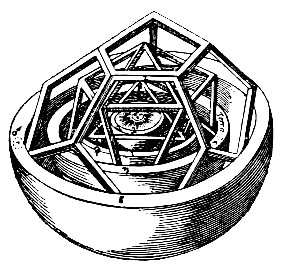 In the beginning, Natural Philosophers (now called Scientists) in the West all believed in the Bible. Bishop Ussher [2] gave the final word on the age of the universe according to the Bible in the early 1600’s, and the Church had all the answers. But then the idea emerged that one can actually test Aristotelian conclusions (purely rational and based on “what everybody knows”) with observations. Copernicus [3] demonstrated with careful observation and applied math around 1600 that only the moon itself orbited the Earth, and all the other planets circled the Sun. The church accepted this, as a philosophical observation, irrelevant to the place of Man in the Universe. Then Galileo [4]made a gadfly of himself by publishing popular books mocking the Pope for publicly continuing in the preaching of Geocentrism when it was clear, with the aid of a telescope, that not only did the planets orbit the sun, but that some of those planets had moons of their own. Many moons, placed where Man couldn’t even see them without modern technology.
Well, it just snowballed from there. Newton [5], a devout Christian, developed math in the late 17th century that accurately modeled the behavior of pretty much everything that man could observe at the time (the Laws of Motion). And those models showed how things naturally happen, without need for divine intervention.  Then in the mid-19th century, J.C. Maxwell [6] developed similar rules to explain electromagnetism (light, electricity, radio, etc). Discovery after discovery kept challenging the universally held beliefs in many areas. Gravity wasn’t related to nor caused by sin. Demons didn’t cause disease. The basic elements weren’t Earth, Air, Fire and Water. Air was a complex substance, but caloric and phlogiston weren’t. The planet and the universe steadily got wider and older and more complex as more and more evidence collected by true believers forced them to acknowledge that nature is as it is, and not how interpretations of the ancient texts described it.
By the 1700’s, many Christians were becoming Deists; they believed in an omnipotent Creator, but not in the meddling and insecure deity portrayed by most western religions. God as a watchmaker, who wound up the universe, and then sat back to watch it play out.
By the start of the 20th Century, there was a problem. The Universe (what we now call our galaxy) was only measured to be 100,000 light years across, yet every measure of geology pointed to many millions –hundreds of millions by some measures– of years of history on the Earth. How could the Earth be orders of magnitude older than the universe? Then came General Relativity, quasars, and the red shift. Suddenly the universe exploded out to billions of years across/old. And then quantum and then nuclear theory led to unstable isotopes being used as accurate clocks. The planet rose to billions of years old, too. When we brought samples back from the moon, they indicated the same age as Earthly rocks. Conflict resolved.
But there is still a small group of people who hold tight to the 17th century interpretation of a literal Genesis story. This movement emerged in the United States after the Scopes Trial [7] in the 1920’s, depending on the idea that a Young Earth precludes the principle that species could have evolved; there wasn’t enough time. Odd schools of thought therefore emerge (Flood Geology, Intellignet Design, etc), that try to sound scientific, yet not actually using that methodology developed centuries ago.
We see comments saying that “old Earth” evidence is only found because the discoverers believe in it. They didn’t always. Most of the earlier and still useful evidence of the age of the Earth was found by those who didn’t initially believe in their own results. And when they did, they had to fight ridicule before the disbelieving community. It is the method that prevailed, not the authority of the discoverer. Nor are convincing arguments much good against the method. Scientists are often wrong. Very often. The scientific method records these wrong results so that they can be checked. And they are. And eventually and asymptotically, the correct ideas are refined and prevail.
Unfortunately, the public only sees the tip of the science iceberg. There are big, splashy announcements of bold ideas. Like Cold Fusion. That was a case when would-be discoverers did an end run around the method and announced to the public before their results could be independently checked. A quiet retraction was printed when the dozens of labs that should have been contacted first, demonstrated universally that the first announcement was based on a procedural error. But research continues. That they didn’t demonstrate something new does not imply that there is nothing new to be discovered.
I blame the media. Remember Halley’s comet? The previous time around, it was a gaudy show. In the 1980’s most astronomers said that it might be visible. The media covered it as the show of the century, assuming that it would be the same show. Technically, it was the same show. But this time we only had partially obstructed nosebleed seats, rather than right on the gridiron. Actual scientists knew this, but their story wasn’t newsworthy. When it turned out to be exactly what the scientists said, the public blamed the scientists for misleading them.
Science is portrayed to the public as a mixture of magic and authority. It is neither. It is a process whereby thousands of brilliant and highly trained competitors are all trying to prove each other wrong, or to come up with a new twist. After a generation or two of consistently and universally failing to prove that something is wrong, then it becomes provisionally accepted: A “theory”. Then it continues to be tested. Nothing is accepted on authority. Rarely is something revolutionary accepted within a decade of its announcement.
 Einstein wasn’t correct about relativity because he was Einstein. He was correct because many experiments and observations failed to prove him wrong, and that his ideas led to other subsequently proven ideas. The same went for Newton, Maxwell, Bohr, Feynman, Hawking, and so on. Up-and-comers are always re-testing the earlier theories using newer methods. Under the sedate public image, real science is contentious and messy.
Finally, science is all about “how”. Religion or faith may cover “why”, for those who need it. The problem comes when unqualified observers (who sometimes have credentials to state otherwise) with a philosophical axe to grind revisit long-discredited arguments and claim them as new discoveries. They dun researchers for refusing to look at their “new evidence”, but neglect to review the existing literature, or to run the standard tests themselves. They just make claims that sound reasonable. Anyone who knows the history of 20th century discovery knows that common sense reasonableness does not match reality beyond the everyday scale of experience. And modern instruments measure far beyond that realm.
To (finally) sum this up. The question comes down to: Do you believe in the Scientific Method and its results, or in the principle that unless it agrees with a particular minority interpretation of The Bible, it is wrong?
Print this post [8]
 [9]
[9]