I started thinking about the the “reductionist attitude [1]” in presenting science when I read Erich’s Post To deal with “arrogant” scientists we need to move beyond reductionism and break the “Galilean Spell” [2] (from May 7, 2008). Curricula seem to begin with biology, work through chemistry, and finally introduce physics. If English were taught categorically as science is now, students would go through phases in this order:
- Elementary English: Analysis of Literature (done orally)
- Intermediate English: Sentence structure, paragraphs, and essays (done graphically)
- Advanced English: Introduction to the Alphabet and Spelling Lessons
The alphabet of science is made up of basic natural “laws” as discovered by Newton, Maxwell, Mendeleev, Heisenberg, and so on. Sentences and paragraphs are like molecules and chemical syntheses. And finally you have enough structure to begin to see how biology works from cells (essays) through organisms (stories) and populations (novels).
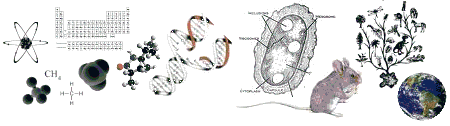 [3]
[3]
One could be taught holistic science, building to the grand ideas from the simple ones. By constructing the ideas instead of breaking them down, the interrelationship and the interactions of the parts can be seen, as well as the nature and function of the parts themselves. A whole is never the sum of the parts; it is the sum of the interactions between the parts set on a foundation of the parts themselves. This becomes obvious when building, but is obscured when deconstructing.
No wonder Americans doubt the “theory of evolution”. Schools try to teach this advanced and universal concept without any foundation. By the time the basic laws of nature (whose interaction supports this conclusion) are introduced, the theory has been mentally discarded.
Why is it done this way? Any child can see biological units (plants, animals, etc) and their behavior with a minimum of math or equipment. It is harder to demonstrate the shape of the electron orbital field around an atom that causes molecules to have the shapes and behaviors that are observed. Linnaean taxonomy [4] is a simple and satisfying system to teach. All a child has to do is to memorize lists; easy on the teachers. But it reflects and subtly enforces the 1700’s creationist view of the ecosphere: That things are and will remain as they always were; as God intended. This is safe, compared to the currently controversial teachings of late 19th century biology, as understood after a certain geologist with a degree in Divinity [5] wrote a popular book about biology.
Without physics and chemistry it is hard to explain why the diversity and complexity of a population necessarily will increase, unless it dies. Without the more basic sciences, it is nearly impossible to explain how the discoveries of higher level sciences are even made. It can seem that unifying ideas, like evolution or the constant rate of radioactive decay, were “just made up”.
And because of the order of teaching, fewer students reach the later, more essential studies. They may give up on science when they cannot make sense of biology, and never learn how those conclusions (natural laws, “theories”) came about.
Print this post [6]
 [7]
[7]