I once created a fake college and I’m proud of it.
This might strike you as odd, because most people who create diploma mills are doing so to make a quick buck by passing out bogus college degrees. [1] These fake diplomas, in turn, allow unqualified people to get promotions and or get jobs for which they are not qualified. The people with these fake diplomas often obtain government jobs, but they are sometimes securing positions of serious responsibility in the private sector, such as in engineering and other technical fields. Providing fake diplomas is a huge national industry, as it has been for many decades.
When I created my fake college, I did not do it to make money. I created my diploma mill while I was working as an Assistant Attorney General for the state of Missouri. I worked in the Trade Offense Division, where I was an attorney charged with investigating and prosecuting criminal and civil fraud.
The year was 1988 and I had been investigating diploma mills (among other types of investigations), often working in tandem with the FBI. Missouri was a hotbed for diploma mills, I learned. It was amazing to me that a person could obtain a degree from a college simply by submitting papers over the period of a few months and then obtain an advanced degree, often an MBA but sometimes a Ph.D. in a specialized or sophisticated field.
I had noticed that several of the bogus colleges I was investigating were “accredited.” One particular accrediting organization showed up repeatedly during my investigations: “The International Accrediting Commission for Schools, Colleges and Theological Seminaries.” This one organization was responsible for accrediting many hundreds of small and medium-sized colleges across the United States, as well as colleges in other countries. Many of these colleges had impressive names. Many of these schools were small Bible colleges and other schools of religious affiliation. There were many secular schools too. The IAC accredited-colleges granted advanced degrees in a wide variety of subjects. The IAC was based in my own state of Missouri.
I arranged for my investigator to call the IAC to see what it took to get accredited. My investigator discussed the accreditation process with the president of the IAC, “Dr. George Reuter.” Reuter explained that he would need make an on-site visit of a college before granting accreditation and that he charged a schedule of fees that ran upwards of $500, plus his transportation costs to get to the college or university. He also insisted on being reimbursed for meals during the day of his onsite visit.
While making this phone call, my investigator, Rick Kastan, called himself “Dr. Richard Taylor,” and indicated that he was in the process of starting a brand-new college, The Eastern Missouri Business College, located in St. Louis. Rick explained to Dr. Rueter that Eastern Missouri Business College would be offering master’s degrees and Ph.D.’s through the mail (remember. . . there was no Internet 18 years ago) in such diverse topics as Genetic Engineering, Social Work, Administration of Justice, Marine Biology and Aerospace Science. Dr. Rueter indicated that we should call him to arrange a site visit when our school was up and running.
 [2]
[2]
As I mentioned, I worked for a state law enforcement office. We managed to scrape up enough money to pay for our accreditation fees, however. We called Dr. Rueter again a few weeks later and arranged for him to come St. Louis to make an official visit to the Eastern Missouri Business College. Although Rueter did not sound very impressive over the phone (he sounded low-energy and not very sharp), we were a bit concerned that when he actually showed up he would want to really know at least some information about our college. We assumed that he might actually ask SOME questions.
If we told the full truth about what we were doing, we would instantly be exposed. If we lied too well, however, perhaps no one would blame Rueter for accrediting us. We went with my gut hunch that Rueter was totally in this for the money and had little to no interest in making sure that our school was legitimate. Therefore, we did some pretty ridiculous things, things that any legitimate accrediting organization would instantly notice. For instance, we filled our college catalog faculty roster with the names of fictitious faculty members bearing the names of TV characters such as The Three Stooges and various characters from comedy shows such as “Green acres” (e.g., the TV pig named Arnold Ziffel taught at our college) and “Leave it to Beaver” (Eddie Haskell also taught at EMBC).
We recruited about a dozen volunteers to pose as professors and administrators and we convinced a local office management firm to donate the use of a 2000 square foot office space for one week. We knew we needed to have some sort of a library, so we borrowed a small bookshelf and stocked it with some books, including a child’s book on fishes called “The Golden Book of Fishes”). We carted over some furniture that we gathered from our midtown office, including some file cabinets. We stocked our “school” with a few boxes worth of meaningless paperwork, but we had no transcripts, no student records, no accounting records and no legitimate records of any kind. Our school had no classrooms. We had a typewriter. We had a few pens and pencils. If Reuter had asked us for any sort of document that a real college maintained (for instance, any student transcript or any class syllabus) we would have been exposed instantly.
Before Dr. Rueter arrived for his inspection, we had an impromptu training session for our “faculty,” our “staff” and our “administrators.” We told them to generally act as though they worked there, but to freely disclose any information that was requested of them by the “accrediting commission.” We planted a few microphones in the the flowerpots, but it proved unnecessary. Dr. Rueter seemed to enjoy the fact that this upstart new college was excited to have him visit–he was more than happy to allow us to take lots of pictures of him during his inspection.
We had created a college catalog that had an official college seal, complete with Latin phrases for “Education is for the birds” and “Everything from petty theft to grand larceny.” We handed a copy of this college catalog to Dr. Rueter when he arrived to inspect our school. He looked around the “school” for about half an hour and then made it clear that he’d seen enough and that he was ready to go have a nice steak lunch with “Dr. Taylor.” During this lunch, Dr. Rueter told “Dr. Taylor” that he was quite impressed with our college.
Before leaving for lunch, the administration presented Dr. Rueter with payment for his accreditation services. Reuter was happy to pose with Rick for a picture of the “official passing of the accreditation check.” 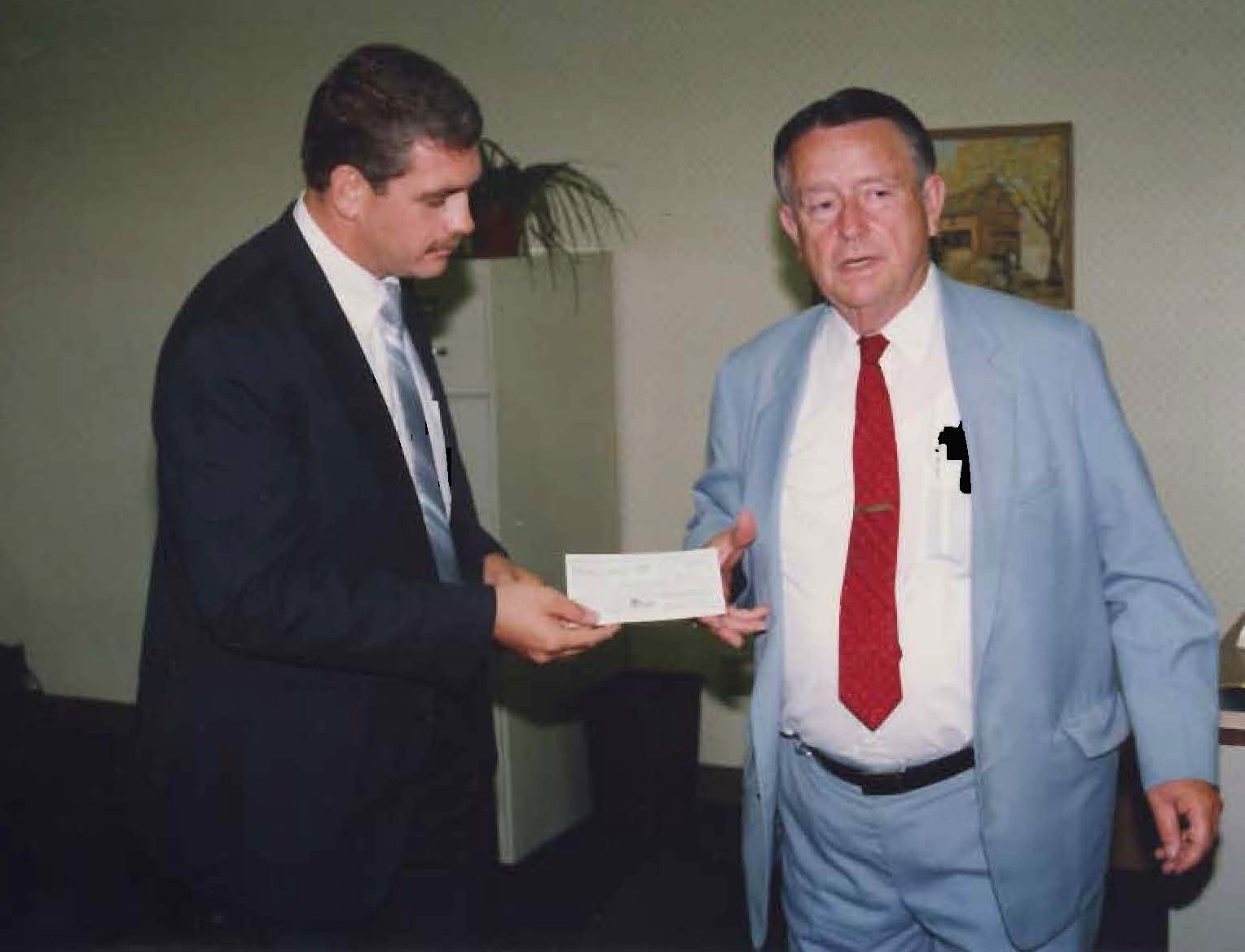 [3]Reuter (the man in the blue suit on the right) was not a bona fide proficient college accreditor. At one time, he was a professor at a college (he, himself, held a degree from a reputable school). He had long since retired from teaching and made a good living from travelling the country annually inspecting dozens of schools at more than $500/each. But he was not qualified to be an accreditor and he put no legitimate effort into inspecting our “school” or any other school.
As I suggested at the top of this post, Reuter’s fraudulent work gave legitimacy to many crooked schools–diploma mills–that merely sold degrees long-distance without any meaningful attempt to provide an education. I realize that “measuring” the quality of education is a tough job, especially when trying to distinguish good schools from especially good schools. But I can assure you that, over the years, many “schools” make little or no effort at all to educate and they should be shut down. A conscientious accreditor can identify those schools by carefully reviewing the schools official records and by actually interviewing the teachers and staff.
Here is a copy of the complete “college catalogue.” [4]
As soon as George Rueter left our campus, our volunteers took apart our college. Within an hour, it was once again an empty office space.
A couple days after the “college” inspection, Dr. Taylor discussed the inspection with Dr. Rueter over the phone. Rueter indicated that the IAC was going to grant us accreditation. It was now our choice (he advised) whether we would like to have a “fancy plaque” to hang in our college. We decided to pay the extra $25 for the fancy plaque.  [5]
[5]
We were elated that we pulled off this stunt, because it made for a fun case and a good story. Telling a good story was in important aspect of my job, because it could illustrate a serious problem for the public and the media. After we received our “fancy plaque” I filed a lawsuit to close down The International Accrediting Commission for Schools, Colleges, and Theological Seminaries. Dr. George Rueter, represented by an attorney, quickly agreed to shut down his organization and pay a fine of $15,000. The story played quite well in the press, which led to considerable media attention being paid to the many bogus colleges that were handing out their bogus degrees. One of those media outlets that picked up the story was the Chronicle Of Higher Education (in its November 22, 1989 edition).
 [6]
[6]
To celebrate our success, we purchased dozens of T-shirts bearing the official seal of the Eastern Missouri Business College. You can see from the picture below that the Attorney General himself was quite pleased with our sting operation.
 [7]
[7]
While I was doing this investigation, I was surprised to learn that any private individual or company can offer its services to accredit colleges. It doesn’t take any government certification to be an accreditor. On the other hand, legitimate accreditors put real effort into the project and produce detailed reports of what they find. Reuter never produced anything in writing. He merely told us that we were a good college and sent us our “fancy plaque.” It is good to remember this lesson when considering any organization that “certifies” or “accredits” any business. Some of them are incredibly thorough and honest and others are shams, set up and controlled by the very industry they “monitor.” Yes, in a perfect world we would have accreditors of accreditors. And accreditors of accreditors of accreditors.
Speaking of scams, soon after completing the sting operation, I grew out of favor with the Missouri Attorney General, William L. Webster. When I took the job as an Assistant Attorney General, I assumed that I was supposed to prosecute people and businesses that were perpetrating frauds on the public and that this could include car dealers and other large businesses that contributed to the political campaign of the Attorney General. It eventually became obvious to me that my beliefs were not shared by many of my supervisors.
To make a long story short, I was asked to transfer to different Division of the Attorney General’s Office (out of the Trade Offense Division) after I insisted on prosecuting crooked car dealers and other businesses who were violating the law. I was told that several terrific cases I was handling were “weak” and that I should drop the prosecutions or at least allow car dealers who had systematically stolen millions of dollars to merely promise that they would stop stealing. After I refused that transfer I was fired. I refused to take the transfer because to do so would be to acquiesce in a big fraud. A friend of mine, also an Assistant Attorney General with the state of Missouri, was trying to do his best to prosecute other large crooked businesses. He lost his job too. His firing is another long story and it also involves corruption in high places.
Fast forward a few years (1992) and Webster, who was running for governor of Missouri, started being heavily investigated for many things, including the manner in which he kept his own attorneys from vigorously investigating some crooked businesses. Many of those news leaks concerned my own cases, and many of those leaks occurred during the last few months I worked at the office, leading to considerable suspicion that I was leaking information on my own cases (I would suggest that anyone considering leaking to the press regarding crooked things going on in their own place of employment should be prepared for a rough ride). Webster eventually lost his race for governor and ended up going to prison for two years for misusing state property.
It recently occurred to me that this story about the IAC might be a good story to share, even though it’s a few days after April Fools’ Day. If you want to know more about how this college sting operation was set up, feel free to read this post on (believe it or not) Car Talk [8]or this post in Education Week. [9] I had to laugh when I just noticed that EMBC showed up on a suspect college list published by the state of Michigan (we never issued a diploma). [10]
I truly enjoyed working for the Attorney General’s Office. Being able to set up sting operations–an ongoing part of my job–was a lot of fun and we ended up stopping more than a few businesses from ripping off the public. While I was thinking about writing about this sting operation, I went through some old photos and found this picture of me 18 years ago when I worked as an Assistant Attorney General. This photo brings out lots of emotions. It brings back some pride that I vigorously investigated and prosecuted a wide variety of fraud, but it also brings back the grave disappointment I felt in some people who should have stood up and done the right thing while I was being forced out of the office. It could have all been so much easier if only a couple more well-placed people stood up and told the truth. Now it all seems so very long ago . . .
 [11]
[11]
Epilogue: I should make clear that there are many reputable schools that offer highly valuable and legitimate degrees in low residency or no residency programs. I’m not trying to impugn all colleges that lack traditional brick-and-mortar campuses.
Here are a few more pics showing the front and the inside of our “college”:
 [12]
[12]
 [13]
[13]
Print this post [14]
 [15]
[15]