[Warning: This Post is rated “R” for Rant]
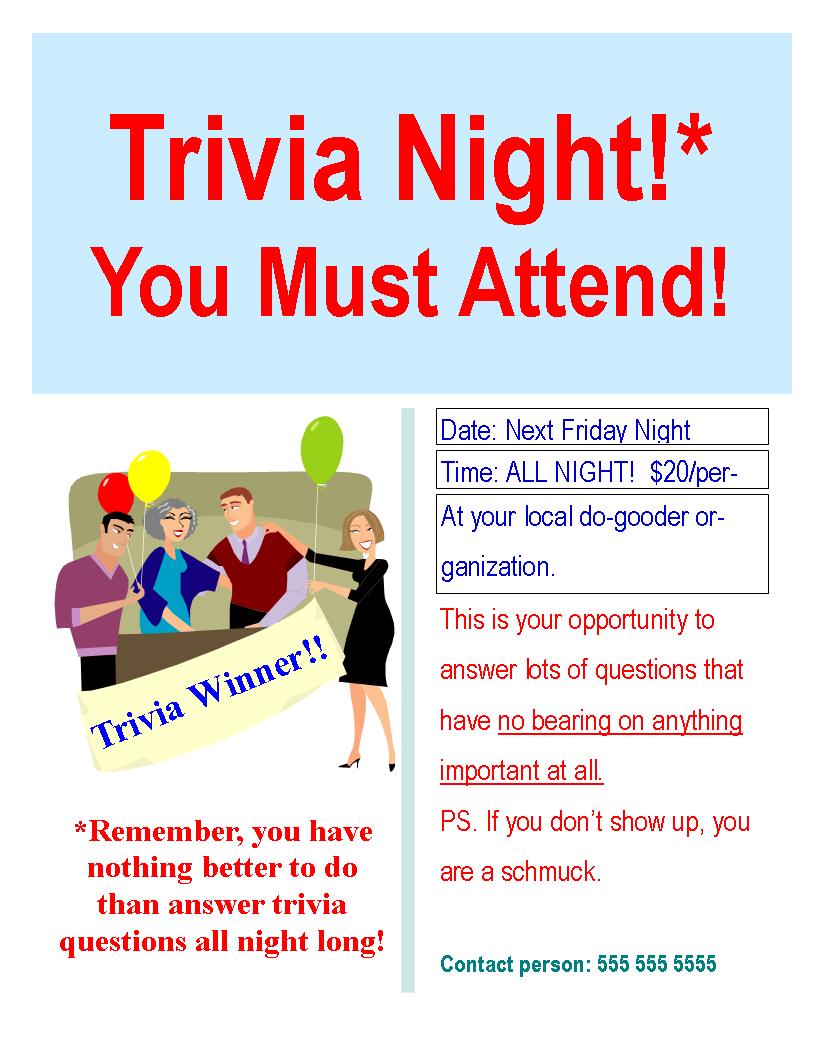
I’ve been to several Trivia Nights, so I do have some basis for opining on this topic. It’s time that I made my feelings absolutely clear: I do not like trivia nights. I don’t see the point of trivia nights. Trivia Nights are things that keep people from having good conversations. I will explain further.
I understand that Trivia Nights are often held to raise money for good causes. I don’t have any problem with raising money for good causes. Actually, I would happily pay a reasonable sum of money in order to not have to sit through another Trivia Night. I will pay my fair share to help raise that money for that good cause, as long as I don’t have to attend Trivia Night.
I should also make it clear that I sometimes enjoy trivia. Occasionally, I find myself reading a list of trivia questions, the kind of list where I can immediately check the answer. In that way, I can review dozens of questions per minute, until I’ve had my fill of trivia (which is usually a minute or two). Not a bad diversion, once in awhile.
What I don’t like, however, is an intentional onslaught of slow-motion trivia. Trivia Nights consist of intentional onslaughts of slow-motion trivia. Each question is read slowly to a room filled with dozens tables that are each filled with people. The tables compete against each other. Each question is simultaneously considered for a minute or two by all the people in attendance, the participants of each table whispering to each other in order to strategize or to determine whether they know the answer. They also whisper to make sure that the nearby tables don’t overhear the ostensibly correct answer. Once in awhile, a table of people can deduce a correct answer or at least make an educated guess. Equally often, however, someone at the table immediately knows the answer or no one knows the answer. When no one at the table knows the answer (or even if someone does know the answer), it is everyone’s job to consume some of the massive offerings of food and drinks at the table. Thus is process of Trivia Night, which involves the reading of as many as 100 questions. What kinds of questions? Here are some samples of the kinds of questions you’d actually have to deal with at a Trivia Night:
- What was the year Ferguson Jenkins was inducted into baseball’s Hall of Fame?
- Name the song that was used in a love scene in the film Top Gun.
- State the name of the actress who appeared in both of Bill Cosby’s TV shows.
- What is the difference between an American roulette wheel and a European roulette wheel?
- State the exact number of Republican Party Presidents there have been.
- What was the nickname of alleged Philadelphia mobster Joey Merlino.
- What was Eddie Haskell’s mother’s name on the 1960s TV show “Leave it to Beaver.”
- What is the third longest river in Australia?
As far as I’m concerned, the answer to each of these questions is I don’t know and I don’t care. Why don’t I care? Because these topics are trivial. That these topics are trivial means that they are not important. Things that are not important should not be the focus of long fundraising sessions, unless those sessions are fun. For me, answering 100 slow-motion trivia questions over four hours is not fun. Why is it not fun? Because these topics are trivial (etc.).
If I had my way, I would make an announcement to everyone at Trivia Night. I would tell everyone that that they’ve already paid their money to support the cause, so that those who are inclined to do so should feel free to move into an adjacent room to munch on the snacks and have fun or serious conversations-any topic at all and none of it interrupted by trivia questions. I’ve never run this experiment, but I would bet that half the people attending would be tempted to get up and leave except that they would be called traitors by the other people at their tables and accused of ruining the ability of that table of people to win. Win? Win what? Perhaps it is some sort of cheap trophy or some sort of paper certificate. Maybe it’s a little cash. Most likely, it’s a strange sense of self-satisfaction based upon a weird self-deprecating mental exertion. At Trivia Night, what “winning” represents is that the “winners” table consists of people who know more useless stuff than any other table in the room. We’ll kind of stuff? Factoids. Mental singularities. Through the social phenomenon of Trivia Night, topics which are useless are mysteriously elevated to positions of existential importance. Why? Because the scorekeeper says so.
I’ll be the first to admit that I am not typical when it comes to competing. I generally don’t like to keep score, no matter what I’m doing. My emphasis is making sure I don’t embarrass myself. For instance, I’ve played a fair amount of tennis and racquetball in my life. I’ve never enjoyed keeping score. I’d rather put the ball into play and to work hard at winning a point. I truly don’t care what the final score is, as long as I am working hard, exercising and improving my game. In fact, it embarrasses me to have to keep score. Either I “lose” and I am embarrassed or I “win” and I am embarrassed. I just don’t see the point (no pun intended).
Trivia often comes up in general conversations. In many cases, trivia is quirky enough to provoke a new topic in that conversation. But I can’t imagine enjoying a discussion where any of the parties persistently injects trivia into the conversation. It would be as frustrating as listening to someone drumming up dozens of puns. A matter of trivia should find its way into a conversation much like a good pun, not intentionally, but only spontaneously and not too often. When trivia questions (or puns) are forced in quantity, there is no better conversation-killer. Whenever trivia questions (or, eventually, answers) are blared over a loud speaker system every minute or two, no meaningful conversation has any chance of getting off the ground. The night is soley about factoids, food and the “competition.”
Truly, trivia can be enjoyable when it arises “naturally.” That often happens during a good conversation. When civilized people are stumped about any insignificant fact, however, they don’t brag to each other about who knows more useless stuff. Instead, they use Google. This reminds me that Einstein was ahead of his time in many ways. He said, “Never memorize what you can look up in books. [2]” Answers to trivia questions can be looked up whenever they are needed.
Such a faux sense of accomplishment, then, on Trivia Night! And such a vast social expenditure, it would seem to me. Let’s assume that 100 people, each with an earning power of $20 per hour, spent four hours in a room answering 100 trivia questions. That’s at least $8,000 worth of time and energy expended to guess 100 things not worth guessing. That’s $80 per useless question.
The effects of trivia night go much further than Trivia Night. I know several people who can barely wait for the next Trivia Night. They travel from place to place, paying their entry fees and hoping to win prizes and honors for their proficient recall of obscure facts. I sense that, even in their off-hours, they have narrowed their perceptual and memory strategies in order to vacuum up countless new obscure facts for the next Trivia Night. Aren’t they missing out on the stunning connections among relevant and interesting real-world facts? Perhaps not, and perhaps it is none of my business how they run their lives.
In sum, please don’t be offended if I turn down your next request to attend a Trivia Night. The problem is most likely that I’d rather have a meaningful conversation with you, even if that meaningful conversation includes a smattering of trivia and puns.
Print this post [3]
 [4]
[4]