Four familiar words. Four words not even found in this form in the bible, at that. Why should we even pay attention to this ancient and revered phrase?
Actually, it dates back to a Christian political activist in the 19th century pushing the treasury to make sure that future archaeologists (on finding no evidence of our civilization but our coins) know that we were a Christian nation. It was thus briefly seen on the U.S. 2-cent piece at the end of the civil war. And then retired, not to be seen again for over a generation.
Then came the morality movement backlash from “The Gay 90’s”. Picture a disco era for your great-great-grandparents. This post-Victorian backlash eventually led to the 18th and 21st amendments (prohibition and its repeal). Meanwhile, this slogan started appearing on coins in 1908. There is nothing like the fear of pleasure to get politicians who need to appear churchy to move on a moral issue.
I just read an article “IN GOD WE TRUST” — STAMPING OUT RELIGION ON NATIONAL CURRENCY [1] that suggests protest in the form of marking out the offending theist sentiment on any folding money that passes through our hands. Although it is petty vandalism, it is not a federal offense. As long as an alteration you make to money does not change its value in any way, it isn’t illegal.
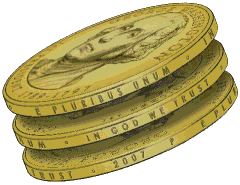 As I read that article, I considered making a rubber stamp along the lines of “You are not alone. Other atheists have handled this bill” to print along the top margin. Maybe I need something shorter.
Of course, if I/we/someone starts doing this, a whole series of “You are not alone” dollars might start spreading for each disenfranchised group. This is not a bad thing. Too many people in this country stay in their comfy insular groups and forget about the actual diversity that makes this a great country.
Meanwhile, look at more than just the corners of your money. How many Where’s George [2] bills have you blindly passed? I sometimes take a minute to register them when I get them.
Back to my central “In God We Trust” point:
Deeper than “Who is this God whose interior we depend on?”
Are we really willing members of this “We” that all of us are tacitly agreeing to each time we pass along currency?
Print this post [3]
 [4]
[4]