People have all kinds of hobbies. Some people like to knit. Other people like to collect stamps. I like to go to church while playing the role of “anthropologist.”
When I am thinking about visiting a church, my biggest decision is deciding what church to visit. That was my decision three days ago. I had already been to a stern and humorless evangelical church. [1] The thing I remembered about that church was the scriptural quotation featured on the T-shirts of hundreds of the people attending: “The fear of the Lord is the beginning of knowledge.” It was a quote from Proverbs 1:7. I remember thinking “Of all the quotes they could’ve chosen from the Bible, this one is strange indeed. Any good teacher knows that the best students are driven by natural curiosity and a good dose of skepticism, not by fear.”
Back to my task of choosing a church. Last week, I just happened to be in the car listening to a fundamentalist A.M. radio station when I heard neocon talk show host Paul McGuire [2] ranting about a new crop of churches designed for young people, churches that allegedly don’t spend enough time on the Bible but, instead, cater to the social needs of the congregation. Maguire’s rant went on for several minutes, long enough for me to conclude that I simply had to go to one of these new hip churches to see for myself.
As it turns out, one of those new “emerging” churches is located about a mile from my house and it is called The Journey. [3] This is not your mama and papa’s church, as you can tell from the pictures below. First of all, how many churches have their website featured prominently on their sign? This building used to be owned by a Catholic Church, but the Catholics are busy turning ever-more conservative, it seems. In fact, the pope just announced that Catholic pharmacists should not dispense evil drugs such as birth control pills. [4] This top-down management style has had the effect of running off lots of actual or potential Catholic parishioners. Hence, the closing of this particular Catholic Church and its sale to “The Journey.”

After I entered the church, I noticed that the Catholic statues had been removed (Catholics love forelorn-looking statues) and that the inside of the church had been painted in strikingly tasteful Ralph Laurenesque colors. There was no altar, but only a stage with music stands and microphones. There was a wooden crucifix, but no graphic image of mutilated and bleeding man on that cross. Featured more prominently than the cross was a big screen above the cross on which the song lyrics and the PowerPoint images relating to the sermon would be projected.
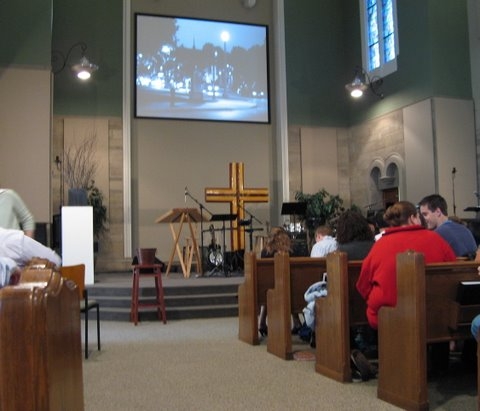
As I walked into this church of The Journey (which has existed since only 2002) I heard Coldplay and other popular music amplified throughout the building. The people in the church were casually dressed and fairly young (typically ranging from their 20s to their 40s). I couldn’t help but notice that the men were more handsome than average and the women were more beautiful than average, compared to many other churches I’ve attended. It was like going to an upscale bar, except there was no alcohol or smoking and it was Sunday morning. Compared to other churches I’ve attended, these people tended to be in much better physical shape and they looked much more focused and animated than many congregations, based upon their facial expressions. As I walked through the church trying to decide where to sit, the parishioners were notably friendly (though church-goers all tend to be friendly when they get together). I couldn’t help but think that this is a different kind of crowd than one would find in many churches, and that this place had been transformed into their place, a place where many traditions and formalisms would be left behind.
The service began when a man came out and greeted the people by saying “Hi, I’m Mike.” Mike played the guitar and sang, leading the parishioners in the singing of several songs, accompanied by an accordionist. The sound system was outstanding.
I paid special attention to the words of the songs. The were songs of thanks and humility and love of God. The songs repeatedly mentioned family themes such as surrendering the parishioners lives to God, their father, and being “adopted” by God through Jesus. The songs were largely devoid of lyrics urging that we constantly grovel before God and proclaim that we’re nothing but dirty little cockroaches deserving to be thrown into the deepest pits of hell (some churches take this approach, believe it or not).
After the music, “Darrin” took the stage and started his long talk. Darrin Patrick, a confident yet warm fellow about 40-years of age, was casually dressed and armed with a bottle of water. “Are you ready to get yelled at for 45 minutes?” The congregation chuckled.
Darrin’s talk distinguished between surface-level obedience and heart-level obedience. Before I heard the talk I was assuming that, perhaps, this church would minimize the Bible, focusing on psychology and other quasi-religious approaches. I was wrong, however. Darrin spent much of his talk pointing out and elaborating specific Bible passages. Now for the big coincidence: one of the passages he discussed was the same passage celebrated by those austere evangelicals described above, Proverbs 1:7: “The fear of the Lord is the beginning of knowledge.” Darrin worked really hard to spin this passage in a nonthreatening way. In fact, he intellectually contorted himself into a pretzel. He “explained” that the “fear” referred to the trembling a believer felt because “God is working in you.” I wasn’t convinced, nor do I think any thoughtful person would have bought this explanation. It seems to me that fear is always a bad basis for knowledge, at least among sincere and thoughtful students; there’s no way to spin it otherwise. Strained Bible interpretation (“hermeneutics”) is the plight of people who take it as their duty to “explain” or “harmonize” the vague, troublesome and self-contradictory passages of the Bible as the foundation for their social organizations. I would clear it all out and start anew, but parishioners (and prospective parishioners) are familiar with such words and images, allowing them to feel more quickly at home. And, of course, I’ve never started a church, so what would I know? Other than my conviction that that the miracles touted by the Bible never happened. And I do speak as an ordained minister! [5]
Darrin made it clear that he was not there to terrorize and oppress the congregation. Based upon the types of people filling this church, they would not stand for it. Nor would they be the sort of crowd that would simply lap up just any absurdity he threw their way. For instance, he explained that God is a Trinity with one “what” and three “who’s.” He paused. Then he asked who understood this concept of the Trinity. Then he explained that no one understands it. “We can’t wrap our minds around it.” I wondered just how many of the people there were OK with the “God is love” message, but were bored with most of the rest, tolerating this church (just as they would tolerate most any church) because of the social connections it provides. The Journey provides many opportunities for social gatherings. In addition to the Sunday services, there are film nights, community improvement endeavors and informal theology gatherings at a local micro-brewery.
Back to the fear, however. Darrin explained that now is a time for “fear and trembling, because we’re really dealing with God.” He reminded the people that we are “riddled with insecurity and God is working in us.”
Having good ideas is not good enough, according to Darrin. The Bible is not important to us merely because it has good ideas. It’s good because “it’s God speaking.” He explained that “there will be heaven and we will see Jesus in heaven.” Is it enough for a person to simply believe? Not at all. “We are saved by faith alone, but not by faith that remains alone.” Darrin explain that we don’t have a God we work for; we have a God that works in and through us. It is God’s work that “enables our good work.” As you might sense, this talk was closely based on the same Bible passages one would hear in many other sorts of Christian churches, though there was something different about this church.
Darrin explained that God motivates us so that we want to obey. He quoted from Ezekial (36:23) and Jeremiah (32:40 “I will put from of me in their hearts, that they may not turn from me.”). These passages made me think of mind control— it sounded like a God who hypnotizes us into doing his will, something that actually sounds incompatible with the our alleged exercise of free will. After all, if God alters the human mind too much, then it’s no longer the human being who is doing the choosing.
Just when you thought that Darrin was getting a little heavy-handed, he backed off. He sometimes spoke of his own failings and insecurities. He indicated that explaining biblical verses is often not easy and sometimes not fun.
Darrin cited C.S. Lewis, who stated that a perfect man does not act out of a sense of duty, and that duty is a substitute for love like a crutch as a substitute for a healthy leg. Darrin explained that we are free to keep God’s law but we are not slaves to keep God’s law. At bottom, “you don’t have to live in fear. You aren’t going to be punished because God crushed your sins on a cross.”
He took some swipes at conservative Christian churches. Many Christians “act like slaves, not children.” He criticized churches that are obsessed with rule-following. See the attached handout from the service: The Journey – son and slave.pdf [6] The Journey cultivated God’s “children,” whereas those stern churches out there made “slaves” of their followers. Seemed like a pretty fair generalization. To me, however, it has never been clear why it should be admirable that an adult assume the role of “child” to a God. Shouldn’t adults always assume the role of adults? Responsible, questioning adults? It seems that it would only be in this way that people could avoid a co-dependence on God [7] (assuming that there is a God).
We need to “stop relegating God to external laws, according to Darrin. We need a little more delight and less duty.” Darrin admitted that he didn’t sign up to be a church leader “to be condemning.”
He invited the newcomers to the church to join in the communion. He suggested to these newcomers that they feel no compulsion to donate money to the church, but simply enjoy the service. Interestingly, the ritual had largely been stripped out of the service (compared to, for instance, the highly ritualistic Catholic Mass). There were no droning chants and responses at The Journey. What might be termed the liturgy took up perhaps five minutes of the entire service. Almost the entire service consisted of the music and the long talk. Ironically, many Catholics I know love those rote chants and songs–these scripted portions are their favorite parts of the Catholic Mass. They like being left alone, intellectually speaking.
The Journey’s written literature indicates that the church is based upon “the Bible as the Word of God.” The written basis of this religion (for the most part, the Bible) is really hard to distinguish from the written beliefs of most other Christian churches. There was something about the attitude of the people of this church, however, that was far different than other churches, especially conservative churches. This church was clearly not based upon fear, oppression or bigotry. There was no mention of hell, for example. I spoke to a couple of folks who attended this church regularly and learned that this is not the kind of church that excludes and deprecates people who are different (such as gays) or goes out of its way to attack those who might cling to other beliefs or no beliefs. Here’s a sentence from the literature: “We believe that it’s healthy for people of all world-views and spiritual beliefs to have their ideas and philosophies both challenged and encouraged in a safe, open environment.”
The Journey, which now consists of more than two thousand members, portrays itself to be a big tent that invites a wide variety of people to join. The church literature indicates that The Journey encourages community involvement in such groups as Habitat for Humanity. The church is big on supporting art and artists.
In conclusion, this seemed like it would be a great church to join for anyone who believed in the stories of the Bible. Unfortunately, I do not believe such stories (for the reasons I’ve stated throughout this blog). For those seeking endorphins, [8] this might, indeed, be a good church to join. There was synchronized standing and sitting, carefully performed music and the opportunity to mingle with friendly-seeming others, for instance.
I felt like I was sitting between two diametrically opposed worlds when I returned home after the service. At The Journey, I was far from the threatening and humorless preachings of the conservative evangelical church I wrote about a year and a half ago. [1] On the other hand, the people of The Journey still cling to many traditional beliefs, and it really wasn’t just a big “party,” as Paul McGuire might’ve suggested. A thought continues to tantalize me: why not just give up the many oxymoronic belief and establish a church where people simply come together to coordinate their efforts to do good in the community? Why assert impossible beliefs? Why claim that dead people become alive and that invisible beings concern themselves with our lives? I’ve tried to answer this before, [9] so I won’t go into it here (but also see here [10]).
I will admit this, however. There is something significant about atmosphere of a church that goes way beyond the words spoken. It is truly incredible how two entirely different churches (The Journey compared to the evangelical church I previously wrote about [1]) can rely upon the same book and the same scriptural readings, yet come to such different ways of treating their members and treating outsiders.
I actually did enjoy my time at The Journey, though I don’t buy into most of their religious claims. It occurred to me that those who attended this church had a notably positive energy about them. It occurred to me that I would very much like to be part of a community group like this, one that included so many positive and energetic people. I’m not a candidate for the membership of any church, however. I do not allow myself to say I believe things that I don’t believe, however, and I’m not entirely comfortable being around people who say they believe things that I don’t think they really believe.
Despite the many assertions about God, crucifixion and heaven, I am convinced that those who attend The Journey include lots of good-hearted and decent folks and I’m glad for them that they have each other and that the community receives the benefit of their good works.
Print this post [11]
 [12]
[12]