The imperative phrase is proclaimed on millions of bumper stickers: “Support the Troops.”
Tell me what it means to “support the troops” and then I’ll tell you whether I support the troops. Fair enough? Until you can tell me what the phrase means, asking me whether I “support the troops” is like asking me to sign a blank check. I don’t sign blank checks.
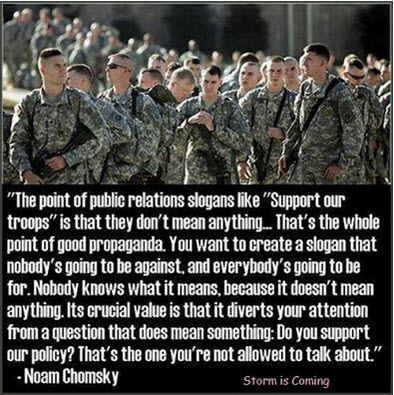
The vague phrase “Support the troops” is a challenge that is not only found on bumper stickers these days. For instance, Bill Arkin of the Washington Post recently wrote about soldiers who are increasingly expressing frustration with the growing opposition to the war back home. [1] Many of the soldiers took it personally. Arkin quotes Staff Sergeant Manuel Sahagun:
One thing I don’t like is when people back home say they support all troops, but they don’t support the war. If they’re going to support us, support us all the way.
Arkin goes so far as to characterize the volunteer troops as “mercenaries,” suggesting that we’d be having an entirely different national discussion if we had a draft. Arkin’s “mercenary” comment quickly caused a firestorm. Overnight, his blog drew more than 900 comments. Arkin also drew the ire of conservatives from coast to coast. Did he fail to “support the troops”?
“Support the troops” is a hopelessly vague phrase; it means different things to different people. For instance, when I am asked whether I support the troops, it could mean any of the following things:
1. Do I “support the troops” in the sense that I generally support the war?
The biggest problem is that the troops are fighting the war; ultimately, the war is what the troops do. If there were no troops, there wouldn’t be a war. Hence, I have sympathy with Sergeant Sahagun’s frustration. How can we support the soldiers but not what the soldiers do? The challenge of whether I support the troops does requires, then, that I consider what the Iraq war is all about. What is the war in Iraq about? I don’t buy the Administration’s official line. To the contrary, see this list from Iraq Veterans Against the War: [2]
- The Iraq war is based on lies and deception.
- The Iraq war violates international law.
- Corporate profiteering is driving the war in Iraq.
- Overwhelming civilian casualties are a daily occurrence in Iraq.
- Soldiers have the right to refuse illegal war.
- Service members are facing serious health consequences due to our Government’s negligence.
- The war in Iraq is tearing our families apart.
- The Iraq war is robbing us of funding sorely needed here at home.
- The war dehumanizes Iraqis and denies them their right to self-determination.
- Our military is being exhausted by repeated deployments, involuntary extensions, and activations of the Reserve and National Guard.
Do I hope for the safe return of the troops to their families? Absolutely. Do I support the troops insofar as they are fighting a war described by the items on the above list? Not at all.
2. Do I “support the troops” in that I agree with everything the troops are doing.
Sorry, but I can’t wholeheartedly “support” them in this way. Innocent people (Iraqi civilians) are dying by the tens of thousands (or maybe the hundreds of thousands), often as a result of American bombs and bullets. Many of these civilian casualties (though by no means all of them) result from deplorable violence indiscriminately inflicted on innocent people by our own troops. Many videos showing this senseless violence can now be found on the Internet. Iraqi houses are invaded in the middle of the night, the men wrongly accused, beaten and sometimes killed based on crude curbside justice. Thousands of them are thrown in prisons, only to be threatened before being released. Many of those who are released were treated miserably while in custody without any meaningful measures to protect them. At Abu Ghraib [3], many Iraqis were tortured and beaten while in U.S. custody.
It is impossible to separate what the troops are doing with the ultimate effect: the U.S. unwillingness to leave Iraq in the context of the U.S. craving to maintain permanent bases in Iraq to confiscate oil is creating hundreds of thousands of extremists who hate the United States.
3. By saying I “support the troops” am I asserting that the motives and actions all of the soldiers are honorable?
Sorry, I can’t “support” them in this sense either, at least not unequivocally. For some soldiers, yes. They joined to “help defend the U.S.” and they are putting themselves in grave danger to do their best to carry out the vague (impossible) mission they’ve been given. There should be many tens of thousands of statues erected for these many brave and selfless men and women.
But not all soldiers have pure motives. Consider, for instance, a very popular current tattoo among the Iraq troops: “Killing is our business and business is good.” I’ve recently heard this from the sister of several active soldiers, one serving in Iraq and another in Afghanistan. Her brothers candidly tell her that the only thing that interests them about going into combat is $400/month and a chance for some adventure. They also see combat as an investment in their own resumes, a way to eventually parlay government combat service into the jobs of private contractors for the government, at a wage in excess of $100,000. For these people, this war is not about helping Iraq. Not at all.
Consider also the rampant racism among the troops (e.g., the use of the word “Haji” [4] ) and the constant disparagement of Middle Eastern cultures and Islam (including a variety of derogatory nicknames for Iraqis). Consider the skulls and crossbones painted on many of our armored vehicles in Iraq and the heavy metal blaring from them. The Pentagon knows of these things and is heavily censoring [5] the soldiers’ own photos and videos of these disturbing images. And see here [6] (The Invisible American [7] is yet another disturbing set of videos.) For a recent report on military censorship, take a look at this piece from the NYT. [8]
4. Do I “support the troops” in that I think that it’s OK that the soldiers joined the military?
I know that many of the people currently in Iraq and Afghanistan joined to pitch in to help with national emergencies and to get funding for a college education. They trusted that their government would only throw them into combat for compelling reasons, but they’ve been betrayed. I have no problem that many of them joined the military. Then again, see #3, above.
5. By “support the troops,” are you asking whether I think that it’s OK for the troops to do their jobs based on the platitudes and judgment of the president?
In the early stages of the war, that was understandable. As the war continues, though, I can no longer “support” blind allegiance to the president.
6. Do I support soldiers’ blind obedience of the orders of their superiors?
In the early stages of the war, yes. No longer. I cannot continue to support a soldier’s unsubstantiated belief that complex social disputes should be or can be solved through the use of bullets, bombs and other forms of violence.
At some point, the disconnect between the actions of the soldiers and the many alleged goals of the Iraq occupation should have become apparent to anyone who cared to know the truth. I don’t support anyone’s blind obedience of anyone, anywhere. This defense was rejected at Nuremburg.
But these soldiers have been put in a terrible position with few realistic options. I have great sympathy for them. I must also note that I have great sympathy for those relatively few souls who have refused to report [9] on the basis that the Iraq war is horribly misguided and brutally destructive to innocent people (including both the troops and Iraqi civilians).
7. Do I “support the troops” in the sense that I don’t want any more of them killed?
Yes. Bring them home! In my opinion, their continued presence in Iraq is causing more problems than it is solving.
—
What do soldiers mean, then, when they want me to “support” them? I suspect that they seek carte blanche approval from the people back home. They want us to say something that they can interpret as “You are AOK!” No waivers or disclaimers. They want to feel proud of what they are doing, no matter what that happens to be.
Sorry, I can’t do that. I need to understand the question being asked in order to responsibly answer it. Whenever this question is asked (“Do I support the troops”) I know that the person asking is seeking a feeble-minded answer to a vague question. For my part, I would prefer to judge the troops, the extent possible, on an individual basis. I don’t “support the troops” on a group basis any more than I am willing to “support lawyers” or “support politicians” or “support restaurants.” When I hear a claim that I am supposed to “support” any large heterogeneous group, I suspect that the bad apples are trying to get me to give all members of the group (including the bad apples) the credit earned only by some members of the group.
Those who ask the question (“Do you support the troops”) pretend that all troops are the same, but this is definitely not true. Not all troops are unapproachably wise and experienced and measured and sensitive human beings. I know that many of them are, in fact, almost thoughtlessly acting out those violent video-games they played all-too-often in their teen-aged years. Based on my viewing of more than a few combat videos from Iraq (those that the Pentagon didn’t succeed in censoring), I know that many of the troops are embarrassingly parochial in their thinking and all-too-willing to obey the orders of equally distressing commanders.
I can’t judge the troops as a collective without judging the war too. For that, I apologize, because I know that I cannot give the troops what they crave and they, in fact, need, given that so many of them have been put in impossible situations.
Many of the troops are angry with people who are unwilling to say “I support the troops” disturbs me, but they need to realize that they are too close to the violence to make reliable judgments. In fact, they should be humble in their judgments. Shooting people and blowing up buildings don’t endow soldiers omniscience and perfect judgment. In fact, it likely does the opposite; cognitive dissonance would be expected to cause the thoughts of soldiers to conform to their actions, not vice versa. What I do (whatever it is) is good, because I do it.
The Pentagon doesn’t like this nuanced type of talk, of course. It wants to use the images of fighting U.S. soldiers as proof that the war is justified, then to bootstrap that back to prove that we support the troops. This ploy is insidiously circular. The truth is that the fact that our soldiers are fighting is irrelevant to whether the cause is worthy. It is much easier to march and fight than to truly justify a cause.
From the detached perspectives of many of us back home, questioning the war and the troops is supporting the troops. To those soldiers who demand that I “support” them, I would turn the question around: “Do you support the war, or do you just support your little corner of it, your own perspective?”
To the question “Do I support the troops?” I therefore give this answer: In some ways yes, but in other ways know. If you want to hear a more precise answer, ask a more precise question.
Resources concerning why I can’t unequivocally say I “support the troops”:
The military’s news blackout. [10] How can we decide whether we “support the troops” in the absence of sufficient information?
Here’s a video on many of the good things U.S. troops are accomplishing [11].
For a very small sampling of the reasons why I can’t unequivocally say that I “Support the troops,” see here [12], here [13], here [14], here [15], here [16], here [17], here [18], here [19], here [20], here [21], here [22], here [23] and here [24].
Print this post [25]
 [26]
[26]