Could this headline ever run in a major newspaper?
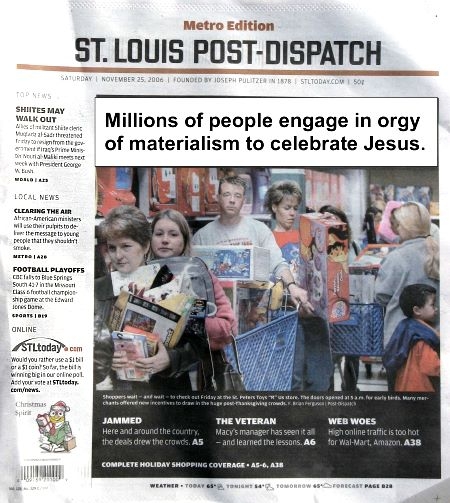
Of course not! Never is the alleged wall between the news department and the sales department of newspapers so low as during the holy season of senseless spending.
Yes, I changed this headline to make a point. The real headline disturbed me and I was struggling to effectively explain why. I even considered an alternative make-believe headline: “In the name of Jesus, newspapers promote the buying of useless things, through purported news articles, to make their advertisers happy.” Both of my false headlines reflect the deep and disturbing reality of what drives modern day American Christmas better than the headline that actually ran. Here’s the actual front page headline reporting the earth-shaking news that Thanksgiving Friday retail sales were brisk:
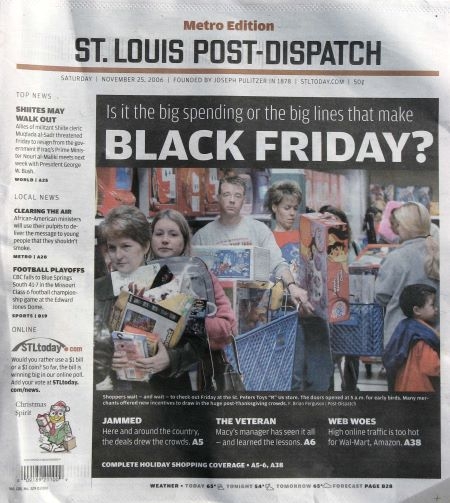
The actual headline works hard to convince us that we the shoppers are heroes trying to conquer the challenge of shopping on a deadline or, perhaps, victims of the long lines. I seriously question both of those characterizations. I would say that many of us have been hoodwinked by fake news.
For the next thirty days or so, newspaper “articles” and television “news” reports will work hard to convince us to buy expensive and unnecessary consumer goods, allegedly to honor Jesus Christ. The message is absurd. Absurd, but powerfully seductive. After all, what is Christmas without conspicuous consumption? Not much of anything, according to all of the ads we’re about to see. Incredibly, this seductive message is built into almost every Christmas story ever written. For an example, see my earlier post on the Grinch who Stole Christmas. [1]
If Jesus really existed and he returned to Earth to go shopping during Christmas (yes, this is far-fetched) He would really get pissed at what was going on in his name. I would love to see the look on His face as scores of sincere but credulous Christians tried to justify the American Christmas “celebration.” When each additional attempt to convince Him that the American version of Christmas is “wonderful” or even “normal,” the veins in his forehead would pop out yet another notch. Until He went on an all-out rampage, trashing all of the Christmas displays in the Wal-Marts, K-Marts and all the other corporate-owned stores promoting unnecessary and expensive consumer goods in His name. How do I know all this? Because the dollars we blow at Christmas are fungible [2] and because I read the Bible:
21:12 And Jesus went into the temple of God, and cast out all them that sold and bought in the temple, and overthrew the tables of the moneychangers, and the seats of them that sold doves,
21:13 And said unto them, It is written, My house shall be called the house of prayer; but ye have made it a den of thieves.
Matthew 21:12-13. [3] No, it’s not exactly a parallel. This passage isn’t relevant because we’ve turned churches into stores (though we’ve actually done this). Rather, it’s because we’ve turned our stores into churches.
The American tradition that consumer lavish spending is a necessary part of Christmas Day is a classic non-sequitur. What is a non sequitur? [4]
1. Logic. an inference or a conclusion that does not follow from the premises.
2. a statement containing an illogical conclusion.
For their own selfish reasons, newspapers and other advertising media instruct us to buy lots of unnecessary stuff to honor Jesus. But how is buying things (or killing trees) “because it’s Christmas” any more logical than playing ping-pong or weeding the garden “because it’s Christmas”? Is the New Testament message really to “love one another” by buying each other unnecessary (and often useless) things? Or is it to love one another in ways that require real sacrifice and thus are more deserving of honor?
And why aren’t the churches working hard to teach their American flocks that the standard Christmas message (buy lots of things to honor Jesus) is utterly absurd? Could it be that the main function of most churches is to provide salve for the conscience, to clear the way for the status quo [5]? I dare any person to pick up any present he or she was ever given “for Christmas” and to explain how that gift honored Jesus. Go ahead, pick up that Gameboy, or that perfume, or even that new cordless drill. If you didn’t really need those things at all, then you certainly didn’t need any of them on Christmas.
The need to buy gifts for Christmas is a major league non sequitur that ranks right up there those other classic non sequiturs promoted by many versions of Christianity: A) Jesus died to save us (as though God couldn’t simply save us without slaughtering his son); and B) People who aren’t religious are moral degenerates (as though non-Christians never lead generous, kind and praiseworthy lives).
If repeated often enough without critical scrutiny, non-sequiturs take on the ambience of logic. It’s Christmas, therefore I must buy gifts. If this doesn’t seem patently absurd, it’s because you’ve been exposed to thousands of repetitions already. You’ve probably started hearing it while sitting on your father’s lap.
“Buy a gift for someone to honor Jesus.” What kind of gift? It doesn’t matter, of course. Frivolous gifts, expensive gifts, quirky gifts, gag gifts or even gifts “for the man or woman who has everything,” “Why?” Just because! Repeated 1000 times, “Buy gifts because it is Christmas” starts to sound undeniably logical, but it isn’t. It seems logical thanks to habit and thanks to your constant exposure to unrelenting social expectations, expectations fueled by manipulative news stories like the one at the top of this post. “Because” is a very powerful frame, [6] indeed, even when it is not connected up with any valid reason at all.
Given that we crave lots of unnecessary stuff, it’s not very difficult for creative beings to conjure up reasons for justifying that stuff. Though I must admit, it is one of humanity’s finest bits of mental gymnastics to develop a system of getting stuff by giving stuff–-promoting it as a duty for everyone to give gifts–all that giving culminating in the mass receipt of gifts back to the gift givers. Great Yankee ingenuity!
I couldn’t help but notice how our advertisers promote compulsive shopping the same way that our government promotes the war on terror. First, stores make everyone nervous by suggesting that there are long lines at the stores and that there might not be any presents left by the time you get to the store. Next, they show lots of pictures reminding potential shoppers that they need to buy useless things because everybody else is buying useless things. That is the way of the herd, and we are people of the herd. There is no better technique for selling slippers or for empowering the executive branch than by scaring us into conformity.
Since I’m mid-rant and a little out of control, here’s another question I need answered: why is a materialistic orgy any less odious during the Christmas season than it would be on any other day of the year? No one is raising any hands, so I’ll move on.
The St. Louis Post-Dispatch is the only major newspaper serving a metro area of 2.5 million people. It commonly promotes useless consumption as if there were nothing more important to write about. The Post-Dispatch has degenerated so much over the past few decades that they ought to just call it “Post-Integrity.” Though this sounds harsh, let me explain. The actual headline about “Black Friday” followed on the heels of other front page articles that primed the newspaper’s readers to hit the stores hard on Thanksgiving Friday. Another front page headline last week promoted Sony’s PlayStation. The unrelenting message of all of these “news stories” is that we must celebrate the King of Kings with the purchase of things and more things. And most of America buys that message.
I truly do wish each of you a wonderful Christmas season. But screw the stores that suggest that buying stuff at Christmas is somehow about Jesus. And to hell with the accomplices of those stores, all of those “news” sources who spew the lie that the only path to cosmic truth and family harmony runs through the well-lit aisles of their advertisers’ stores.
Print this post [7]
 [8]
[8]